Illustrated · 3 min

+4 contributors




Who Was Charles Darwin?
Charles Robert Darwin was not a straight-A student, and he often fell behind at school. His father wanted him to study medicine, but he could not stand the sight of blood.
Who knew that Darwin would one day become the father of evolution and a prominent figure in the history of science?
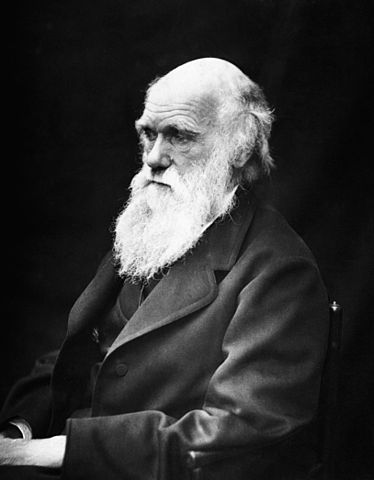
Image source: By Julia Margaret Cameron [Public domain], via Wikimedia Commons
Charles Darwin was born in England in the early 1800s. After realizing that he was not fit for medicine, Darwin joined a captain aboard a ship called the Beagle.
They traveled the ocean for several years on their voyage around the world to map the coast of South America. Darwin was always fascinated with nature and spent his time abroad collecting samples of plants and studying animals.
Very quickly, Darwin made three important observations:
1. Species vary around the world.
Darwin traveled around the world and took notice of the different animals he encountered. In South America, he found rheas. In Africa, he saw a similar flightless bird, the ostrich. In Australia, he found the emu. All three are very similar, but each one is found only on one continent.
Why are they different on each continent? Why are they only found on those continents?
2. Species vary locally.
Not only were species different around the world, but they were also very diverse locally. When Darwin traveled to the Galápagos Islands, he found several types of finches. Each type had a slightly different beak.
What could be the reason for these differences?
3. Species vary over time.
Darwin was also interested in fossils. He found a fossil of what looked like a giant armadillo. What's even more interesting is that it was found where modern armadillos live today.
How are the two species related? What happened to the fossilized species?
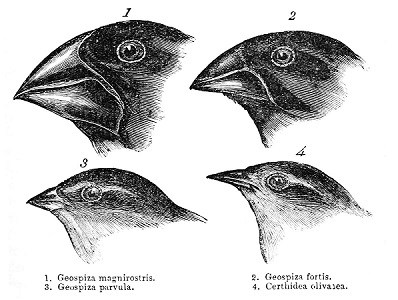
Image source: By John Gould (14.Sep.1804 - 3.Feb.1881) [Public domain], via Wikimedia Commons
Darwin came up with a testable hypothesis, which he tested again and again. After thorough studies and conference with other scientists like Alfred Russel Wallace, he constructed his theory of natural selection. His first book was called On the Origin of Species by Means of Natural Selection and outlines several crucial concepts.
Organisms in a population have to compete for resources such as food, water, and shelter. If an organism cannot get enough resources, it will not survive long enough to reproduce.
Darwin saw a great variation in traits among members of a population. Some traits were more beneficial than others. Adaptation describes any trait that can be passed on to an organism which helps it survive.
Fitness describes how well an organism can survive and reproduce in its environment. Different adaptations can increase or decrease fitness. Survival of the fittest is the concept that organisms with high fitness will survive and reproduce while those with low fitness will not. Survival of the fittest refers to an individual organism's fitness.
Natural selection is a mechanism of evolution. Organisms with favorable traits will survive and reproduce. This means they get to pass those traits on to their offspring. Unfavorable traits will, in theory, disappear over time as organisms with those traits often don't survive long enough to reproduce.
Natural selection refers to entire populations of organisms. If one organism out-competes another organism, we are talking about the survival of the fittest.
If we notice that a population of green frogs in a region is increasing while a population of gray frogs in the same area is decreasing, we are talking about natural selection.
Charles Darwin died in 1882 and was laid to rest in Westminster Abbey. Darwin's theory of evolution remains one of the most well-known ideas in natural history and one of the most influential theories in biology.