Illustrated · 1 min

+2 contributors


What Are Chromosomes?
Living organisms need extensive genetic information to function. In order for all of this information to fit inside each cell, it needs to be compact. This is the function of the chromosome.

Image source: By OpenClipart-Vectors CC0, via pixabay.com
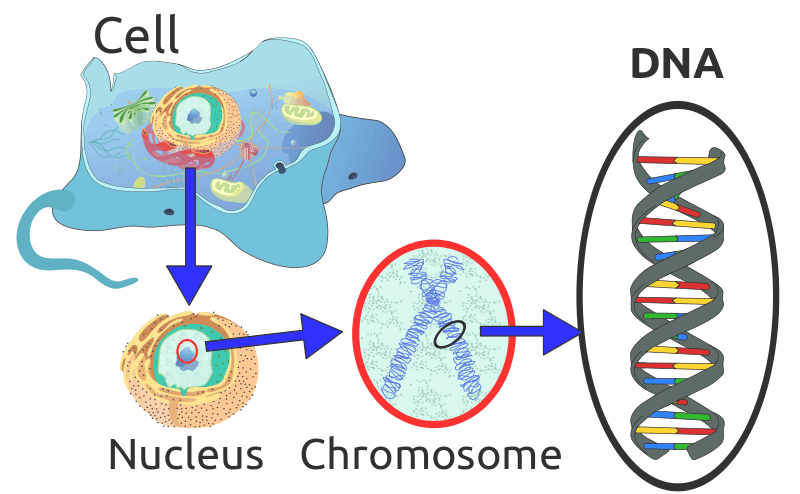
The figure above shows how DNA is condensed into chromosomes. Each chromosome is made up of a single molecule of DNA, and each species has a different number of chromosomes.
To form a chromosome, DNA is first wrapped around proteins called histones. The DNA-histone complex is called a nucleosome. From here, DNA is further coiled into chromatin. Chromatin can be super-coiled to form a chromosome. However, chromosomes are only seen during cell division. Normally, DNA exists in the form of chromatin.
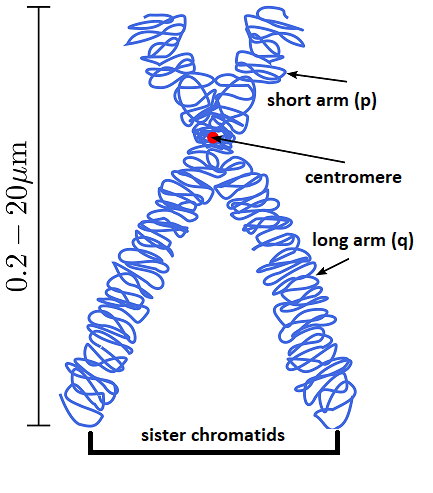
Image source: By Magnus Manske, Dietzel65, and Tryphon CC BY-SA 3.0, via Wikimedia Commons
The diagram above shows different parts of the chromosome. Each chromosome is made of two sister chromatids. Chromatids separate during cell division (mitosis or meiosis). After separation, each chromatid is called a chromosome (see figure below for more details on this). The chromatids are joined in the middle by a centromere. Each chromosome has a short arm (p) and a long arm (q).

Image source: By Gabi Slizewska
When a cell divides, chromatin condenses to form chromosomes. These chromosomes need to be replicated so that when the parent cell divides, each new cell gets all the genetic information it needs. This is especially important in sex cells, which go on to be fertilized to produce offspring. If there is a problem during the segregation and separation of chromosomes of sex cells, it may cause genetic mutations in the offspring.