Read · 1 min
Crystalline Solids
There are three phases of matter: solid, liquid, and gas. Solids are distinguished by a defined shape and closely packed atoms. Among solids there are different types:
-
Metallic: hard metals elements like iron or alloys like bronze.
-
Amorphous: soft solids like plastics and rubber.
-
Crystalline: materials that form crystal lattices like sugar and sodium chloride (table salt).
Crystalline solids are distinctive from amorphous solids. Amorphous solids have disorganized particles throughout. Crystalline solids have highly organized structures that persist throughout the whole substance. The ions, molecules, or atoms within a crystal maintain a repeated pattern that causes distinct visible shapes.
Types Of Crystalline Solids
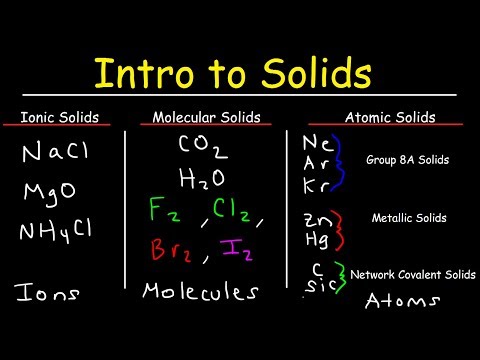
Crystals can be classified into different types of crystalline solids.
-
Ionic: the particles that make up these crystals are ions. A common example is table salt (NaCl).
-
Molecular: the particles making up the crystal consist of molecules. These molecules experience Van der Waal's forces. So, they are held together by dispersion, dipole-dipole interactions, or hydrogen bonding. A great example is ice. The HO molecules are held together by water's hydrogen bonding.
-
Covalent Network: atoms within this solid interact through covalent bonds in a 3D arrangement. An example is diamond which is made of networks of carbon.
-
Metallic: these are solids with metallic properties. They are made of large networks of atoms. Silver and tin are examples.