Cloning — Definition & Examples

Before this, knowWhat Is Genetic Engineering? — Definition & Examples

Video

(Video) Cloning 101

by DNA Learning Center

What Is Cloning?

Cloning is the process of creating a genetically identical copy of an organism. In this video, DNA Learning Center explains how it works.

Vocabulary Review:\color{#8925AE}{\text{Vocabulary Review:}}

Genetic Engineering\color{#8925AE}{\text{Genetic Engineering}} : The process of changing the genetic material of an organism

Selective Breeding\color{#8925AE}{\text{Selective Breeding}} : Also known as artificial selection, this is the process of breeding organisms to create offspring with desired traits

Cloning\color{#8925AE}{\text{Cloning}} : Creating a genetically identical copy of an organism

Genetically Modified Organisms\color{#8925AE}{\text{Genetically Modified Organisms}} : Organisms that have had their genome altered in some way

Gene Therapy\color{#8925AE}{\text{Gene Therapy}} : Inserting normal genes in place of missing or defective ones to fix genetic disorders

Illustrated · 2 min

The Genetics of Cloning

A genetic engineering technique that is constantly making headlines is cloning.

For some organisms, like certain bacteria and plants, making clones is completely natural.

In the lab, cloning is often used to make copies of certain genes. This is done by taking a piece of DNA that contains the gene of interest and placing it in a vector. Vectors are segments of DNA into which scientists can insert their target gene. The vector can also be placed into another organism, like a bacterium, where it will continue to divide. We end up with many copies of the same gene, which makes it much easier to study.

A more controversial topic is cloning a human through the use of science. Clones can form naturally in humans and these are known as identical twins. Identical twins will have the same exact DNA. The cloning of animals has been under controversy for many years. One example you might be familiar with is creating clones of extinct species, like dinosaurs or woolly mammoths. However, some animals have been successfully cloned. One of the most famous cloned animals is Dolly the sheep.

A diagram showing how a tiger would be cloned, in general. We start with a somatic cell from a donor tiger and an egg cell from a surrogate tiger. The nucleus of the somatic cell is fused with the egg cell which has had its nucleus removed. The egg cell divides until a clone of the donor tiger forms.

Image source: By Gabi Slizewska

To clone an animal, scientists take an egg cell and remove the nucleus (which contains the DNA). Then, they take a somatic cell and insert its DNA into the egg cell. A somatic cell is essentially any cell other than sperm and eggs.

Scientists use an electrical current to fuse the somatic DNA with the egg cell, which then acts as if it was fertilized and begins to divide. The egg can be placed in a surrogate mother. The mother will give birth to an organism that is identical to the organism from which the somatic cell was taken.

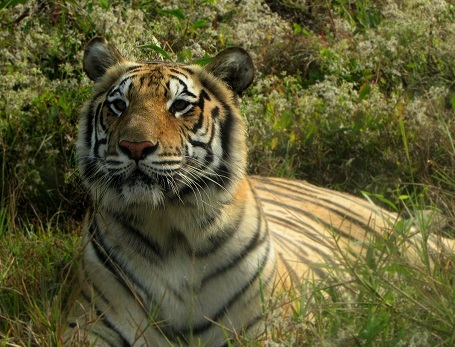
A Bengal tiger

Image source: By Arefin Shamsul CC0, via pexels.com

Today, therapeutic cloning is used to study, and hopefully treat, diseases like Alzheimer's. Many scientists are also looking to cloning as a way to save endangered animals like the Bengal tiger. However, this form of genetic engineering is still highly controversial, and many ethical questions have to be considered.

Read · 1 min

Summary of Cloning

Cloning is the process by which scientists are able to take the genetic information from an adult organism and insert it into an egg cell in order to produce a genetically identical copy.

This process is done by taking an egg cell from an organism. The DNA is then removed from this cell and replaced with DNA from another organism of the same species. The egg is then placed in a foster mother where it can develop into an embryo and eventually into a fully grown organism.

Type a concept, like “slope” or “photosynthesis”.

↑ ↓ to choose · Enter to openSearch explanations and problems