My wife and I enjoy hiking. At the end of our favorite hike, there is a small waterfall. The waterfall forms a gentle pool. Every spring, baby tadpoles hatch and swim in every direction. But, what's even more unique is the insects. Every time we go, bugs are gliding on the water's surface. Why can the bugs sit on top of the water? Chemistry can teach us the answer!
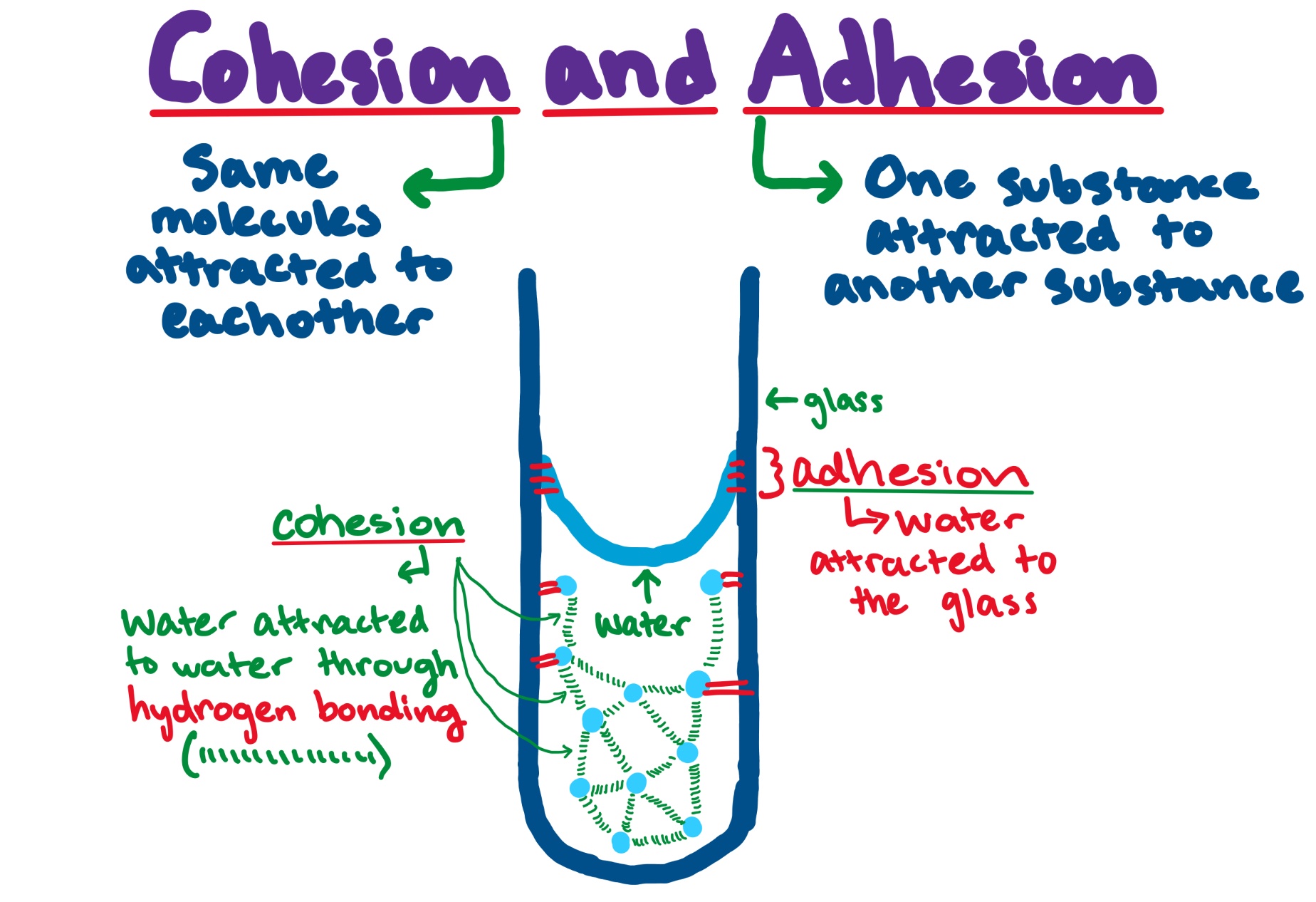
As we studied the physical properties of liquids, we got a brief glimpse at cohesion and adhesion. Cohesion is a substance's attraction to itself. In contrast, adhesion is a substance's electrostatic interactions with its surroundings. They are competing forces. If cohesion is more significant, then the molecules or atoms will stick together. When adhesion overtakes cohesion, the liquid will spread out.
Cohesion and adhesion result from Van der Waal's forces. Remember, Van der Waal's forces encompass London dispersion, dipole-dipole, hydrogen bonding, and ion-dipole forces. Cohesion depends on a surface's intermolecular forces. A liquid's inner molecules are embedded. They experience intermolecular interactions in all directions. So, their total forces are zero. But, the surface molecules are not enclosed. They feel an inward and an outward force. Cohesion attracts them, inward, towards like molecules. Meanwhile, adhesion pulls them outward toward their surroundings.
Cohesion and Adhesion in Water
We see cohesion and adhesion in water all the time. Imagine a raindrop. Why is it a sphere? Because cohesion surpasses adhesion. The cohesive force is hydrogen bonding. London dispersion effects between water and air create adhesion. Air consists of non-polar diatomic gasses and a minuscule amount of argon gas. So the only interaction they can have is London dispersion! We know that water's hydrogen bonds dominant the dispersion interactions.
Cohesion and Adhesion in Mercury
Mercury (Hg) is a unique element. It is one of only two elements, on the periodic table, that is a liquid at standard temperature and pressure. Mercury is a transition metal, so it forms metallic bonds. Metalic bonds have significant bond strength. Why? Because of the sea of electrons. So, mercury undergoes strong cohesion. If you place mercury into a beaker, it will form a droplet. Mercury will flow because of gravity. Yet, even when flowing, it will stick to itself.
The Meniscus
In a chemistry lab experiment, your teacher may have told you to measure to the bottom of the meniscus. When water settles in a graduated cylinder, the water bends. We call the curvature a meniscus. The graduated cylinder's glass is very polar. The polarity pulls the water's surface toward the graduated cylinder. So, the curvature points downward. We say it is concave-down. A concave-down meniscus happens because the adhesive force exceeds the cohesive force.
The opposite happens with mercury. Its metallic bonds exceed the glass's dipole interactions. So, mercury's surface pulls away from the glass. In a graduated cylinder, mercury would form an upward dome. We say it is concave-up. A concave-up meniscus occurs when cohesion outweighs adhesion.
Capillary Effect
I'm a huge coffee snob! Every morning I make myself a pour-over coffee. For a pour-over, I have to wet my coffee filters. When I slowly wet the filter, the filter sucks the water up above the water level. I'm observing the capillary effect!
The capillary effect is when a liquid flows against gravity. It only happens in very narrow spaces where there is significant adhesion. My coffee filter is an amorphous solid. The fibers are of various sizes. They randomly overlap to form pores. The filter's fibers attract the water. The water wicks up, filling the pores. Eventually, the water's mass is large enough that gravity and adhesion are equal. So, the water stops flowing.
Chemistry in the Real World: Water Striders
Let's return to the insects gliding on the water. Why don't they sink? We now know the answer is cohesion. The water molecules on the pool's surface attract each other. The insect's weight distributes between his six legs. So, the force exerted by each leg is weaker than the water's attraction. The water can hold the insect. It can walk on water! We will explore this in more detail when we study surface tension.