
Illustrated · 1 min
We will first consider an elastic collision
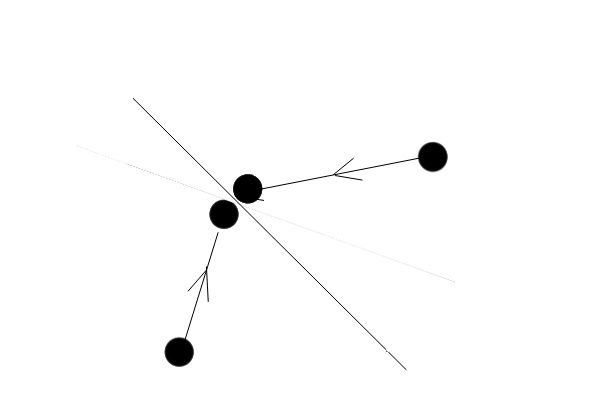
A 2D collision
When two objects collide, they exert an impulse normal to the plane at which they are colliding, due to the normal force.
If we separate the velocities into components parallel and normal to the plane of collision, we see that the parallel components of the velocities should be unaffected by the collision, since the only force exerted is normal to the plane. We can then treat the perpendicular components as a regular 1D collision.
If the object is not spherical, the resultant impulses may also cause some rotational motion, as the impulse may not be directed at the center of mass.
A common result of this is that elastic collisions between two spheres of the same mass where one sphere is stationary will always result in the spheres moving in perpendicular directions. The normal component of the velocity/momentum is completely transferred to the stationary sphere, while the parallel component is unaffected.