We've been studying the behavior of gases. The kinetic molecular theory explained the assumption we make about gas molecules. For example, there is a lot of empty space between the molecules. So, they don't experience any of Van der Waal's forces. It also helped us imagine the gas's movement in a container. They move in a straight line until they collide with another molecule or the sides of the container. Once we understood their behavior, we turned our attention to the gas laws.
We started with Boyle's law. It inversely linked the gas pressure and volume. Next, we turned to Charles' law. It examined the direct relationship between a gas's volume and temperature. Finally, we studied Gay-Lussac's law. It compared the pressure and temperature of a gas.
The gas laws helped us explore the relationships between volumes, pressures, and temperatures. But, what happens if we need to consider all three? We use the combined gas law! The combined gas law blends Boyle's, Charles', and Gay-Lussac's laws. So, now we can solve problems where volume, pressure, and temperature change! Let's explore the combined gas law.
Forms of the Combined Gas Law
We have two rules for the combined gas law. The first is that we assume the moles of gas stay constant. The second is that all temperature measurements are in Kelvin. Just like the other gas laws, the combined gas law has multiple forms. Let's explore each one.
- TPV=k
The first form is a ratio that equals a constant. We multiply pressure and volume in the numerator. In the denominator, we have the temperature. The combined gas law is difficult to use qualitatively. For example, if the temperature increases, the product of pressure and volume increases. But, that does not tell us much. For example, we don't know if the pressure increased by one percent or ninety-nine percent. The same is true of the volume's increase.
- T1P1V1=T2P2V2
The power of the combined gas law comes from the second form. In form one, the ratio was a constant. So, if we change all the variables, the proportion is still the same. Therefore, the initial is equal to the final. If a system's pressure, volume, and temperature change, we can still calculate each term.
Using the Combined Gas Law
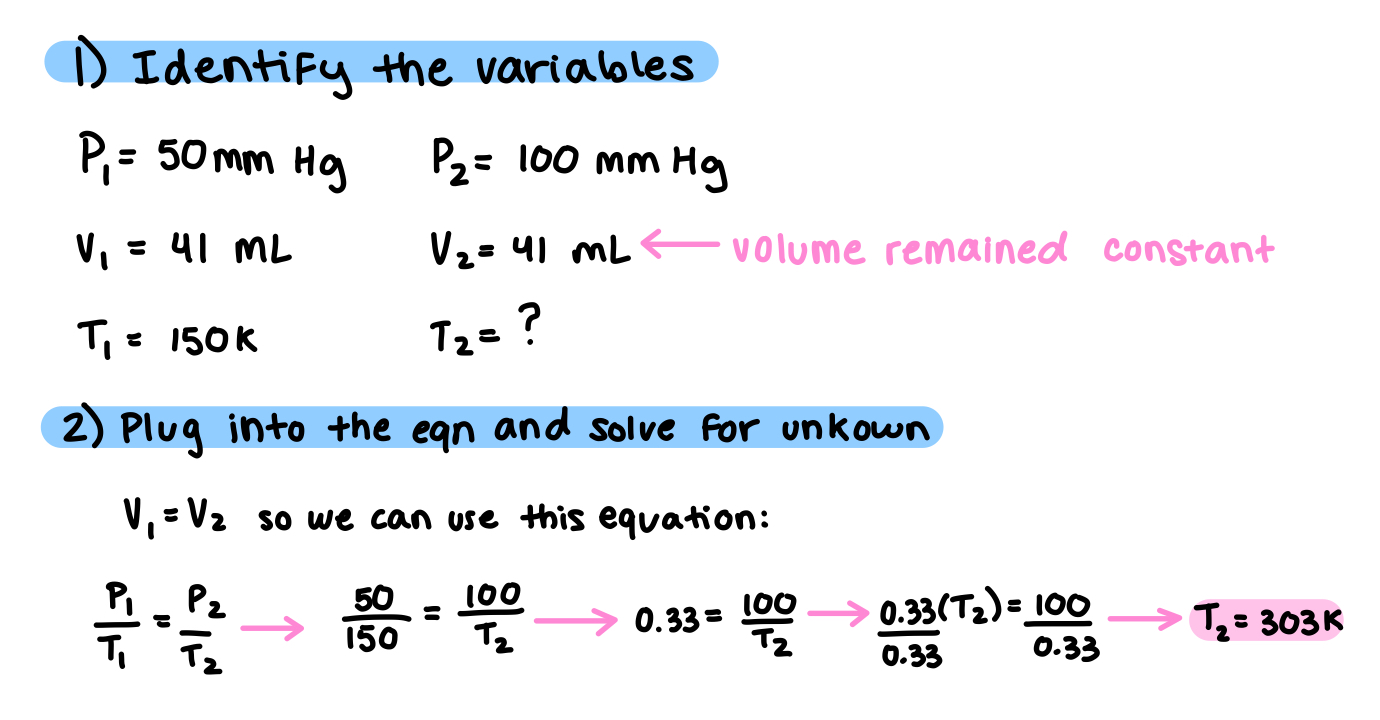
There are two ways to use the combined gas law. The easiest way is to derive the Boyle's, Charles' or the Gay-Lussac law. If the temperature is kept constant, the combined gas law reverts to P1V1=P2V2. That's Boyle's law! When we fix the pressure, we have T1V1=T2V2 which is Charles' law. Finally, if we keep the volume the same, we get the Gay-Lussac law. The equation becomes T1P1=T2P2.
The second way to use the combined gas law is to solve for one of the variables. For example, let's imagine we had one mole of the noble gas helium. It's at standard temperature and pressure. Now, we heat the gas to 300.0 K. The pressure increases to 1.5 bar. What's the new volume?
First, list all the terms.
At STP, P1=1.0bar and T1=273.15K.
The problem does not tell us the initial volume. We need to remember that one mole of gas at STP is 22.4 liters. So, V1=22.4.
The problem tells us that the ending pressure and temperature are P2=1.5bar and T2=300.0K.
Let's solve for the final volume.
T1P1V1=T2P2V2
273.15K1.0bar×22.4L=300.0K1.5bar×V2
0.082=0.005×V2
V2=16.4L
Combined Gas Law at Absolute Zero
Just like Charles' law, the combined gas law breaks down as we approach absolute zero. We know that any gas would condense before reaching absolute zero. As we decrease the temperature, we lessen kinetic energy. When the kinetic energy is low, the molecules experience electrostatic interactions. So, they behave as real gases. The combined gas law is a good approximation under standard conditions.
Adding Moles to the Combined Gas Law
The combined gas law assumes that the moles are constant. What happens if we change the number of moles too? We have the ideal gas law! It adds Avogadro's relationship to the other gas laws. From the ideal gas law, you can derive all the connections, including the combined law.