
Illustrated · 1 min
By Sylvia Freeman

+1 contributors
Contributors

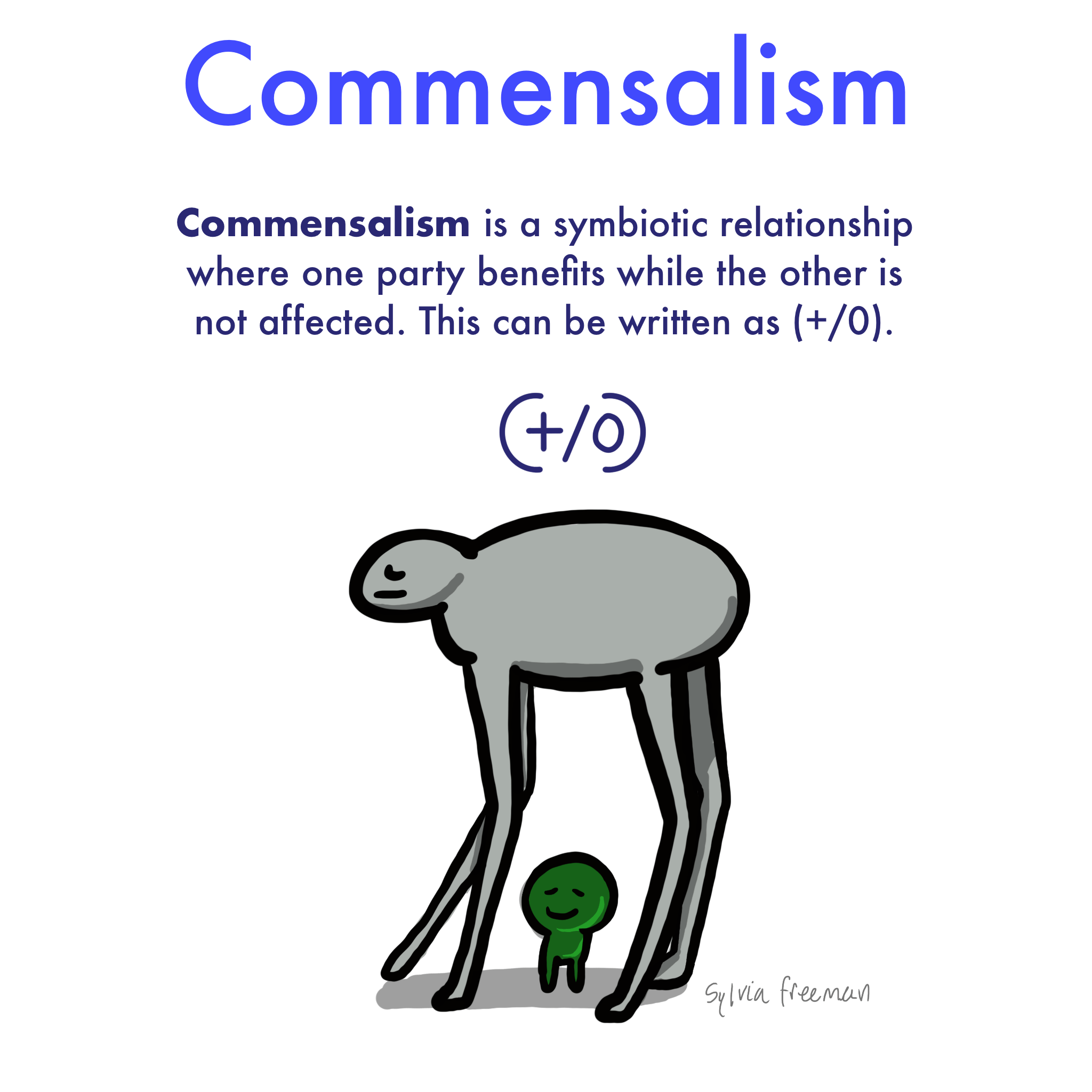
Image source: By Sylvia Freeman
Illustrated · 1 min
Image source: By Sylvia Freeman
Illustrated · 1 min

Image source: By Sarah Morgan
In a commensal relationship, one organism benefits while the other organism is unaffected. Usually, the second organism does not notice or care that the other is there. What could the benefiting species get from the other species? Most commonly they get nutrients, shelter, or transport from the other commensal species.
While some bacteria can become parasitic by causing cavities, the vast majority of bacteria in your mouth live happy lives eating food and waste left behind after you've eaten a meal. You might not notice the bacteria are even there, but they are able to live and reproduce because of the food that you eat.
Another really cool example of commensal species is cattle egrets and cattle. The cattle egrets hang out on top of the cows and eat the bugs that are kicked up. The cows really couldn't care less, but it makes getting food pretty easy for the egrets. The cattle egrets actually do this with a few large species such as rhinos, cattle, and elephants.
: A close, long-term relationship between two species
: How organisms compete for resources like food and water
: The relationship between a predator and its prey
: A relationship between two organisms that helps both of them
: A relationship where one organism benefits and nothing really happens to the other organism
: A relationship where one organism benefits and the other organism is harmed
Illustrated · 3 min
Commensalism is a type of symbiotic relationship where one commensal species is positively impacted and the other organism is unaffected. This might seem weird compared to the other types of symbiotic relationships where both species are invested in the relationship. But just like the more mainstream types of symbiosis, commensalism involves two species living and interacting in the same community.

Image source: By Valeri Natole
In commensalist symbiosis, the supporting organism (commensal organism 2 in the graph above) doesn't have to put out any effort—there's no negative effect on its existence.
Under the Sea
Cute, little hermit crabs have a commensal relationship with sea snails (and sometimes other creatures that leave behind bony structures when they die). When a sea snail dies, it decomposes and leaves behind the hard shell it made and lived in. Then, a lucky hermit crab comes along and, if it can fit into the abandoned shell, moves in. The shell provides safety and a home to the hermit crab and the sea snail is not effected because it was already dead.

Image source: By Yulia Kolosova CC BY 4.0, via Wikimedia Commons
In the Plant World
You've probably seen epiphytes, or epiphytic plants, without realizing it. "Air plants" and bromeliads are both classified as epiphytes. These are plants that live on other plants for support but are not parasites. The epiphytes get physical support against gravity from their larger host plants, which remain unaffected.

Image source: By Prashanthns CC BY-SA 3.0, via Wikimedia Commons
Up in the Sky
Nesting birds and trees have a commensal relationship, too. The birds build their nests high up in the trees for protection and support. Meanwhile, the supporting tree just goes on living its big tree life, not really changed by the parent birds building their nest or the baby birds that will live there.

Image source: By brewbooks CC BY-SA 2.0, via Wikimedia Commons

Image source: By Valeri Natole
In all of the other possible symbiotic relationships, each organism is affected. Commensalism is the only one where a participating species is left alone.
In mutualism, both parties get a benefit from their relationship.
In parasitism, the parasite benefits while the host suffers.
Predator-prey relationships are a bit more complex than parasitic ones because predator-prey relationships can actually benefit the prey species even at the cost of individual prey organisms. (That involves some advanced math to fully understand, though.) So, basically, predator-prey relationships are like parasitic relationships—one species is helped and one is harmed.
We mentioned earlier that air plants are types of epiphytic plants living in commensal interspecies relationships with trees and other larger plants. In fact, "epiphtyic" means a plant that grows on another plant without hurting it. The air plants use these larger species for support without damaging or benefiting the bigger organisms. Air plants are intriguing because they don't need soil to survive.

Image source: By Juan Carlos Fonseca Mata CC BY-SA 4.0, via Wikimedia Commons

Image source: By Valeri Natole
Air plants have become a popular addition to homes lately. So, how can you care for your household commensalist friends? Chances are you don't have any big tropical trees at home. But with the right care an air plant can live without a "host" species. Your air plant is going to need three things:

Image source: By Valeri Natole
Video
by WIRED

One type of symbiosis is called commensalism.
In this relationship, an individual from one species benefits from the interaction, and the other one does not. However, the organism which doesn't benefit isn't hurt by the relationship.
So, what happened to "no free rides"? The commensalist relationship between remoras, or shark suckers, and larger marine animals proves that this old adage isn't always true.


