Steps
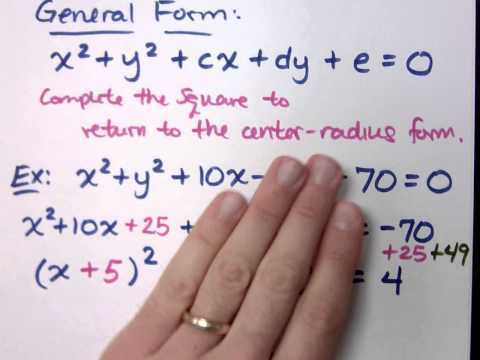
Let's look at the equation we are starting with.
x2+y2+cx+dy+e=0
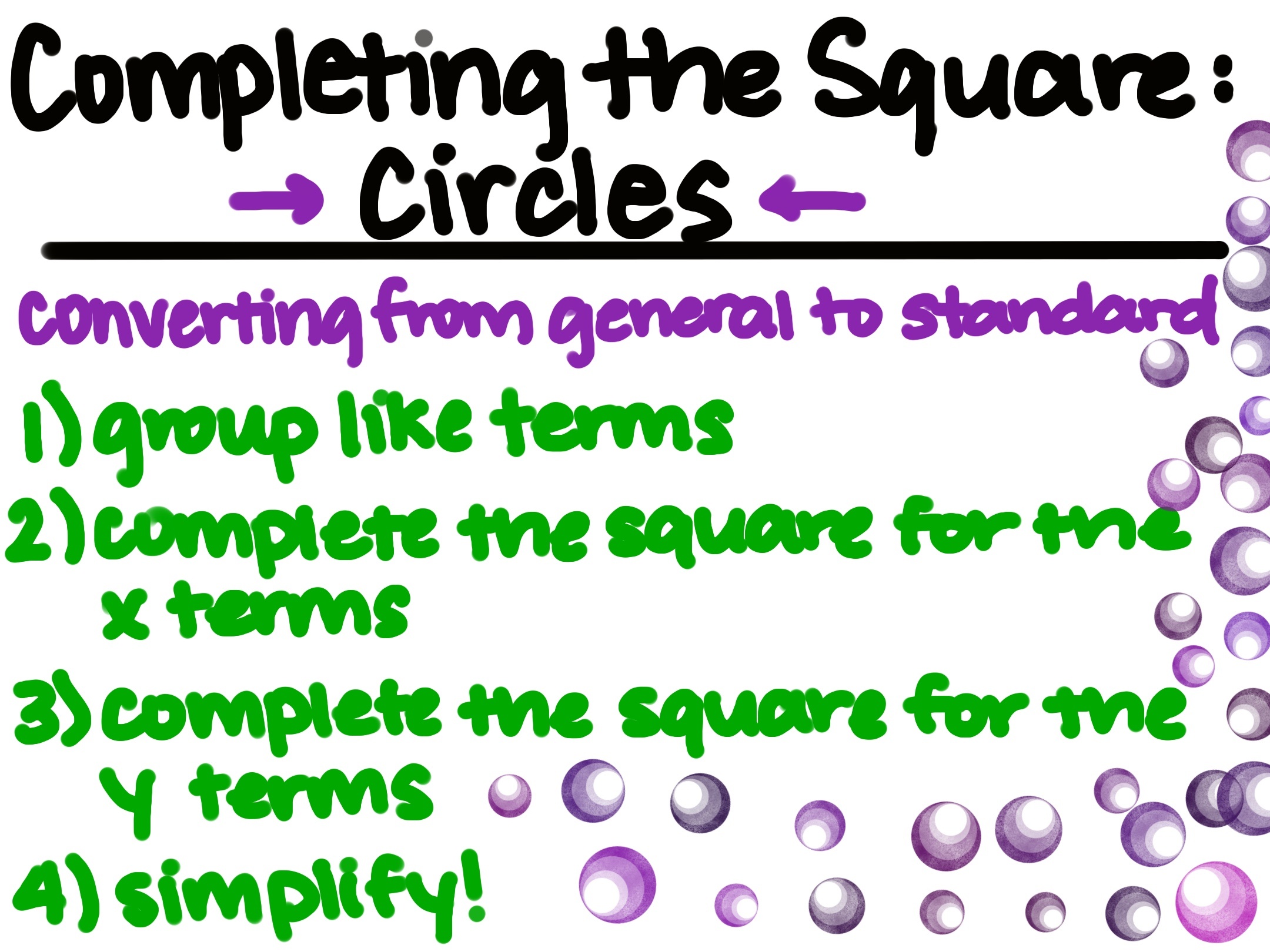
Our first step is to group all like terms together.
x2+cx+y2+dy+e=0
Next, we are going to complete the square for just the x terms. We'll do this on the side, and then put the final terms back into our working equation. So, to complete the square, we have:
(x......)−......
We will then look at the sign on the x term, which is positive in this case. We'll add that here.
(x+......)−......
Now, look at the coefficient of x in the original equation. In this case, it's c, so we will divide c by 2. We will put this new term in the brackets.
(x+2c)−......
Lastly, we will square the term we just halved, and that will be the value outside of the parentheses.
(x+2c)−(2c)2
Going back, our working equation is now:
(x+2c)−(2c)2+y2+dy+e=0
We will now do the same thing for the y terms. As before, we will do this work on the side, to keep all of our work straight.
(y......)−......
We will then look at the sign on the y term, which is positive in this case. We'll add that here.
(y+......)−......
Now, look at the coefficient of y in the original equation. In this case, it's d, so we will divide d by 2. We will put this new term in the brackets.
(y+2d)−......
Lastly, we will square the term we just halved, and that will be the value outside of the parentheses.
(y+2d)−(2d)2
Let's put these new terms into our working equation.
(x+2c)−(2c)2+(y+2d)−(2d)2+e=0
Let's rearrange the equation so all of the constant terms are together.
(x+2c)+(y+2d)−(2c)2−(2d)2+e=0
Always make sure that the right-hand side of the equation is equal to 0. We're done! This is the basic idea of how to complete the square, transforming the equation from general form to standard form.