Completing the Square to Convert an Ellipse Equation from General Form to Standard Form

Before this, knowConics: Standard Form of an Ellipse

Read · 2 min

Converting an Ellipse Equation from General Form to Standard Form

Now that we've learned about ellipses and the standard form of an ellipse, we can learn about how to convert an ellipse equation from general form to standard form. It might be helpful to review how to complete the square!

Completing the square is a method we use in algebra to manipulate quadratic expressions. When dealing with ellipses, completing the square can be helpful to convert the equation from general form to standard form. The standard form for the equation of an ellipse is:

(x−h)2a2+(y−k)2b2=1\frac{{(x - h)^2}}{{a^2}} + \frac{{(y - k)^2}}{{b^2}} = 1

Here, we know that (h,k)(h,k) is the center of the ellipse, aa is the length of the semi-major axis, and bb is the length of the semi-minor axis.

The general form for an ellipse equation is:

Ax2+By2+Cx+Dy+E=0Ax^2 + By^2 + Cx + Dy + E = 0

We want to convert this general form into the standard form so it's easier to use across different math applications, particularly when dealing with word problems. We can use completing the square to do that.

####Completing the Square

Step 1: Group the xx and yy terms.

Rearrange the terms so that all xx terms are together and all yy terms are together. The equation should look like this:

Ax2+Cx+By2+Dy+E=0Ax^2 + Cx + By^2 + Dy + E = 0

Step 2: Factor out the Coefficient of x2x^2 and y2y^2.

Remember your basic factoring here!

A(x2+CAx)+B(y2+DBy)+E=0A\left(x^2 + \frac{C}{A}x\right) + B\left(y^2 + \frac{D}{B}y\right) + E = 0

Step 3: Complete the Square for xx and yy terms.

To complete the square, we need to add and subtract certain terms inside the parentheses so that the xx and yy terms become perfect squares. This steps involves adding half of the coefficient of xx (or yy) squared. The completed square form is:

A(x+C2A)2+B(y+D2B)2+E=0A\left(x + \frac{C}{2A}\right)^2 + B\left(y + \frac{D}{2B}\right)^2 + E = 0

Step 4: Rearrange the Equation.

Move the constant term to the other side of the equation.

A(x+C2A)2+B(y+D2B)2=−EA\left(x + \frac{C}{2A}\right)^2 + B\left(y + \frac{D}{2B}\right)^2 = - E

Step 5: Divide by the Constant Term.

If necessary, divide both sides of the equation by the constant term on the right side so that the right side equals 11, which is the standard form for the equation of an ellipse.

(x+C2A)2−EA+(y+D2B)2−EB=1\frac{(x + \frac{C}{2A})^2}{\frac{-E}{A}} + \frac{(y + \frac{D}{2B})^2}{\frac{-E}{B}} = 1

Now, we can compare this equation to the standard form of the ellipse equation and identify hh, kk, aa, and bb.

Video · + 1 min read

(Video) Convert Equation of Ellipse from General Form to Standard Form

by Brian McLogan

In this video, Brian McLogan will walk you through an example of completing the square to convert an ellipse equation from general form to standard form.

Summary

Often, we want to turn a long, messy ellipse equation into a neat standard form so it is easy to graph. First, you need to group all of your xx-terms together and your yy-terms together on one side. Next, you will move the regular number over to the other side of the equal sign.

To make perfect squares, you will use the completing the square technique you learned earlier. You need to do this for both the xxs and yys.

A major trick is that whatever number you add to the left side, you must also add to the right side to keep the equation balanced. Finally, you divide everything by the total number on the right side so that the whole equation equals 11.

Illustrated · 1 min

Ellipses: Completing the Square

Sometimes, an ellipse equation is written in general form:

Ax2+By2+Dx+Ey+F=0Ax^2 + By^2 + Dx + Ey + F = 0

To figure out the center and size of an ellipse, we need to change it into standard form. To do that, we use a method called completing the square.

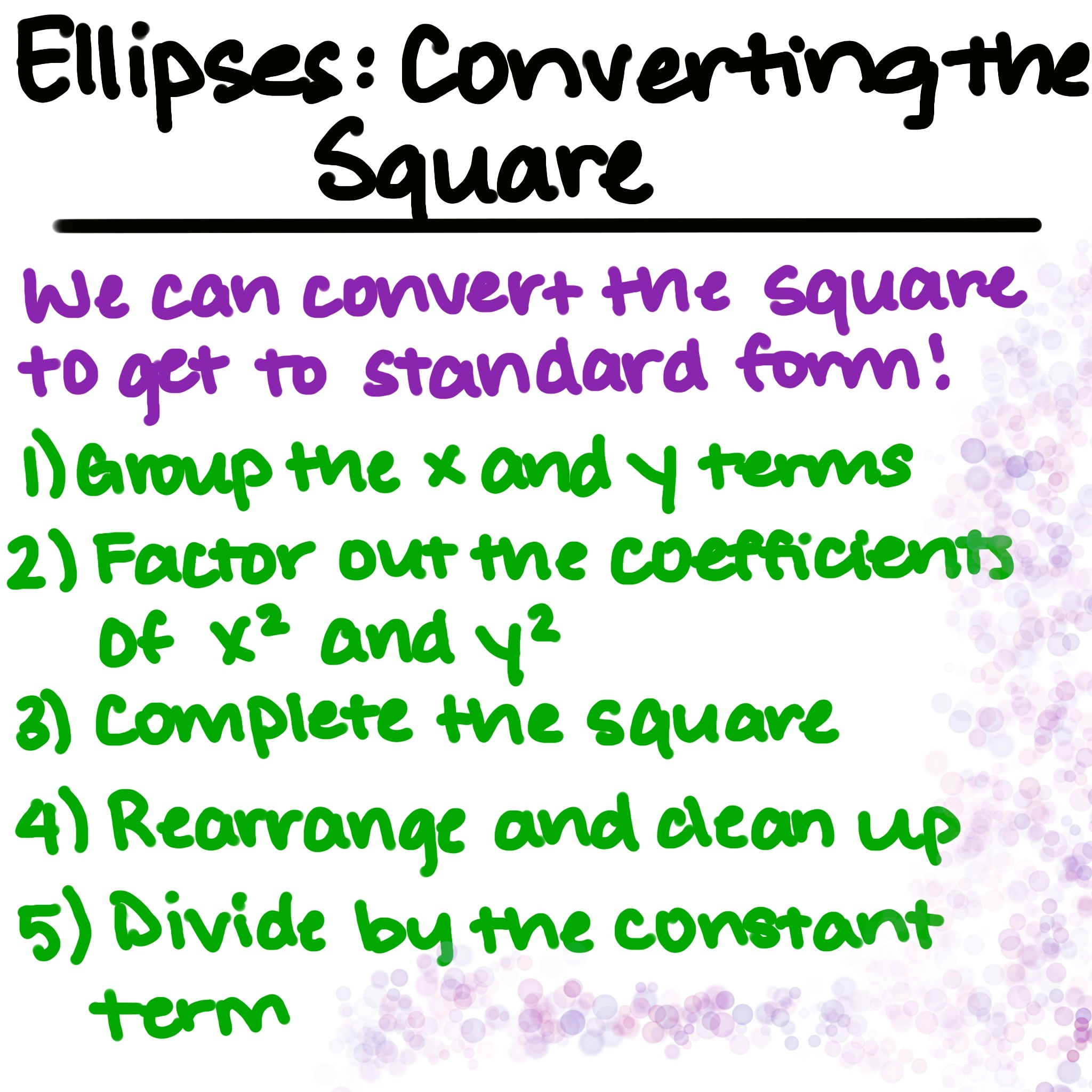
Ellipses: Converting the Square
We can convert the square to get to standard form!
1) Group the x and y terms
2) Factor out the coefficients of x^2 and y^2
3) Complete the square
4) Rearrange and clean up
5) Divide by the constant term

Image source: by Anusha Rahman

Example

Let's say that the equation is: 9x2+9y2−54x−18y=−819x^2 + 9y^2 - 54x - 18y = -81

First, group the xx terms and the yy terms together: (9x2−54x)+(9y2−18y)=−81(9x^2-54x) + (9y^2 - 18y) = -81

Now, factor out the 99 from both groups: 9(x2−6x)+9(y2−2y)=−819(x^2-6x) + 9(y^2-2y)=-81

Next, complete the square inside each parenthesis. For x2−6xx^2−6x, add 99 inside (because (−6/2)2=9(−6/2)^2=9). For y2−2yy^2 - 2y, add 11 inside. But since you added those values inside parentheses that are multiplied by 9, you’re actually adding 9×9=819×9=81 and 9×1=99×1=9 to the left side. So you must also add 8181 and 99 to the right side to keep it balanced.

Now, your equation becomes: 9(x−3)2+9(y−1)2=99(x-3)^2 + 9(y-1)^2=9

Divide everything by 99 to make the right side equal to 11: (x−3)2+(y−1)2=1(x-3)^2 + (y-1)^2=1

This is the standard form of the ellipse! We can quickly see that the center is (3,1)(3,1) and the radius is 11 in all directions. That means it's a circle!

Type a concept, like “slope” or “photosynthesis”.

↑ ↓ to choose · Enter to openSearch explanations and problems