Read · 2 min

Converting an Ellipse Equation from General Form to Standard Form
Now that we've learned about ellipses and the standard form of an ellipse, we can learn about how to convert an ellipse equation from general form to standard form. It might be helpful to review how to complete the square!
Completing the square is a method we use in algebra to manipulate quadratic expressions. When dealing with ellipses, completing the square can be helpful to convert the equation from general form to standard form. The standard form for the equation of an ellipse is:
Here, we know that is the center of the ellipse, is the length of the semi-major axis, and is the length of the semi-minor axis.
The general form for an ellipse equation is:
We want to convert this general form into the standard form so it's easier to use across different math applications, particularly when dealing with word problems. We can use completing the square to do that.
####Completing the Square
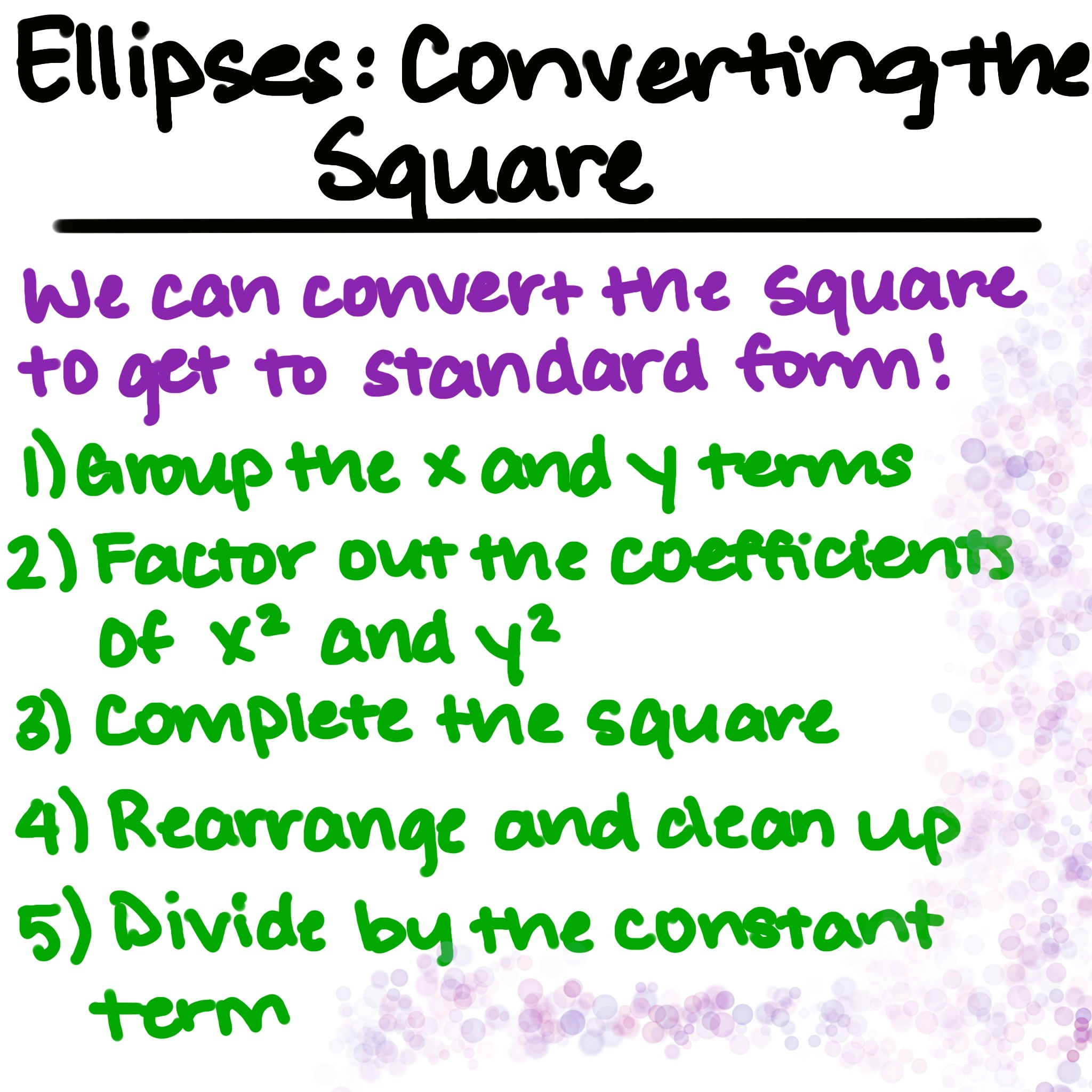
Step 1: Group the and terms.
Rearrange the terms so that all terms are together and all terms are together. The equation should look like this:
Step 2: Factor out the Coefficient of and .
Remember your basic factoring here!
Step 3: Complete the Square for and terms.
To complete the square, we need to add and subtract certain terms inside the parentheses so that the and terms become perfect squares. This steps involves adding half of the coefficient of (or ) squared. The completed square form is:
Step 4: Rearrange the Equation.
Move the constant term to the other side of the equation.
Step 5: Divide by the Constant Term.
If necessary, divide both sides of the equation by the constant term on the right side so that the right side equals , which is the standard form for the equation of an ellipse.
Now, we can compare this equation to the standard form of the ellipse equation and identify , , , and .