Interactive · 1 question

+2 contributors


There are a few different scenarios in which you might have to evaluate a composite function at a given point: using a table, using a graph, or using the expressions of the functions themselves.
Sometimes you may be given a table (or tables) that show the input and output of functions, and you'll be asked to evaluate a composition of these functions at a certain point. How would you go about doing this?
Let's look at an example to see how to solve these types of problems. Say you're given the following table, and you're asked to evaluate
To solve this problem, we will first evaluate Then we will substitute the answer we get into our function. After that, we can find
In order to evaluate all we have to do it look at the table and find the value when As you can see, when then Thus,
Our next step is easy. Remember, we are trying to find But we just found it's Thus, we can substitute in for like so:
Our final step is kind of like the first step. Now that we know that we just have to find the value when We can see that when then Thus, our answer, equals
Note: Be careful with tables! What if you had been asked to find Using the strategy we just learned, we can see that since But wait! We can't evaluate because is not a defined value for it is not in the domain of
Sometimes, you may be given a graph instead of tables to help you evaluate a composite function at a given point. Let's look at an example to learn how to tackle these problems it's similar to the method we used before with tables.
Say you're given the following graph with the function in blue and the function in orange, and you're asked to evaluate

Created using Desmos
Like we previously learned, we will first evaluate Next, we will substitute the answer we get into our function. Then we can find
To evaluate we first look at the graph of and find the value when Since we can see that when then Thus,
Since we can substitute in for
Finally, since we know that we just have to look at the graph of and find the value when Since we can see that when then So, our answer, equals
Lastly, you may only be given the functions themselves, without a table or a graph. Let's see if you can use what you learned to solve a problem of this type:
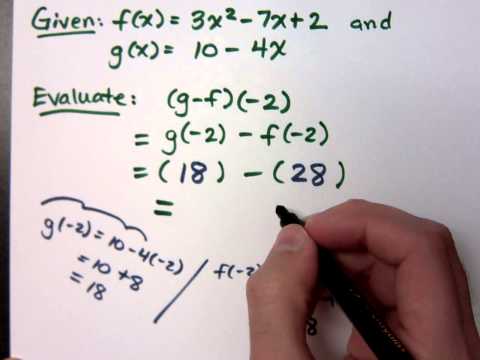
Let and Evaluate
Alright, let's go through this solution step by step.
To evaluate we simply plug into our function:
Since we can substitute in for
To evaluate we plug into our function: So, our answer, equals
There's also another method to solve this problem depending on the situation, this way might be easier! In this method, instead of evaluating first, we instead find and then we substitute in for in our solution.
To find all we do is plug into our function:
To find we just substitute in for
Either way, whether you evaluate first or later, you'll get the same answer!