Interactive · 2 questions
The nucleus of an atom is composed of protons and neutrons. Protons have a positive charge, and a neutron has no charge. Each proton and neutron has an atomic mass of about 1 amu (atomic mass unit). The protons and neutrons are held together by the strong nuclear force.
What is the charge of the nucleus of the atom?
The nucleus of the atom is small and dense. It is basically all of the mass of the atom. The identity of the atom is based upon the number of protons that the atom contains (1 proton is a hydrogen, 2 protons is helium, etc.) The number of protons is also its atomic number.
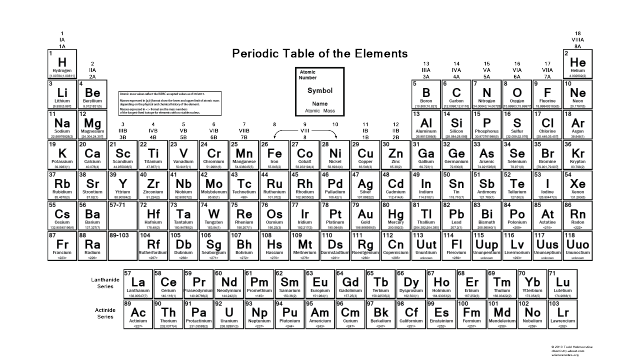
The number on the top left corner of each element's square represents its atomic number.
Based on the periodic table, what is the element symbol with an atomic number of 12?
The neutrons in the nucleus, although having a neutral charge, are very important. They allow for the positively charged protons to be able to be close together in the nucleus; the neutrons act like glue in the nucleus. They also come into more use when discussing isotopes.