
Illustrated · 2 min

+3 contributors



Chemical Compounds
Compounds are, in fancy science terms, substances formed by the chemical combination of one or more elements in fixed proportions. Chemical combination means that the atoms form bonds with each other. This is different from the physical combinations we saw in mixtures.
An easy way to remember this is compounds are chemically combined, but mixtures are mixed.

When atoms bond together, they form compounds.
Image source: By James Childs CC0, via publicdomainpictures.net
Compounds are kind of like baking a cake. You have to combine the ingredients in the exact right proportions or the cake won't cook quite right. If you change one atom in a compound, then it becomes something completely different. If you remove the oxygen atom from water, you now have pure hydrogen.
Compounds come in two varieties: molecules and, well, compounds. All compounds are molecules, but not all molecules are compounds. Compounds must be made up of two or more elements. Molecules can be made up of two atoms of the same element, like .

Image source: By James Childs CC0, via publicdomainpictures.net Image source: By OpenStax College CC BY 3.0, via Wikimedia Commons
These combinations are shown by chemical formulas. With the chemical abbreviations from the periodic table, scientists write chemical formulas as a shorthand. Instead of writing "sodium chloride" or "table salt", they can just write . If there are multiple atoms of the same element in the compound, they put a subscript with the number next to the chemical symbol.

Carbon dioxide
Image source: By Deena Hauze
One of the most well-known chemical formulas is , but you probably know it as water. It is made up of hydrogen and oxygen atoms. The formula tells us that one molecule of water is made up of two hydrogen atoms and one oxygen atom. Any molecule we stumble across with this formula is water.
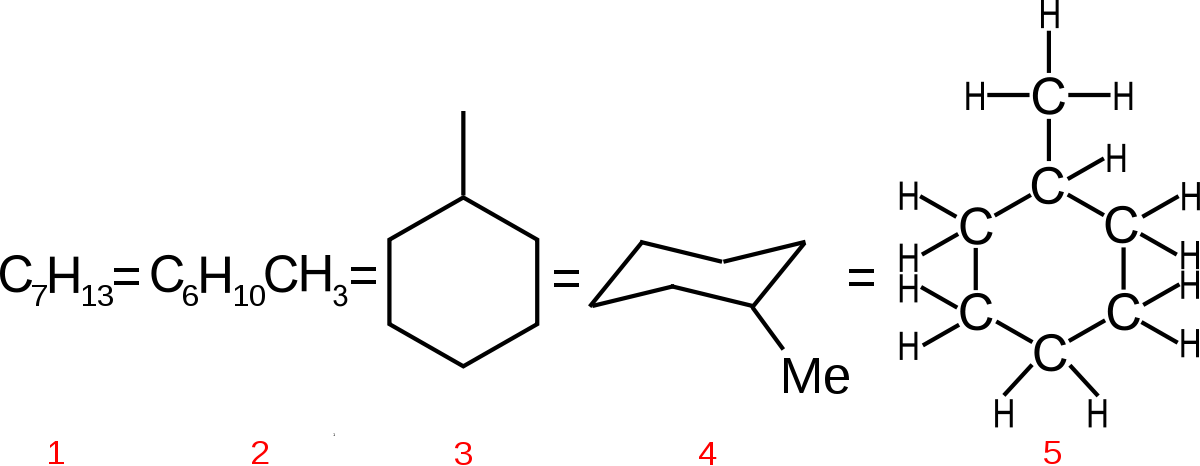
Five different representations of the molecule "methylcyclohexane". From the name alone, we can see why scientists use shorthand chemical formulas.
Image source: By Doxepine [Public domain], via Wikimedia Commons
Compounds have very different chemical and physical properties than the elements they are made of. Table salt is made from two elements that are typically dangerous in their elemental form, yet it is perfectly safe to use and eat.
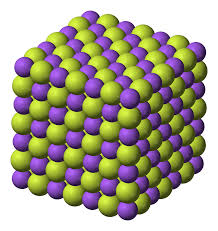
Sodium chloride (NaCl) is a chemical compound.
Image source: By Benjah-bmm27 [Public domain], via Wikimedia Commons
So, let's explore the properties of table salt. It is made from one sodium atom and one chlorine atom. Sodium is a metal that typically explodes when it comes into contact with water, while chlorine is a poisonous yellow/green gas.
However, when we combine these two hazardous elements, we end up with common table salt.
: The smallest particle of an element that has the properties of that element
: The positively and neutrally charged subatomic particles, protons and neutrons, located in the center of the atom
: A substance that can not be broken down into other substances. All atoms of an element have the same atomic number
: Substance consisting of atoms of the same type
: Substances formed by the chemical combination of one or more elements in fixed proportions
: The number of protons in the nucleus, which lets us identify which element it is
: The number of protons and neutrons in the nucleus


