Illustrated · 2 min
What is a Concentration Cell?
Remember learning about the difference between active and inert electrodes? We talked about how active electrodes are found in voltaic cells and inert electrodes are found in something mildly unfamiliar, an electrolytic cell?
While the voltaic, or galvanic, cell, a particular electrochemical cell, produces electricity utilizing a chemical reaction to convert chemical energy into electrical energy, an electrolytic cell does it quite differently. This kind of cell instead uses an electric current for the propagation of a chemical reaction, thus converting electrical energy into chemical energy.
Concentration Cell
A concentration cell is one type of electrolytic cell. In galvanic cells, different electrodes are used, but the two half-cells of a concentration cell actually contain identical electrodes. Instead, the half-cells differ in concentration.
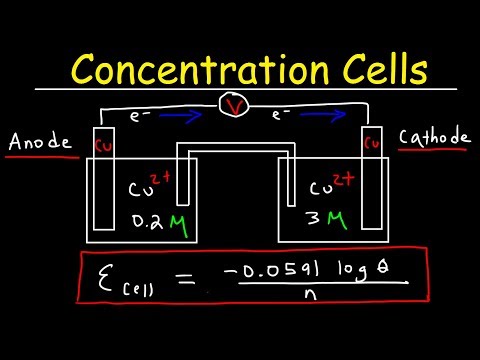
By diluting the more concentrated solution, and then once concentrating the more dilute solution, the concentration cell is able to produce a voltage. The electrons from the more dilute cell are transferred to the more concentrated solution, and as the cell reaches equilibrium, a potential difference is created. The diagram below demonstrates the move to equilibrium and discharge of electricity.

Concentration Cells by Summer Black
In the diagram, I have listed several key components of a concentration cell. To allow for ion transfer while the cells remain separate, a salt bridge provides the perfect pathway. The two electrodes are called the anode and cathode. The anode loses electrons (oxidation) that move to the cathode with gains them (reduction). The voltmeter measures the cell potential, or electromotive force/voltage, and is typically right in between the two half-cells. So basically, a concentration cell has all the same parts as a galvanic cell but instead differs in concentration rather than substance.
Applications of Concentration Cells
Standard Electrode Potential of Concentration Cells
Since the electrodes of a concentration cell are identical, the standard electrode potential, which you will see written as , is equal to zero. However, since there is an ion concentration difference, there is still a potential difference between the two half-cells. And the Nerst Equation is used to find just that.
At ,
In this equation,
- is the reduction potential, a voltage that is measured using a voltmeter (of cell, so cell potential)
- is the standard reduction potential
- 0.0592 comes from the gas constant, R, and the temperature, T, at , but in Kelvin so 198K, multiplied together
- z is the ion charge in moles of electrons
- F is Faraday's constant (9.65 x C )
- And Q is the reaction quotient, which can be found with the equation:
If Q ends up being equal to 1 (Q=1), then taking the log of it would give you zero. In this case, the
pH meter
A pH meter is a specific type of concentration cell that determines the pH of a solution using the basic setup. The higher the voltage reads, the more acidic the solution is.