
Illustrated · 1 min
By Gabi Slizewska

+1 contributors
Contributors


Image source: By Gabi Slizewska
Illustrated · 1 min
Image source: By Gabi Slizewska
Video
by Ms Cooper's A level Biology

Check out this video for an awesome explanation on how substrate and enzyme concentrations affect the rate of reaction. Ms. Cooper makes this easy to understand by including some great graphs.
Video
by Aaron Sams on TED-Ed
This funny video shows how chemical reactions can be like getting a date to the dance. Pay close attention to how the scientist speeds up the rate of reaction by changing the "concentration" of students in the school.
Illustrated · 1 min
Enzyme reaction rates depend on how often enzymes come in contact with molecules of the substrate.

Image source: By fullofstars [Public domain], via Wikimedia Commons
Increasing the amount of substrate in a reaction will increase the rate of the reaction because the enzymes run into more and more substrates. The rate of reaction will increase until it reaches its saturation point. The saturation point is reached when the enzymes are all occupied and are never searching for substrates. The only way to increase the reaction rate once the saturation point is reached is to increase the amount of enzymes.
Illustrated · 1 min
The rate of reaction or reaction rate is a measurement of how fast a reaction occurs.
Most often, we look at how quickly products are being made or how quickly substrates are being used up in order to determine rate.
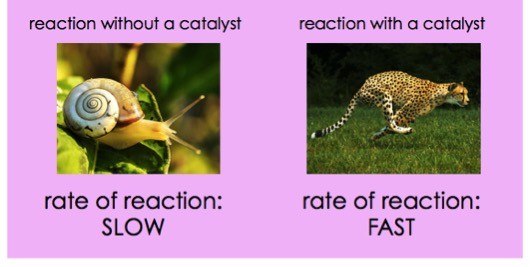
Image source: By István Mihály (Mhy) CC0, via pixabay.com Image source: By Gregory Wilson (Director and cinematographer) CC BY 3.0, via Wikimedia Commons
Let's look at two ways to increase reaction rate.
Increasing the enzyme concentration will make the rate of reaction increase as long as there is enough substrate available to work on.
If we assume that there is an endless supply of substrate available, the reaction rate will go up in a straight line, as seen below.

Image source: By Hannah Bonville
Increasing the substrate concentration will increase the reaction rate until all of the available enzymes become saturated, or in use.
Once all of the available enzyme active sites are occupied (have substrate bound to them, forming an enzyme-substrate complex), increasing the substrate concentration further will have no effect on the reaction rate.

Image source: By GYassineMrabetTalk [Public domain], via Wikimedia Commons

