Read · 1 min
The amount of space inside the boundary of a flat (2-dimensional) object such as a rectangle, triangle, or circle. All 2-dimensional shapes do not have thickness.
Read · 1 min
The amount of space inside the boundary of a flat (2-dimensional) object such as a rectangle, triangle, or circle. All 2-dimensional shapes do not have thickness.
Working through past problems on one idea at a time is one of the most effective ways to prepare. These are real problems from the AMC 8, AMC 10, AMC 12 and AIME, the national math competitions for middle and high school students, each with a worked solution on LIVE by Po-Shen Loh.
Illustrated · 1 min
Area is the amount of space a shape takes up in two dimensions. In one dimension, length is the number of unit line (segments) that can fit end to end along the line; in two dimensions, area is the number of unit squares that can fit inside the shape.
For example, if you want to know the area of a room that has a tiled floor, and each tile is 1 unit square (1 ft x 1ft), then you can simply count the number of tiles that fit in the room. The area of the room is the number of unit squares that fit inside.
This simple method can also help you when you're trying to calculate the area of irregular shapes. For example, say you want to estimate the area of Antarctica from this map.
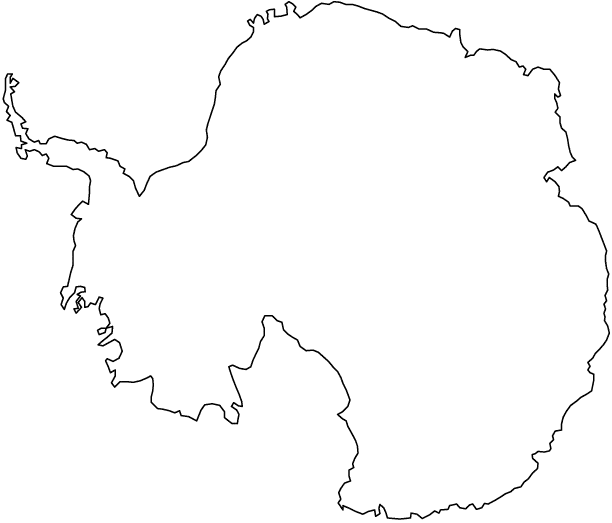
By EsauBJ4611 - Own work, CC BY-SA 4.0, Wikimedia Commons
There are plenty of formulas to calculate area of circles, squares, triangles, etc., but what shape is Antarctica? It would be a lot of work to divide the continent up into regular shapes in order to use those formulas.
But you can just overlay a grid on top, like this.

By EsauBJ4611 - Own work, CC BY-SA 4.0, Wikimedia Commons edited by Cassandra Cyril
Just like your room's tiled floor made calculating its area a counting task, rather than complicated formula, this does the same thing: you just gave Antarctica a tiled floor! To estimate area, all you have to do is establish a scale for your map and your grid, then count up the number of unit squares that fill the shape, estimating for how to combine the partial ones.
Interactive · 1 question
What's the simplest area?
If we have a more complicated region, we can break it up into small rectangles (perhaps squares, for simplicity).
What's the area of a rectangle with sides and ?
Read · 1 min
Area is the extent or measurement of a surface or piece of land. For example, the area of a triangle would be what is enclosed by the triangle.
Read · 1 min
Why are congruence translations area preserving?
Well, location is a relative concept, with one location being based on another location (or in Cartesian Coordinates, the origin). So, if we simply redefine the origin as a different point, then the shapes "position" has changed, even though we haven't actually done anything to it! Also, the origin's area clearly hasn't changed, since it is a point with no area, so therefore congruence translations preserve area.
Interactive · 2 questions
Area is, intuitively, the amount of -dimensional space that a figure occupies. The problem with this definition is that it is almost impossible to work with it rigorously, so instead we set postulates that conform with our intuitive notions of area.
If two figures are congruent, how do we think their areas should be related?
Our intuition tells us that two figures that are congruent should have the same area, since they are the same shape and thus occupy the same amount of space. Thus, we set the following postulate:
If two figures are congruent, then they have the same area.
Now, if we split up a region into two subregions, how do we think the areas of the subregions should relate to the area of the entire region?
Again, our intuition dictates the postulate we make. Since the subregions together take up the same amount of space as the entire region, their areas should add up to the area of the whole region. This brings us the next postulate, typically called the Area Addition Postulate:
The area of a space is equal to the sum of the areas of its nonoverlapping regions.
Finally, we want a baseline with which to compute areas. For example, from the two postulates above, we can take a complicated region and divide it into simple regions, but these postulates still tell us nothing about what values those areas should assume. In addition, the notion of "amount of -dimensional space" is also very unhelpful when computing areas.
Let's examine a very simple shape: a square with a side length of unit. What do you think its area should be?
Most would agree that, since a square with a side length of unit is the simplest shape possible, it should have the simplest area possible, namely "square" unit. This notion of area is quite literal, as it is literally a square of unit, hence the term "square unit." In general, it seems pleasing that a square of side length should have area equal to , and this gives us our final postulate:
The area of a square is equal to the square of its side length.
With these postulates, we are now ready to calculate the areas of many interesting figures, and to use the notion of area as a powerful geometric tool.
Interactive · 1 question
Say you have a figure , and you do a transformation on to get figure . But this is a congruence transformation, so . Let the area of be .
Now what is the area of ?