Conditional Probability to Determine Independence

Before this, knowWhat Is Conditional Probability?

Illustrated · 1 min

Conditional probability is often used when finding the probability of some event A occurring given that another event B occurs. Mathematically, we can denote this in the form of P(A∣B)P(A | B).

As an example, let's take the venn-diagram below, where the entire probability of A occurring is denoted by the area of circle A, the probability of B occurring is denoted by the area of circle B, and the probability that neither A nor B occurs is denoted by the area of the square which does not cover the area of conjoining circles A and B.
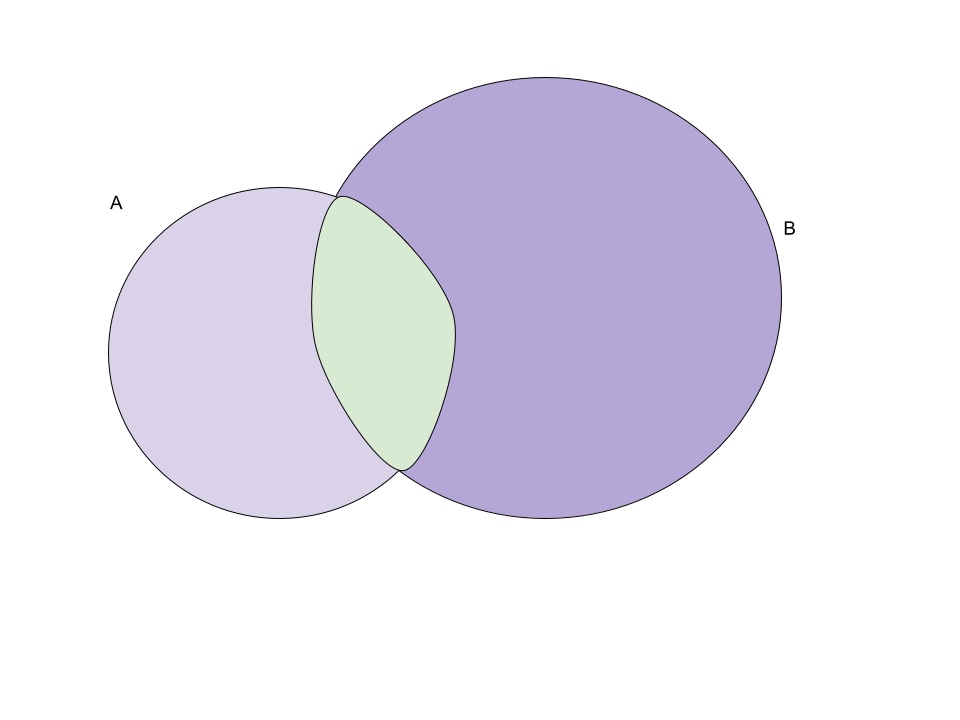
Two purple circles intersecting. The overlapping space is green.

Image source: by Anusha Rahman

In order to find the probability that A occurs given that B occurs, we must note that because B occurs, we must find what probability within circle B contains circle A. Both A and B occur within the shaded region in the above venn-diagram; the shaded region may be denoted as P(A∩B)P(A \cap B), or the "probability of A intersection B". As a result, to find the conditional probability of A given B, we must divide the probability that both A and B occur by the probability that B occurrs, yielding the equation P(A∣B)=P(A∩B)P(B)P(A | B) = \frac{P(A \cap B)}{P(B)}.

In order for the outcome of A to be independent of the outcome of B, the probability that A occurs overall must be the same regardless of the outcome of B. Therefore, we must know that for A to be independent of B, the probability of A must be equal to the probability of A given that B occurs. Mathematically speaking, P(A)=P(A∣B)P(A) = P(A | B) if A and B are independent events.

Read · 1 min

In probability, we say two events are independent if knowing one event occurred doesn't change the probability of the other event.

For example, the probability that a fair coin shows "tails" after being flipped is 12\frac{1}{2}. Let's think about what happens if we know that your favorite food is ice cream. Perhaps this changes the probability of getting "tails"! Nah.

Thus, "flipping tails on a fair coin" and "knowing your favorite food" are independent events.

Mathematically to check for independence the following expressions hold true.

  1. P(A∣B)=P(A)P(A|B) = P(A) or

  2. P(B∣A)=P(B)P(B|A) = P(B) or

  3. P(A∩B)=P(A)∗P(B)P(A \cap B) = P(A) * P(B)

such that

P(A∣B)=P(A∩B)/P(B)P(A | B)= P(A \cap B) / P(B)

Video

(Video) Conditional Probability and Independence

by Jalayer Academy

In this video by Jalayer Academy, you will learn about how to use conditional probability to determine independence.

Illustrated · 1 min

Using Conditional Probability to Determine Independence

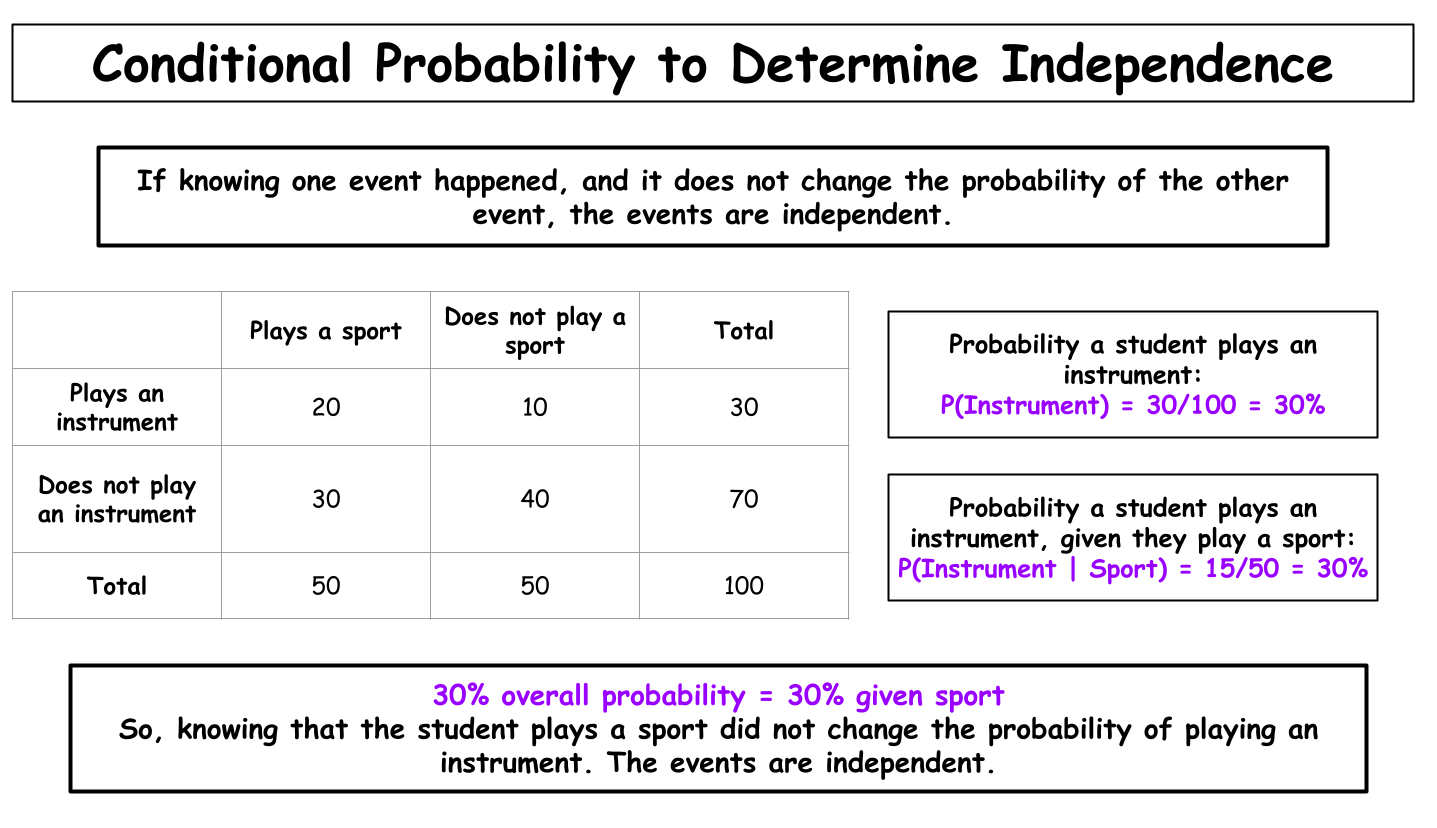
Conditional probability can help us decide whether two events are independent. Two events are independent when knowing that one event happened does not change the probability of the other event. You will use the same technique as before when finding conditional probability, using two way tables!

If knowing one event happened does not change the probability of the other event, the events are independent. Knowing that the student plays a sport did not change the probability of playing an instrument. The events are independent.

Image source: by Anusha Rahman

From the table, we see that 3030 out of 100100 students play an instrument. This means that the overall probability that a student plays an instrument is 30%30\%.

Next, we can find the probability that a student plays an instrument, given that the student plays a sport. Out of the 5050 students who play a sport, 1515 also play an instrument. This conditional probability is also 30%30\%.

Because the two probabilities are equal, knowing that a student plays a sport did not change the chance that the student plays an instrument. This tells us that playing a sport and playing an instrument are independent events.

In general, if the original probability and the conditional probability are equal, the events are independent. If the probabilities are different, the events are dependent.

Type a concept, like “slope” or “photosynthesis”.

↑ ↓ to choose · Enter to openSearch explanations and problems