Illustrated · 1 min
+1 contributors

Conditional probability is often used when finding the probability of some event A occurring given that another event B occurs. Mathematically, we can denote this in the form of .
As an example, let's take the venn-diagram below, where the entire probability of A occurring is denoted by the area of circle A, the probability of B occurring is denoted by the area of circle B, and the probability that neither A nor B occurs is denoted by the area of the square which does not cover the area of conjoining circles A and B.
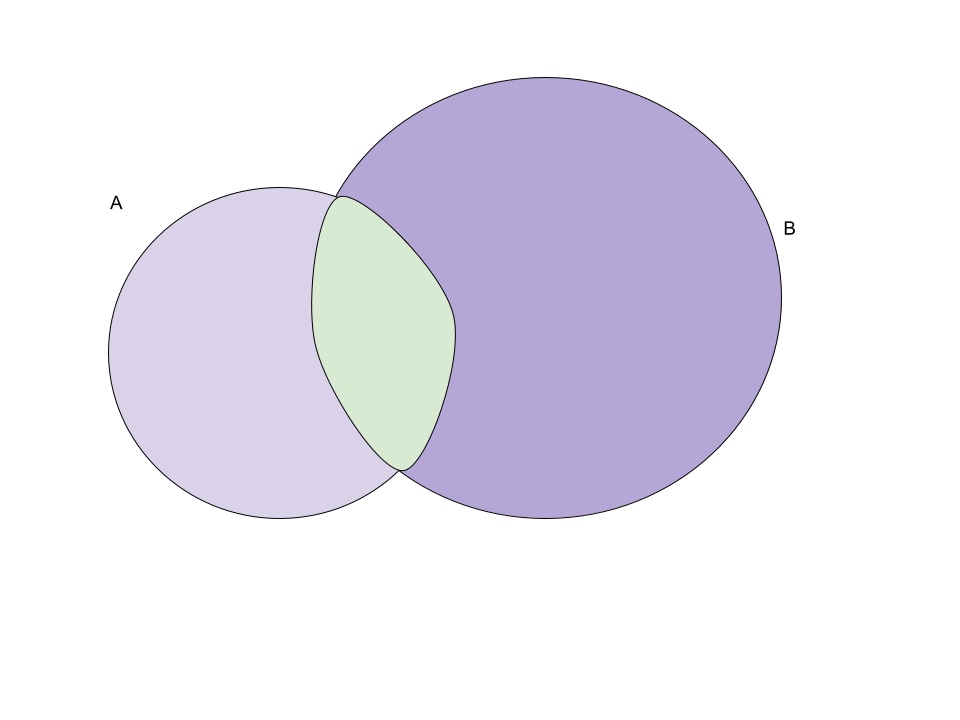
Image source: by Anusha Rahman
In order to find the probability that A occurs given that B occurs, we must note that because B occurs, we must find what probability within circle B contains circle A. Both A and B occur within the shaded region in the above venn-diagram; the shaded region may be denoted as , or the "probability of A intersection B". As a result, to find the conditional probability of A given B, we must divide the probability that both A and B occur by the probability that B occurrs, yielding the equation .
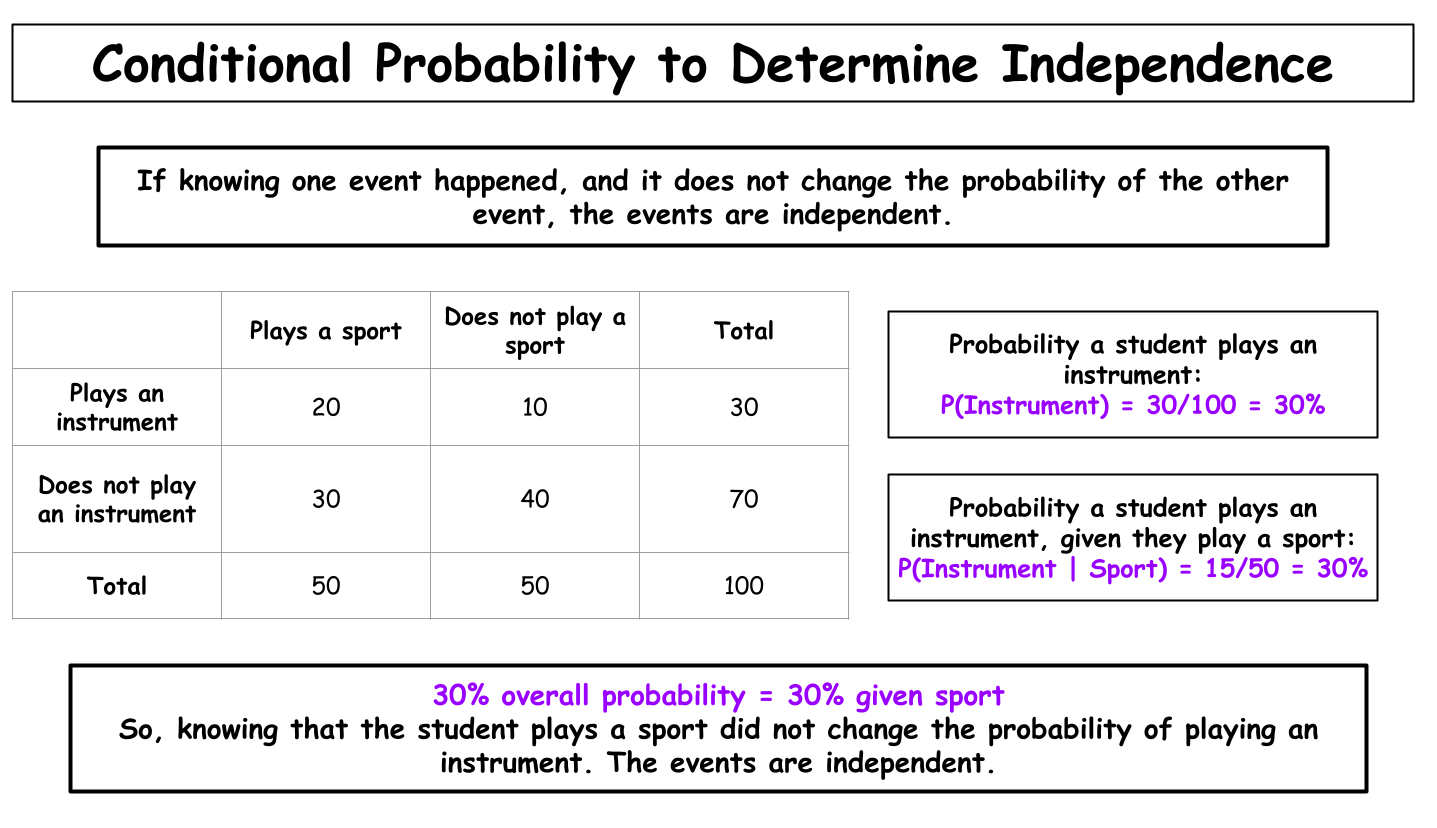
In order for the outcome of A to be independent of the outcome of B, the probability that A occurs overall must be the same regardless of the outcome of B. Therefore, we must know that for A to be independent of B, the probability of A must be equal to the probability of A given that B occurs. Mathematically speaking, if A and B are independent events.