
Illustrated · 1 min

We've learned a lot about parabolas previously, when we talked about quadratics. We know this topic really well. In this lesson, we will take the idea of quadratics a step further, to understand how parabolas are related to a cone.
Parabolas and Cones
Interestingly, parabolas come from the intersection of a plane and double cone. Here is an image of a parabola intersecting a cone.
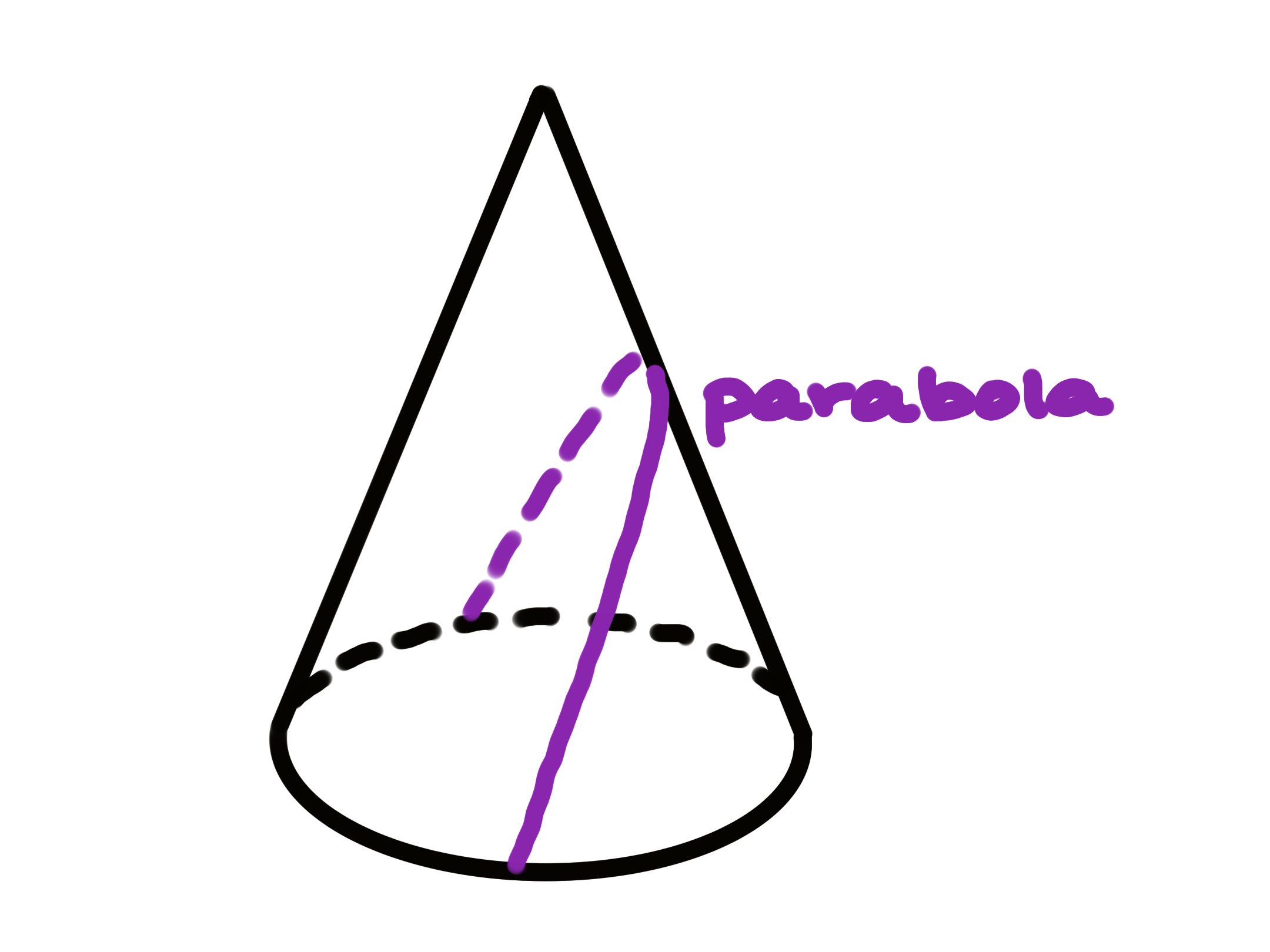
Image source: by Anusha Rahman
We can see this plane and cone intersect in a different image.
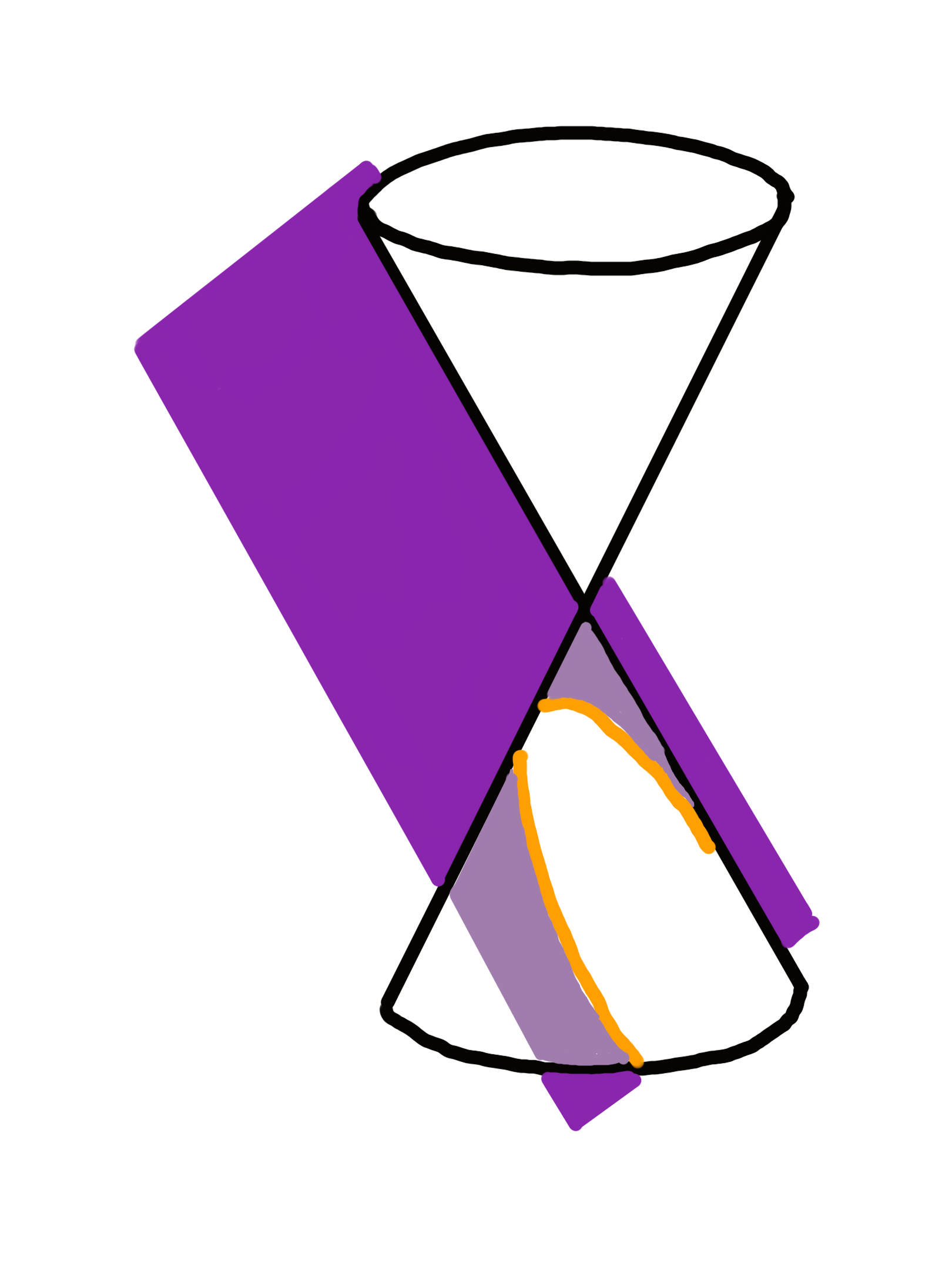
Image source: by Anusha Rahman
The orange line is what we typically think of as a parabola!
A parabola is a curved shape that you make by cutting a cone with a straight slice that is parallel to one side. A parabola has a special fixed point (called the focus) and a special line that helps to define its shape (called the directrix).
Every point on the parabola is the same distance from the focus of the parabola and the directrix. This is a special rule that makes the parabola curve perfect. We can measure that distance using the distance formula.
So, that means that if you pick any point on the parabola, the distance to the focus of the parabola is equal to the distance to the directrix. The point is called the solutions because it fits this rule. You'll get a set of all points that form the shape of the parabola. You'll learn more about this when we dive into graphing and transforming parabolas.
You might be wondering - the parabola needs to have an equation! The standard form of the parabola equation is:
To solve a problem with a parabola, we often draw a line segment from the point on the parabola to both the focus and the directrix to show the distances match.
In the next lesson, we will learn about the vertex and axis of symmetry for a parabola.


