Read · 3 min
+1 contributors

Ellipses: (almost) everything you need to know
Informal definition
You may have heard of the definition that an ellipse is an oval. You can't answer this with "an oval is an ellipse", because that is circular logic. We can, however, say that an ellipse is a stretched-out circle. We take two diameters of a given circle that are perpendicular to each other, and scale each by any positive real number (preserving the midpoints). Thus we have a stretched-out circle, or an ellipse.
Two formal definitions
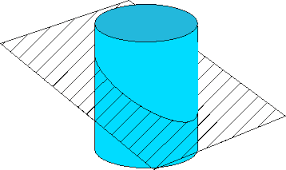
An ellipse can be defined in two ways. One is that it is any intersection of a plane with a double cone that is bounded. (Hyperbolas, parabolas, and the union of two lines are the unbounded intersections of a plane and a double cone). This allows for two special cases: a circle and a single point (which itself can be considered a degenerate case of a circle).
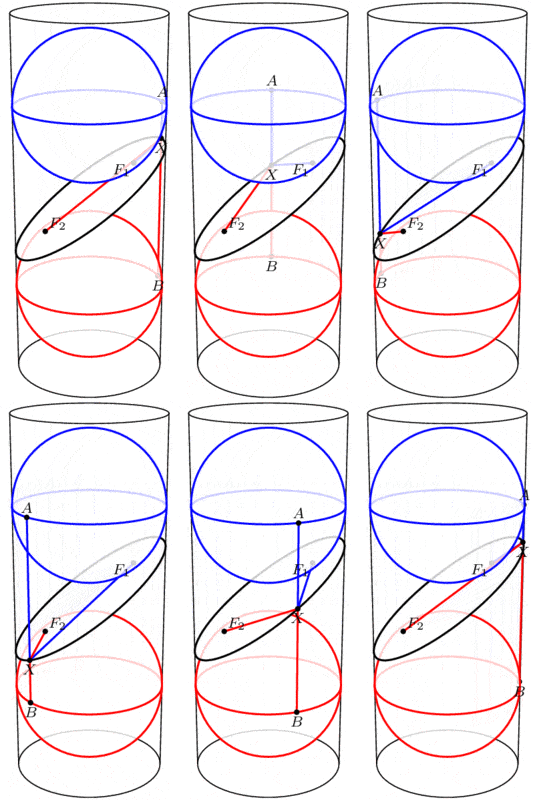
The second definition does not require leaving from the plane. Given two points in the plane (called foci, and denoted and ), and a positive real number (called the sum of focal radii, and denoted - you'll see why it's and not just ) that is greater than the distance between the two points, an ellipse is the set of all points such that .
Equation of an ellipse with foci on the axis and equidistant from the origin
We consider the simplest case: the foci are on the axis and the midpoint of is , so the foci have coordinates . We apply the distance formula:
The last step works because of the fact that we have , so therfore . Now, if we make the substitution , the familiar formula
arises.
Properties of an ellipse
In an ellipse, is the length of the major axis and is the minor axis. The distance beween the foci is , and satisfy . The chord perpendicular to the major axis at one of the foci is called the latus rectum, or the focal chord. It has length equal to (this can be shown easily by finding twice the positive value associated with the value .
More general equations
If you instead have the foci on the axis, then the distance formula yields an identical formula except and are switched.
If the midpoint of were to be translated to instead of , then and would be replaced by and respectively.
If is not parallel to one of the axes, then the equation gets a bit more challenging. First of all, an term will appear. The general equation for a conic section is . Not all of these are ellipses, obviously - in the case where , , , you have , which is obviously not an ellipse. In fact, a general conic section is an ellipse if and only if (here also called the discriminant) is less than .
Special Cases
Suppose describes an ellipse. Now, if and , this is still an ellipse (, but it's a special ellipse - it's a circle. In this case the distance between the foci is , so the length of the minor axis is equal to that of the major axis.
A degenerate case appears when you have a circle, , but specifically when . In this case, the square is already completed - after combining terms you get . In this case, the conic is a circle with radius , or a single point. This is a degenerate conic section and is often not listed by textbooks to be one of the cases of conic sections.