Conservation of Genetic Material — DNA Replication

Before this, knowDNA Structure — Overview & Diagrams

Illustrated · 1 min

DNA Replication

DNA is the genetic material of all living things. All organisms store their genetic information using the same four nitrogen bases as we do.

It turns out that DNA is also highly conserved. The conservation begins during DNA replication.

Originally, there were three classical models of DNA replication proposed.

The Conservative Model

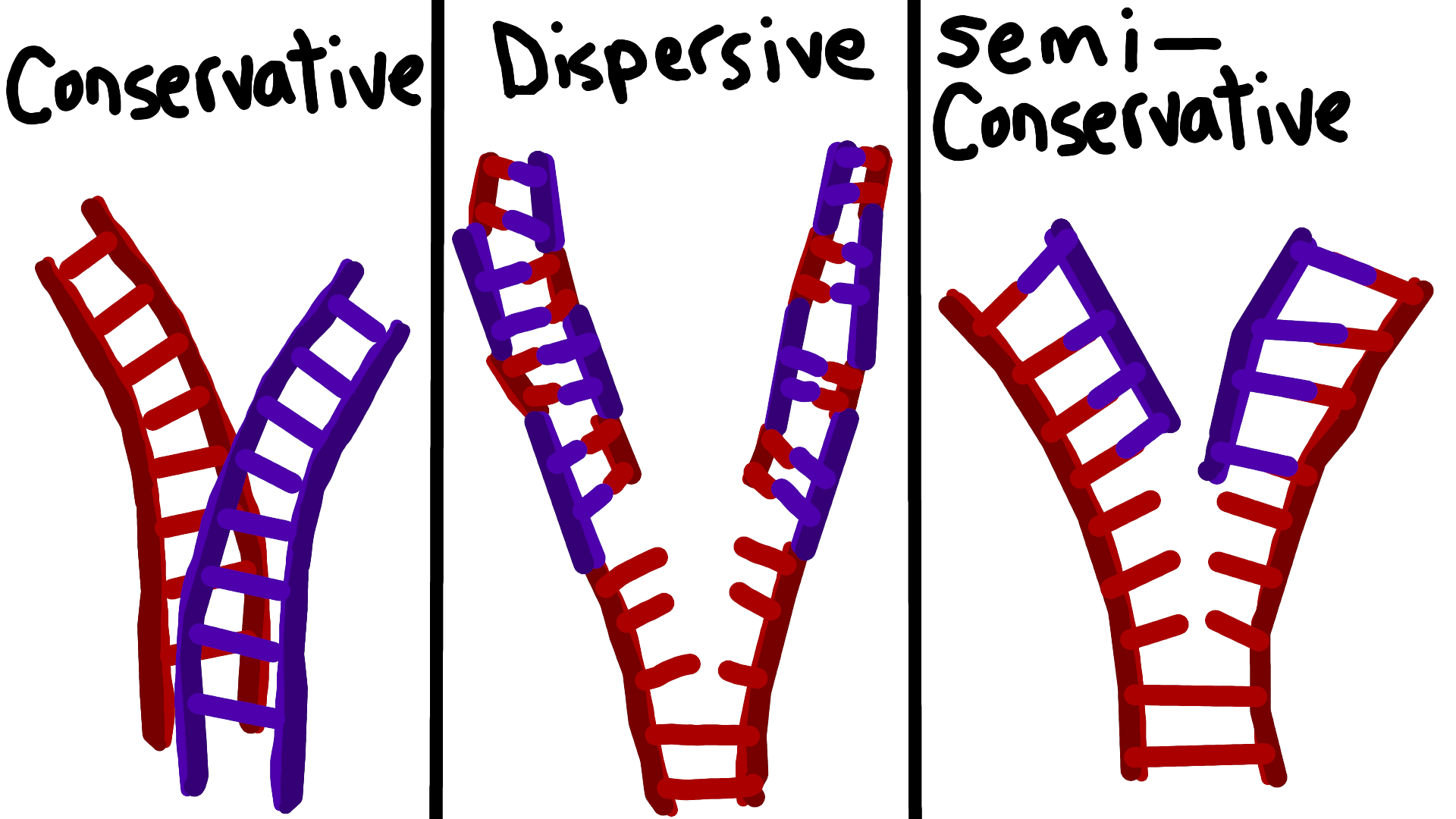
The conservative model hypothesized that each of the two strands of DNA acted as templates to create two new strands. The original strands reconnected after replication so that there was a DNA molecule containing the two original strands, and a DNA molecule containing two new strands.

The conservative model of DNA replication

Image source: By Gabi Slizewska

Dispersive Model

The dispersive model suggested that the original DNA molecule was broken into small, double-stranded fragments which served as templates. The result was two DNA molecules with pieces of the original DNA as well as the newly synthesized DNA throughout the structure.

The dispersive model of DNA replication

Image source: By Gabi Slizewska

The Correct Model: The Semi-Conservative Model

The third model turned out to be correct. The semi-conservative model proposed that the two DNA strands unwind, and each one serves as a template to synthesize a new complementary strand. This way, the result was two DNA molecules, each consisting of one original strand, and one newly synthesized strand.

This is only possible because of the complementary nature of base pairs.

The semiconservative model of DNA replication

Image source: By Gabi Slizewska

Illustrated · 2 min

How Is the Replication of DNA Conservative?

So we know that DNA has to replicate somehow. But what kinds of patterns does the DNA strand follow when it copies itself?

The image shows the three hypothesized methods of DNA replication: conservative, dispersive, and semi-conservative.

Image source: By Sarah Morgan

Originally, there used to be three hypothesized methods of DNA replication.

The first method, conservative replication, had the DNA strand completely conserved. Two old DNA strands stuck together, and two new DNA strands were synthesized and stuck together. The old and new DNA did not bind to one another.

Another method, dispersive replication, did have old and new DNA binding to each other. However, the old DNA strands would break up into many small parts. Then, new DNA would be synthesized off of those parts. This would create new DNA that was made of many scattered segments of old and new DNA.

The third method, semiconservative replication, had old DNA separating in two, having new DNA synthesized off of it, which then resulted in DNA that was half old and half new.

What Was the Meselson-Stahl Experiment?

The semi-conservative replication method was found to be correct. In their experiment, heavy isotopes of nitrogen were used to track where old, or template, DNA strands went. Since DNA contains lots of nitrogen, it was easy to replace it with a heavier isotope. After a few rounds of DNA replication, the DNA was collected and tested for density.

If the replication was completely conservative, the DNA strands would either be 100% heavy nitrogen or 100% normal nitrogen. However, the experiment found that the DNA strands were half heavy nitrogen and half normal nitrogen. This meant that the replication could be either semi-conservative or dispersive.

So, they waited a while longer and took the measurements again. If the system was dispersive, the DNA would all weigh the same, as the heavy nitrogen would average out as the DNA fragments were dispersed. However, they found that some DNA was half heavy nitrogen and half normal nitrogen, while others were all normal nitrogen. This proved that replication was semi-conservative. Remember, over time, new DNA strands become template strands that are copied into even newer DNA strands. If a parent strand was one heavy and one normal strand, and the normal strand was used as a template, the new strand will be two normal strands.

Video

(Video) The Most Beautiful Experiment in Biology: Meselson & Stahl, The Semi-Conservative Replication of DNA

by YourekaScience

What Was the Meselson-Stahl Experiment?

DNA replication is a semi-conservative process. Scientists figured this out using the Meselson-Stahl experiment. Before this discovery, there were many hypotheses about how DNA is replicated. You can learn about how semi-conservative replication was proven by Meselson and Stahl in this video.

Type a concept, like “slope” or “photosynthesis”.

↑ ↓ to choose · Enter to openSearch explanations and problems