Illustrated · 1 min

+2 contributors


DNA Replication
DNA is the genetic material of all living things. All organisms store their genetic information using the same four nitrogen bases as we do.
It turns out that DNA is also highly conserved. The conservation begins during DNA replication.
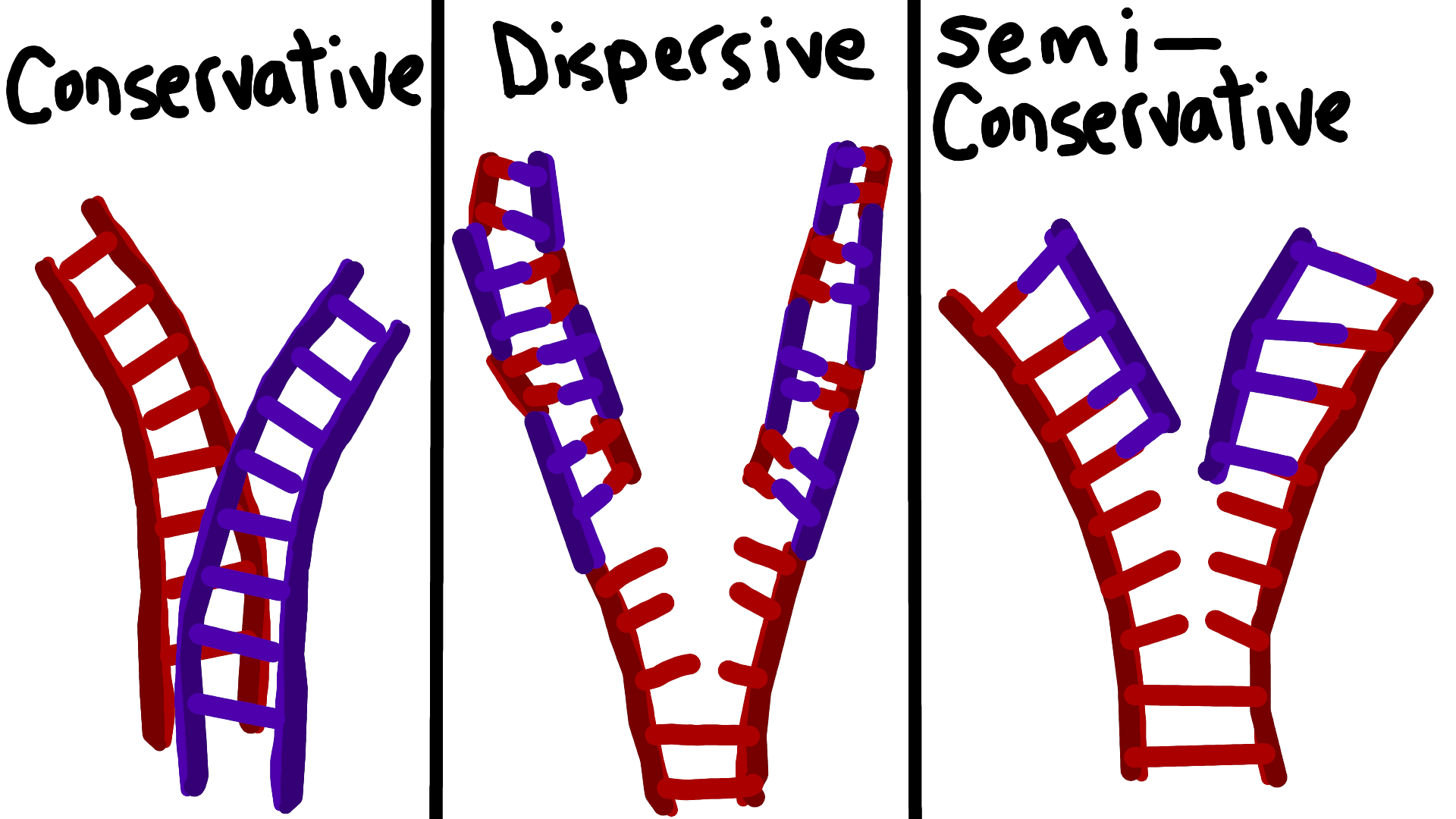
Originally, there were three classical models of DNA replication proposed.
The Conservative Model
The conservative model hypothesized that each of the two strands of DNA acted as templates to create two new strands. The original strands reconnected after replication so that there was a DNA molecule containing the two original strands, and a DNA molecule containing two new strands.

Image source: By Gabi Slizewska
Dispersive Model
The dispersive model suggested that the original DNA molecule was broken into small, double-stranded fragments which served as templates. The result was two DNA molecules with pieces of the original DNA as well as the newly synthesized DNA throughout the structure.

Image source: By Gabi Slizewska
The Correct Model: The Semi-Conservative Model
The third model turned out to be correct. The semi-conservative model proposed that the two DNA strands unwind, and each one serves as a template to synthesize a new complementary strand. This way, the result was two DNA molecules, each consisting of one original strand, and one newly synthesized strand.
This is only possible because of the complementary nature of base pairs.

Image source: By Gabi Slizewska