Construction: Perpendicular Bisector

Interactive · 2 questions

Let's say I have a circle ω\omega with center OO.

And a chord ABAB.

Now make a perpendicular line from OO to ABAB

If the length of ACAC is 7 units, what do you think will be the length of CBCB?

Choose one answer

Interactive · 1 question

While we solve geometry problems, it is very pertinent to draw a diagram so that we can make up our mind about what does the question want. In this article we are going to talk about how to construct a perpendicular line.

Prior to start the messy work (maybe it's not that messy?), you need: a compass, a ruler and of course, a paper.

Are you ready?

Choose all correct answers

Interactive · 1 question

Example Walk Through: How to Construct a Perpendicular Bisector \\

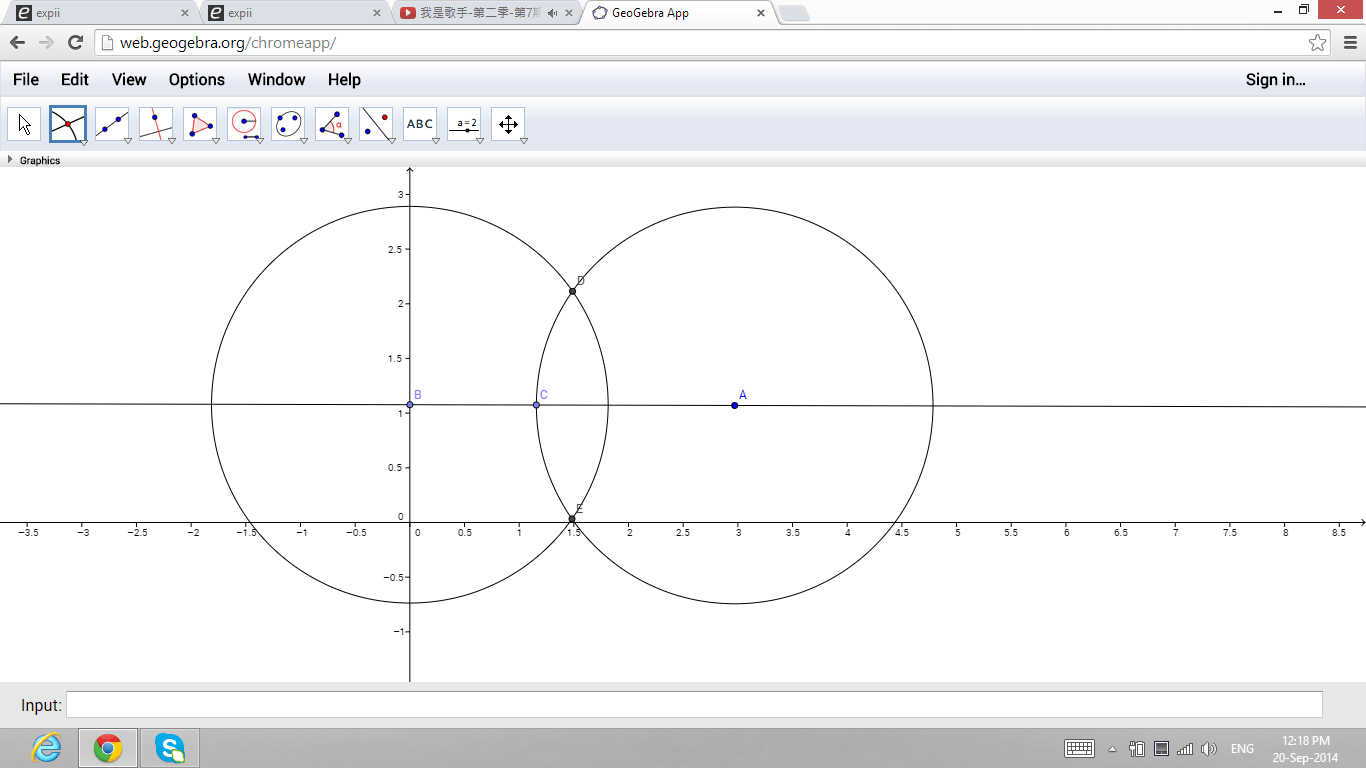
Can we find the perpendicular bisector of a line segment without measuring to find the midpoint and right angle?

Let's start with line segment AB.

Use one end of the line segment as the center and make a circle (Let's start with A here).

Estimate and make sure the radius is bigger than half of the line segment.

Create another circle with the same radius, this time with B as the center.

You can also do the above step but create arcs, instead of circles.

Connect the intersection, and you have the perpendicular bisector!

If you want to see why this method works, read **Walk through: Why does the construction method work? **

When we create the circles (or arcs), why does the radius have to be bigger than half of the line segment? Choose the best answer.

Choose one answer

Illustrated · 1 min

Walk through: Why does the construction method work? \\

To see how to construct a perpendicular bisector, read Example Walk Through: How to Construct a Perpendicular Bisector.

Let's start from the beginning.

Connect the intersections of the arcs/circles, we get the perpendicular bisector.

Connect some more lines to help us out

Connect the two end points of the line segment and the intersections. The four new line segments are equal because they are all radii of the two circles (with the same radius!)

Now to show that CD‾\overline{CD} is a perpendicular bisector of AB‾\overline{AB}, we show the two properties: perpendicular and bisector, separately.

First, let's show perpendicularity

This part is a bit tricky. We rely a lot on the fact that the sum of 3 angles in a triangle is 180 degrees.

Next, show that CD‾\overline{CD} is a bisector of AB‾\overline{AB}

Type a concept, like “slope” or “photosynthesis”.

↑ ↓ to choose · Enter to openSearch explanations and problems