Sometimes you will be given quantities with different units of measure (e.g. metric units), in different measurement systems (e.g the imperial system of measure, the International System of Units, the metric system, the customary system), and asked to compare them. For these types of problems, use unit rates to follow these two steps:
Do a conversion between measurement systems so that all quantities have the same units.
Marie is 65.75 inches=167.005 cm tall, and Jane is 162.56 cm tall.
167.005 cm>162.56 cm
Thus, Marie is taller! More importantly, Jane is shorter!
Find your level
The problems run from approachable to very hard, and each is rated by how often real students solve it, so you can pick your next step. These are real problems from the AMC 8 and AMC 12, the national math competitions for middle and high school students, each with a worked solution on LIVE by Po-Shen Loh.
Most of the time, a measurement problem is going to ask you a more involved question than just a conversion. This means that you might have to do a conversion or two and then think about what the problem is asking you in order to find the correct answer. Here is an example.
Example 1
You buy 30 pounds of ground beef. You make 20 hamburgers, using 80 ounces of the meat. How many hamburgers can you make with the remaining ground beef?
Solution
First, we should convert pounds into ounces. There are 16 ounces in 1 pound. That means, we can make the following conversion.
30 pounds×1 pound16 ounces=480 ounces
Now, we know there are 480 ounces of ground beef in total. You made 20 hamburgers using 80 ounces of beef. We want to find how many ounces of beef are used to make one hamburger. We see,
20 hamburgers80 ounces=4 ounces per hamburger
Now, find how many ounces of beef we have left after those 20 hamburgers. We find that by subtracting 80 from 480.
480−80=400
Finally, to find how many hamburgers we can make with the remaining meat, we see, 400 ounces of meat×4 ounces1 hamburger=100 hamburgers
Example 2
Let's try another similar problem.
A road is 5 miles long. Car's are 177.2 inches long. How many cars can fit on the road?
(Assume the cars are touching each other so there is no space between them).
Solution
To solve this problem, the first thing we should do is convert 5 miles into inches.
5 miles×1 mile5,280 feet×1 foot12 inches=316,800 inches
The road is 316,800 inches. Now, we divide that number by the length of the car to see how many cars fit on the road.
316,800 inches×177.2 inches1 car=1,787.8 cars
Now, let's do one more kind of problem where we are comparing different measurements.
Example 3
Alexis can run 1 mile in 15 minutes. Ryan drives 70 yards in 60 seconds. Derek rides his scooter 3.41 miles in 1 hour. They are trying to get to school on time.
Who arrives at school first?
Solution
Alexis arrives to school first. To solve this problem, convert each distance per time into the same units, so they are easier to compare.
First, we will calculate Alexis's distance per time in miles per hour.
15 minute1 mile×1 hour60 minutes= hour4 mile
Now, let's calculate Ryan's distance per time in miles per hour.
60 seconds70 yards×1 hour3,600 seconds×1 yard3 feet×5,280 feet1 mile=hour2.39 miles
Derek's distance per time is given as 3.41 miles per hour. The person going the fastest is Alexis, so Alexis arrives at school first.
There are many unit conversions and rates that we know and use every day, probably without thinking about them.
If someone asked you to wait 60 seconds, you'd know they were asking you to wait 1 minute. This is because you know that there are 60 seconds per minute.
Also, if someone said that their baby was exactly 1 year old, you'd know that the child has been alive for 365 days. This is because you know that there are 365 days per year.
Seconds to minutes can be a simple, everyday conversion.
Image source: By OpenClipart-Vectors CC0 via pixabay.com
Image source: By Clker-Free-Vector-Images CC0 via pixabay.com
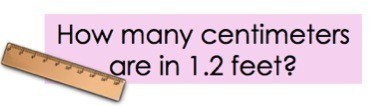
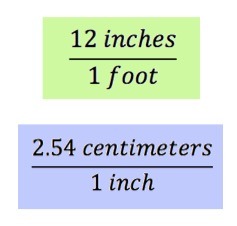
To solve a problem like this, it's important to write down all of the conversions that will be useful:
Image Source: Hannah Bonville
Notice how we can write these rates as fractions. Think of the line separating the numerator and denominator as meaning "per."
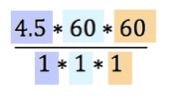
Next, what we need to do is line up the value in the original question (4.5 hours) with each of our conversions. We'll do this in a way that allows us to cancel out units.
Take a look:
Image Source: Hannah Bonville
If you look below, you'll see how we can cancel out some of the units. Notice how the only units that remain after all of the canceling (in red and in yellow) are seconds—the units we need in our answer.
Image Source: Hannah Bonville
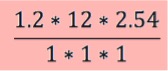
Now, we can clean up and re-write what we've got, so we can finish up:
Image Source: Hannah Bonville
When we multiply across our fraction, what is the result?
Say you need to convert between units in two measurement systems. You can do this conversion by using ratios!
Let's walk through an example of converting between kilometers and miles. We need to first figure out how many kilometers are in a mile (or vice versa), then set up a strategy to convert between the two units.
1.609 kilometers is 1 mile
There are different approaches to converting between the two. Figure out which one you like best and use it! I will present the ratio + cross product method.
Ratio + Cross Product
This method includes expressing the relationship in a ratio and setting up a cross product.
First, express the relationship with a ratio:
1.609 km1 mile
Set up the cross product. All you have to do is put in actual numbers or variables in front of miles and km in your second ratio! If you want to know how many miles is 5 km, you write:
1.609 km1 mile=5 kmx miles
Then solve the cross product! You can dismiss the words to make the ratios simpler, if you want.
1.6091x⋅1.6091.609xxx=5x=5⋅1=5=1.6095≈3.11
So, 5 km≈3.11 miles.
Canceling Units
Another method I use is "canceling units." Think about what unit you need and what unit you have, and try canceling units out (with the right ratio, of course). I use this for more complicated unit conversion problems as well.
Say we want to find out how many miles in 5 km.
We need to find out what the conversion ratio (or rate) is. Do we multiply 5 by 1.609 or do we divide by 1.609? Looking at the equation, we want to cancel out km, and end up with mile. Therefore:
Putting this in the equation:
Image Source: Christine
Now all you have to do, is calculate! the answer is approximately 3.11 miles.
For example he shows how to convert 5 feet to meters. (Feet are from the imperial system, and meters are from the metric system.) To set up conversion tables, you first list the initial known measurement.
5 ft
Then, add a conversion between feet and a different unit. We know 1 foot equals 12 inches. Since feet were previously in the numerator, the next conversion has to have feet in the denominator so the units will cancel out. So we use 1 foot12 inches.
5 ft12 in1 ft
Next, add the conversion between inches and centimeters. This is known to be 1 inch per 2.54 centimeters. As we did before, since inches were previously in the numerator, the new conversion needs to have inches in the denominator. So 1 inch2.54 centimeters.
5 ft12 in1 ft2.54 cm1 in
Lastly, we need to convert a centimeter to a meter. There are 100 centimeters per 1 meter. So 100 centimeters1 meter. (Notice how cm are in the denominator since they were previously in the numerator.)
5 ft12 in1 ft2.54 cm1 in1 m100 cm
Now that the table is set up, you can begin by canceling out units. Once you do that, simply multiply and divide the numbers. Keep the unit that is not canceled out — that is the unit you are trying to find!
5 ft12 in1 ft2.54 cm1 in1 m100 cm51212.5411 m100=1⋅1⋅1005⋅12⋅2.54⋅1 meters=100152.4meters=1.524 meters
Test Yourself
Convert 122 miles to meters. Round to the nearest whole number. (Hint: Use 1 mile≈1.609 km.)
Let's set up our conversion.
122mi1.609 km1 mile1000 m1 km
The last step is to multiply across the top
122⋅1.609⋅1000=196298 m