Converting Between Radians and Degrees

Before this, knowWhat Is the Unit Circle?

Interactive · 1 question

Radians

A radian is another way to measure an angle.

How many Radii can fit in the circumference of a circle?

Choose one answer

Illustrated · 1 min

Degrees

Angles are measured in degrees. For example, a right angle is 90°. A right angle is 1/4 of a circle, or a full rotation, which is 90°x4=360°.

Radians

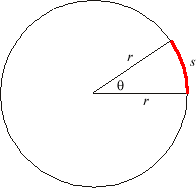
One radian is what we get when we take the radius of the circle and wrap it around the circle.

In this diagram, r is the length of the radius of the circle. The arc r is the same measure as radius r. Thus, the angle formed by the two radii is one radian, or 57.2958...°.

A fancy way to say this is: Arc r subtends the angle with measure 57.2958...°.

Let's look at the bigger picture.

A circle

Image source: by Ankita

If arc r subtends the angle that measures one radian, then think about what angle, in radians, the circumference of the circle subtends.

The circumference of the circle is equal to 2π\pir. If radians are the angle measures that arcs subtend, then the measure of the circumference is 2π\pi radians. This means that half a circle, or 180°, is π\pi radians.

180/π\pi=57.2958...°!

We now can convert between radians and degrees!

Conversions

180° = π\pi radians

90°= π\pi/2 radians

270° = 3π\pi/2 radians

To convert an angle in degrees to radians, we must multiply by π\pi/180.

360°x π\pi/180 = 2π\pi

And to convert from an angle in radians to degrees, we flip π\pi/180 to get 180/π\pi.

2π\pix180/π\pi=360°

Video · + 1 min read

(Video) Converting Degrees to Radians

by Brian McLogan

This video by Brian McLogan walks you through how to convert from degrees to radians.

Summary

To start, we know that the first two quadrants (i.e., all positive yy values) is 180∘180 ^{\circ}. We also know that that same area is 2π2\pi radians.

π180∘\frac{\pi}{180 ^{\circ}}

If we want to convert 30∘30 ^{\circ} to radians, we are going to multiply it by the ratio and simplify:

30∘⋅π180∘=30π180=π6 radians30 ^{\circ} \cdot \frac{\pi}{180 ^{\circ}} = \frac{30\pi}{180}= \frac{\pi}{6} \text{ radians}

This works because the degrees will cancel out, leaving us with just radians.

Now we know that 30∘=π6 radians30 ^{\circ} = \frac{\pi}{6} \text{ radians}

(Video) Converting Radians to Degrees

by Brian McLogan

This second video by Brian McLogan walks through an example of how to convert from radians to degrees.

Summary

We know that quadrants I and II are 180∘180 ^{\circ} or 2π radians2\pi \text{ radians}. We can use the ratio 180∘πradians\frac{180 ^{\circ}}{\pi \text{radians}} to convert from radians to degrees because the radian units will cancel out.

5π4⋅180∘πradians=5⋅180⋅4=22.5⋅\frac{5\pi}{4} \cdot \frac{180 ^{\circ}}{\pi \text{radians}} = \frac{5 \cdot 180 ^{\cdot}}{4} = 22.5 ^{\cdot}

Using this ratio, we found that 5π4\frac{5\pi}{4} radians is 22.5⋅22.5 ^{\cdot}.

Illustrated · 1 min

Converting Between Radians and Degrees

Our next step is to learn how to convert between radians and degrees.

Radians > Degrees
radians = 180/pi

Degrees > Radians
degrees = pi/180

Image source: by Anusha Rahman

If we want to convert from radians →\rightarrow degrees,

degrees=radians⋅180∘π\text{degrees} = \text{radians} \cdot \frac{180^{\circ}}{\pi}

To go the other way, if we want to convert from degrees →\rightarrow radians,

radians=degrees⋅π180∘\text{radians} = \text{degrees} \cdot \frac{\pi}{180^{\circ}}

Type a concept, like “slope” or “photosynthesis”.

↑ ↓ to choose · Enter to openSearch explanations and problems