Interactive · 1 question
Converting Mass of Reactant to Mass of Product
We've been studying stoichiometry. Stoichiometry is the correlation between different quantities of reactants and products. So, for any chemical reaction, we can use math to calculate how much of the product was produced from the reactants! In many ways, it's just a fancy application of dimensional analysis.

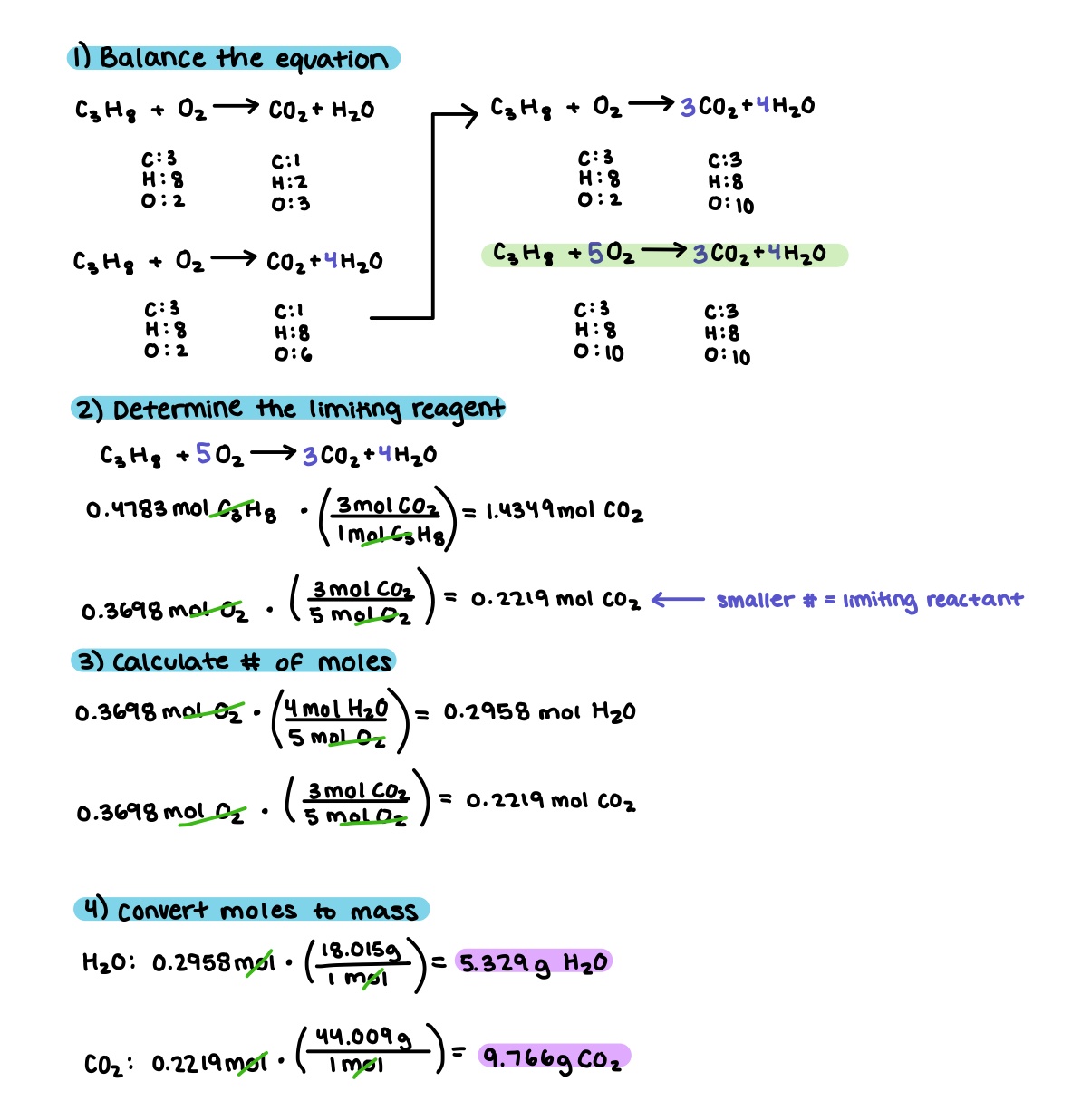
Image source: By Caroline Monahan
Steps on how to convert moles of reactants to moles of products:
-
Make sure the chemical equation is balanced!
-
Determine which reactant is the limiting reagent .
-
Use the limiting reactant to convert from moles of reactants to moles of products.
-
Use the molar mass to convert the moles of product to mass.
Walkthrough on How to Convert Mass of Reactants to Mass of Products
A scientist reacts 5.762 grams of the organic compound methane () with 3.117 grams of diatomic oxygen gas (). The reaction produces carbon dioxide gas () and water (). What are the products' masses?
+ → +
As a side note, does your house uses natural gas? If so, this is the reaction your furnace uses to generate heat. Combustion is an exothermic reaction. So, it releases energy as heat. In chemistry, we call the heat, enthalpy. In future lessons, we'll learn to calculate enthalpy. Anyway, the heat increases the temperature of a heat exchanger. The furnace's fan then blows air past the heat exchanger and on through the house's ductwork. What's the result? Nice warm air comes out of the vents.
1) Make sure the chemical equation is balanced
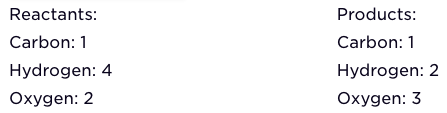
We don’t have equal numbers of each element on each side of the equation. So, before proceeding, we have to balance the equation.
We have four hydrogens in the reactants but only two in the products. How do we balance the hydrogen atoms? Water is the only product with hydrogen. Remember, in the molecular formula, the subscript only applies to the preceding element. So, let's add a coefficient of two in front of the water ().
+ → +
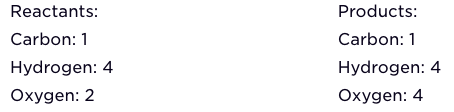
Now we still need to balance the oxygens. There are four oxygens in the products but only two oxygens in the reactants. Let’s fix this by adding a coefficient of two to the reactant side (2).
+ → +
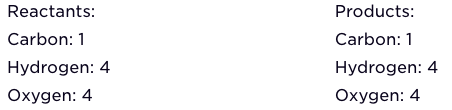
Perfect! The equation is balanced!
2) Using the chemical equation and the information given in the problem, we can now determine the limiting reactant.
Reminder: The problem states that the scientist reacted 5.762g with 3.117g of .
+ → +
To find the moles of each reactant, we need the molar mass. Remember, you can calculate the molar mass by summing the atomic masses of each element. You can find the atomic masses on the periodic table.
Molar Mass of : 16.04 g/mol
Molar Mass of : 31.998 g/mol
Moles of and :
: = 0.3582 mols
: = 0.09741 mol
Now, we can determine which reactant is the limiting reactant. How? By calculating the moles of product. Whichever reactant produces the least amount of product is the limiting reactant. In this case, let's calculate the moles of water produced.
: = 0.7164 mol
: = 0.09741 mol
produces less than . So, is the limiting reactant!
3) Use the limiting reactant to determine the number of moles of product that can form!
= 0.04871 mol
= 0.09741 mol
4) Use the product's molar masses to convert from moles to mass (in grams).
Molar Mass : 44.009 g/mol
Molar Mass : 18.015 g/mol
: = 2.144 g
: = 1.755 g
Now we are finished! In this reaction the scientist can produce 2.144 g and 1.755 g .
Now try a practice problem!
A student reacts 0.4783 mols with 0.3698 mols to produce and how grams of products was produced?
+ → +