Sometimes, in a chemical reaction, our reactants are in the gas phase. But, how much gas do we have? Remember, gases are expandable and compressible. So, they fill their container. We need a way of calculating how much gas we have. Sometimes, one of our products is a gas. So, you can recognize the chemical reaction by the bubbles. We often want to trap the gas and determine how much we produced.
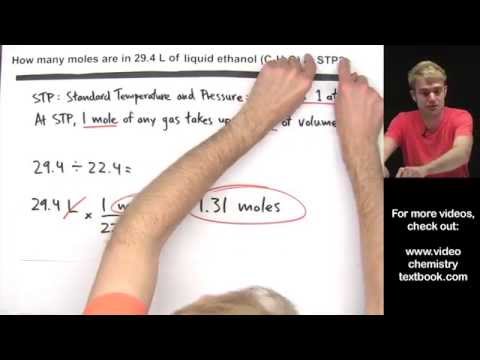
What is the volume of one mole of gas? The answer is 22.4 liters. Does this surprise you? You might think that it depends on the element or molecule. But all ideal gasses have the same volume if the temperatures and pressures are the same. In chemistry, we have a standard reference temperature and pressure. We creatively call it the "standard temperature and pressure" or STP. STP is one atmosphere and zero degrees celsius.
But why does one mole of any gas have the same volume? Let's look at the four gas laws. Charles' law tells us that changing the temperature of a gas changes its volume. Boyle's law stated that changing a gas's pressure changed its volume. The Gay-Lussac law connected that a gas's pressure is proportional to its temperature. Finally, Avagadro recognized that the volume of a gas is dependent on the number of moles.
If you combine the four gas laws into one equation, you get the ideal gas law. The ideal gas law is PV=nRT, where P is pressure, V is volume, n is the number of moles, R is the gas constant, and T is the temperature. Let's rearrange the ideal gas law to nV=PRT. When we do the rearrangement, we have volume per mol. If we are at STP, the volume per mol is the same for all ideal gasses! That is why all ideal gasses have 22.4 molL.
Converting Moles to Volume
Now that we know there are 22.4 molL, it is easy to find the volume. Multiply the number of moles by 22.4 L/mol. But what if you forget the conversion? That's okay, don't panic! Use the ideal gas law to find the volume. Also, remember that the 22.4 molL is at standard temperature and pressure. So, if you are not at STP, you have to use the ideal gas law.
If you need help visualizing the conversion, look at the mole roadmap.