Cotangent Function

Read · 1 min

Cotangent

Cotangent is simply the reciprocal of tangent; in mathematical notation, cot⁡θ=1tan⁡θ\cot{\theta}=\frac{1}{\tan{\theta}}.

Since tan⁡θ=Opposite SideAdjacent Side\tan{\theta}=\frac{\text{Opposite Side}}{\text{Adjacent Side}}, the reciprocal would be cot⁡θ=Adjacent SideOpposite Side\cot{\theta}=\frac{\text{Adjacent Side}}{{\text{Opposite Side}}}.

Strategies involving Cotangent

As with inverse trig functions, it is often useful to convert cotangents into tangents, by replacing cot⁡expression\cot{\rm expression} into 1tan⁡expression\frac{1}{\tan{\rm expression}}.

Illustrated · 1 min

The Cotangent Function

The next in our series of trigonometric functions is the cotangent function! This function is part of our group of functions, the trigonometric functions. These functions help us to understand angles and triangles.

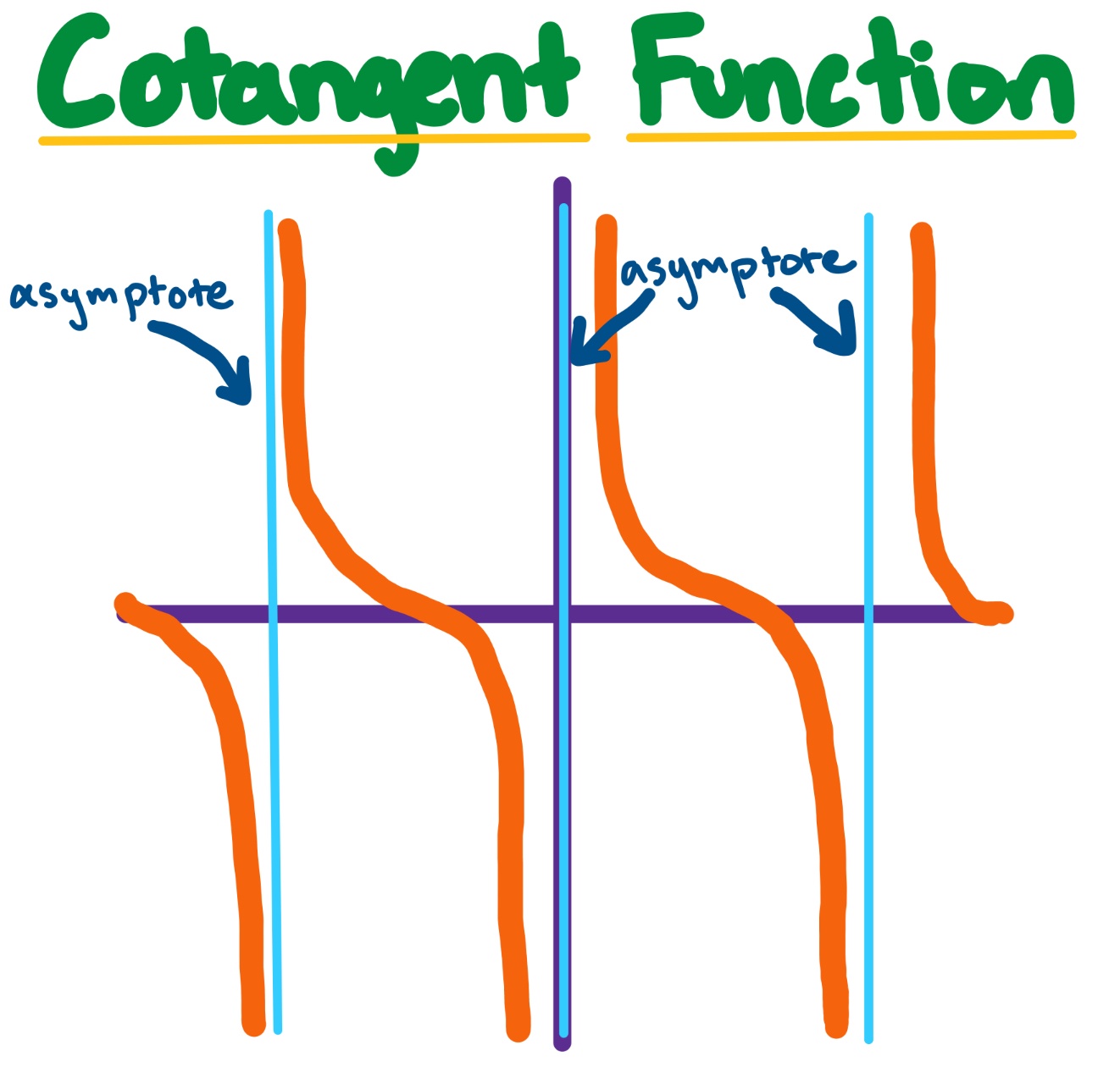
Cotangent Function

Graph of the cotangent function

Image source: by Trisha

Cotangent is the reciprocal of the tangent function. In a right-angled triangle, the ratio of tangent is opposite:adjacent\text{opposite} : \text{adjacent}.

The reciprocal of this ratio is the cotangent: adjacent:opposite\text{adjacent} : \text{opposite}.

Cotangent is written as cot(θ)\text{cot}(\theta), where θ\theta (theta) is the angle. Cotangent is the reciprocal of tangent. Let's see what that means mathematically:

cot(θ)=1÷tan(θ)=cos(θ)÷sin(θ)\text{cot}(\theta) = 1 \div \text{tan}(\theta) = \text{cos}(\theta) \div \text{sin}(\theta)

We use cotangent when working with right angles or in graphing curves. Cotangent goes up and down in a repeating pattern, similar to what we've seen with sine and cosine. Unlike sine and cosine, though, cotangent has vertical asymptotes, usually when sine is zero.

You can also use the unit circle to find cotangent.

Video

(Video) Graphing the Cotangent Function

by Brian McLogan

In this video by Brian McLogan, you will learn how to graph the cotangent function.

Summary

Graph y= cot (x2)y=\text{ cot }(\frac{x}{2})

With cotangent, we are not as concerned with the amplitude. We are concerned with the period, though. We know that the period of the function is πb=π12=2π\frac{\pi}{b} = \frac{\pi}{\frac{1}{2}} = 2\pi.

In the parent function of cotangent,  cot (x)\text{ cot }(x), the vertical asymptotes are x=0x=0 and x=πx=\pi. Because we are changing what is inside of the parentheses, we are also changing the vertical asymptotes. We calculated earlier that the period is 2π2\pi, so we know that our vertical asymptotes are at x=0x=0 and x=2πx=2\pi.

Now we need to tackle the xx-intercept. We can find the first xx-intercept by dividing the period, 2π2\pi by 22. So, our xx-intercept is at π\pi.

Ultimately, our graph looks like:

Graph of y=cot(x/2)

Made using Desmos

Type a concept, like “slope” or “photosynthesis”.

↑ ↓ to choose · Enter to openSearch explanations and problems