
Illustrated · 1 min
By Gabi Slizewska

+1 contributors
Contributors

Sharing Electrons
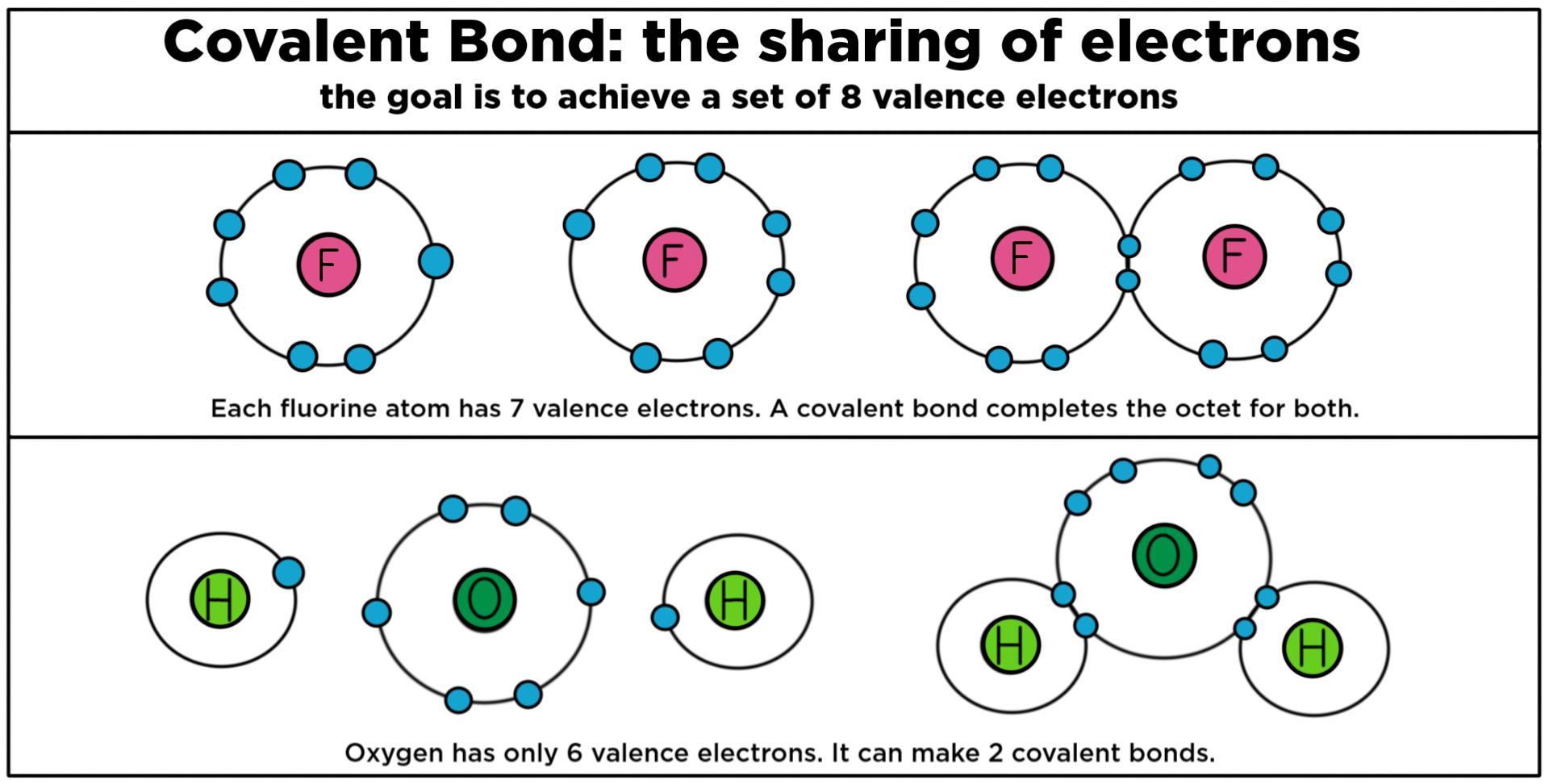
Image source: By Gabi Slizewska
Illustrated · 1 min
Image source: By Gabi Slizewska
Interactive · 1 question
Covalent bonds form when atoms share electrons. That sounds weird, I know. Basically, what this means is that the electron travels around the nuclei of both atoms involved in the bond.

Image source: By Drago Karlo CC BY-SA 4.0, via Wikimedia Commons

Image source: By Drago Karlo CC BY-SA 4.0, via Wikimedia Commons
If the atoms share four electrons, then a double bond is formed. If they share six electrons, then a triple bond is formed.

Image source: By Drago Karlo CC BY-SA 4.0, via Wikimedia Commons
A polar covalent bond happens when the electron distribution of the molecule is uneven (isn't perfectly symmetric).
This can happen when:
There is an uneven distribution of electrons between the individual atoms of the molecule. This happens because some atoms, like oxygen, have a much stronger attraction (electronegativity) for the electrons than other atoms, like hydrogen.
The atoms of the molecule have an uneven geometry. For example, water has a bent molecular shape because of the extra electrons. Of the four electron pairs that can bond, only two are bonded to other atoms.

Image source: By CNX OpenStax CC BY 4.0, via Wikimedia Commons
A nonpolar covalent bond happens when the electron distribution of the entire molecule is the same. All nonpolar molecules that contain an electronegative atom must have symmetric geometry.
For instance, carbon dioxide is nonpolar because it has a central atom bonded to two oxygen atoms. This is known as a linear geometry because it looks like a straight line. If you draw a line through a picture of a molecule and it is identical on both sides of the line, it is symmetric.

Image source: By CNX OpenStax CC BY 4.0, via Wikimedia Commons
Covalent bonds form from the _______ of electrons.
: Partial positive and negative charges caused by some atoms wanting electrons more than other atoms in a molecule
: A bond formed when two atoms share an electron pair
: A bond formed when one atom gives up one or more electrons to a different atom
: Positively charged hydrogens of one molecule are attracted to the negative charge on another molecule
: A way to measure the tendency of an atom to attract pairs of electrons
: A relatively weak intermolecular force that holds molecules together
Read · 1 min
An atom likes to surround itself
With electrons that flit and fly,
And when there are too few around
They grab at atoms passing by.
Ionic bonds will happen when
An atom abducts electrons away.
Due to different electronegativities,
A chlorine steals from sodium's tray.
But a covalent bond is forged
When atoms can share instead,
Between both compound atoms
The electrons can freely tread.
Covalent bonds occur between
Many non-metallic elements.
They stabilize by overlapping
Outer molecular orbital crescents.
They can share six or four or two
Electrons to form a connection,
Triple, double, and single bonds are made by
Electrons zipping between each covalent section.
If an electron lingers at one special atom
More than it hangs out at the other
A polar charge can then be created,
And cause one compound to attract another.
Covalent bonds have standard shapes
Like pyramid, linear, and cube.
They also tend to melt and boil at
Lower heats than ionic bonds do.
Illustrated · 2 min
A covalent bond (sometimes called a molecular bond) forms when two atoms share a pair of electrons.
In atoms, there are these things called orbitals. Orbitals are areas surrounding the nucleus of an atom where electrons reside and float around.
When an atom's orbitals are filled with electrons, it doesn't need any more. Atoms with unfilled orbitals are on the hunt for another atom to share electrons with. Think of it kind of like an online dating service. An atom that has unfilled orbitals is always searching for a partner to share with.

Image source: By Valeri Natole
Covalent bonding occurs when an atom that needs an electron (an atom on the hunt) runs into another atom that also needs an electron. They each decide to share one or more electrons to form an electron pair.
By each of them sharing an electron to form an electron pair, they form a bond. When two atoms share more than one electron, double or even triple bonds can form.

Image source: By DynaBlast CC BY-SA 2.5, via Wikimedia Commons
Methane (chemical formula ) is composed of carbon, which has four electrons in its second orbital. This means it needs four more electrons to be filled. Methane also includes hydrogen, which has one electron in its outer orbital. It needs one more electron to be filled.

Image source: By Apepe32 CC BY-SA 4.0, via Wikimedia Commons
The blue electrons are carbon's original electrons and the red ones are hydrogen's original electrons. Four covalent bonds are formed as carbon donates one electron to each hydrogen and accepts one electron from each hydrogen. In total, four pairs of electrons are shared.
By sharing electrons in this way, the carbon atom and all four hydrogen atoms have filled orbitals. Now they can stop hunting for an electron date.
Some relationships aren't equal. Some bonds aren't either. When the electrons of a molecular bond aren't shared equally by their atoms, it is called a polar bond. This type of bond leaves one of the atoms with a partial charge.
Why are some atoms so possessive of electrons while others aren't? This imbalance is because different elements have different electronegativities. Electronegativity is the tendency to attract electrons. The atom with a higher electronegativity will hog the electrons.

Image source: By User:Cepheus (edited by Valeri Natole) [Public domain], via Wikimedia Commons
Both polar and nonpolar molecular bonds exist.
Nonpolar bonds happen when there is a balanced sharing of electrons. The two ends of a nonpolar covalent bond are electrically neutral; in other words, neither atom has a net charge on it.
Interactive · 2 questions
Every atom is in a constant, desperate struggle to fill its valence shell with electrons. For most elements, the valence shell is the outermost and electron orbitals, meaning that most atoms want to have eight electrons. This is known as the octet rule. Having a complete set allows atoms to have a stable electronic configuration.
Sometimes atoms have such a strong affinity for electrons that they are able to steal electrons from other atoms (a process called ionic bonding), but most of the time there is not a large enough difference in electronegativity () for atoms to do this. Instead, atoms will share electrons in a process called covalent bonding.
Electrons travel around their nuclei in quantum systems called orbitals. These orbitals don't show the exact paths of electrons, but rather where electrons are likely to be found.

Image source: By Benjah-bmm27 [Public Domain], via Wikimedia Commons
When the orbital of one atom overlaps with the orbital of another atom, it creates an area where electrons are super likely to be found.
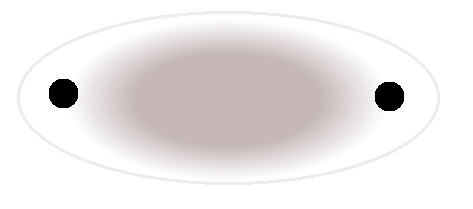
Image source: By Laghi.l CC BY-SA 3.0, via Wikimedia Commons
Moreover, since this area is formed by two different atoms, there are two different electrons that are very likely to be seen in this region. The participating atoms are, in essence, sharing these electrons, and we can view this as each atom gaining an electron. This is the covalent bond.
As mentioned previously, atoms are trying to fill their valence shell. So, if we want to know how many bonds an atom will make, we need to know how many electrons it needs to fill its valence shell.
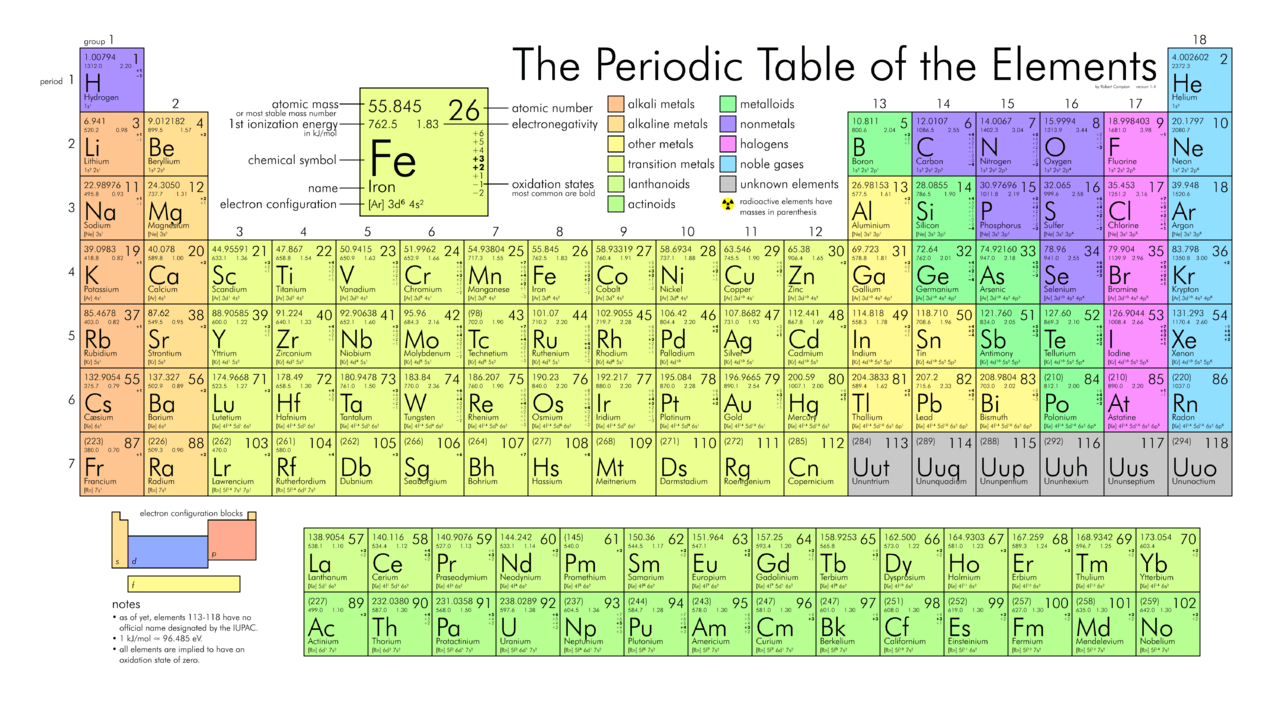
Image source: By 2012rc [Public domain], via Wikimedia Commons
Above each column in the periodic table there is a group number. The group number will tell us how many valence electrons each atom has. Group 1 elements have one, group 2 have two, but then we skip to group 13 as having three. Group 14 have four, group 15 have five, group 16 have six, group 17 have seven, and finally group 18 have already-completed valence shells with eight electrons. (Having a full set of valence electrons is also known as noble gas configuration.) This information is summarized in the table below. For now, we will not be concerned with the transition metals (groups 3–12).
We've done all the hard work at this point. All that is left to do is apply a little logic and an easy-to-remember formula. Since each atom is trying to get eight valence electrons, the number of bonds it will form must be eight minus the number of valence electrons it already has. Let's do a couple of examples. Carbon is group 14, so it has four valence electrons. Plugging this in to our formula, So carbon makes four bonds.
Oxygen is group 16, so it has six valence electrons. So oxygen makes two bonds. Try one on your own now.
How many covalent bonds will nitrogen make?
Sometimes atoms will form multiple bonds with each other. We will only be concerned with single, double, and triple bonds. Higher order bonds form in the same manner discussed above but involve different orbitals for each bond. Two electrons are involved for each bond made.
An important aspect of higher order bonds is that bonds beyond the first add less binding ability. What this means is that a double bond is stronger than a single bond, but it is less than twice as strong as a single bond. Likewise, a triple bond is stronger than a double bond, but it is weaker than three single bonds or 1.5 double bonds.
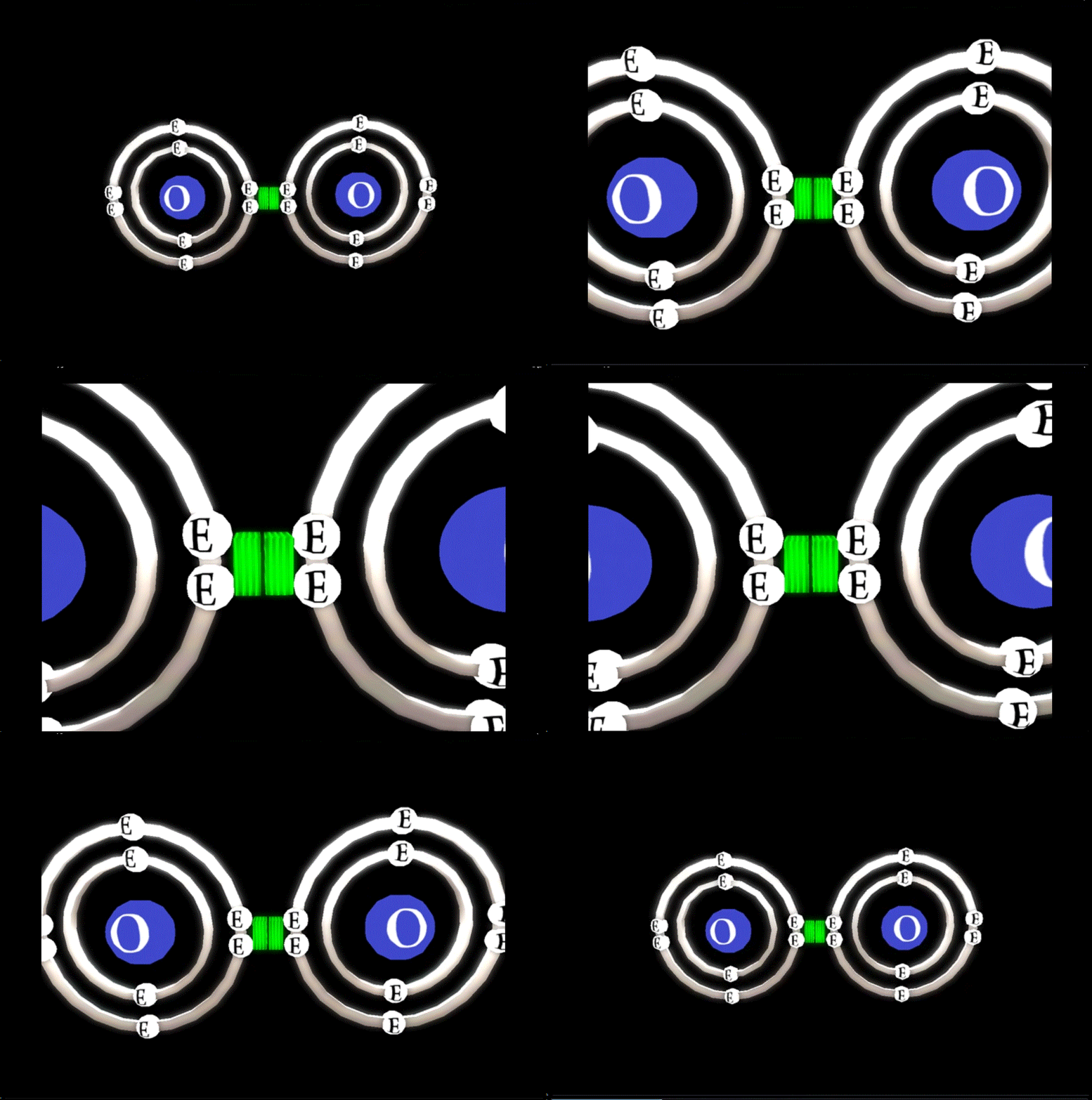
Image source: By Plasmide911 CC BY-SA 3.0, via Wikimedia Commons
How many electrons are involved in a double bond?
If the atoms in the bond do not have the same (or almost the same) electronegativities, then they will form a polar bond. In a polar bond, the electrons prefer to be closer to the more electronegative atom. This results in a partial negative and partial positive charge for the bond and, depending on symmetry, possibly the molecule. Ultimately, polar bonds give rise to many interactions, phenomena, and macroscopic properties.
: The outermost electrons of an atom, composed of the largest and suborbitals the atom has access to
: The attraction between atoms caused by electron sharing
Video
by CrashCourse
This video explains different types of chemical bonds.
: The attraction between electrons and protons of nearby atoms
: The ideal distance between two nuclei where the attractive and repulsive forces cancel out
: How strongly an atom holds shared electrons. Electrons are more attracted to atoms with higher electronegativities. This creates polarity
: An uneven sharing of electrons that creates a slight negative charge at one end and a slight positive charge at the other end
: A bond where the two atoms have different electronegativities, causing a separation of charges
: A bond where two atoms share electrons evenly (or mostly evenly)
Read · 1 min
A covalent bond forms between two atoms. This type of bonding forms molecules.
Covalent bonds can be polar or nonpolar. That's because in this type of bond, electrons are shared. That means they have the potential to be shared unevenly (polar) or evenly (nonpolar). Whether a molecular bond is polar or nonpolar depends on the electronegativities of the participating atoms.
An ionic bond forms between two ions. In an ionic bond, electrons are transferred, not shared.
Electronegativity is important to both covalent and ionic bonds. Elements with relatively similar electronegativities to one another will likely form covalent bonds. If the electronegativity difference is big enough, one atom will steal the other atom's electrons. The atom with the super strong electronegativity is the thief. Once one (or more than one) electron has been stolen, there are now two oppositely charged ions: an anion and a cation. An ionic bond can then form between them.




