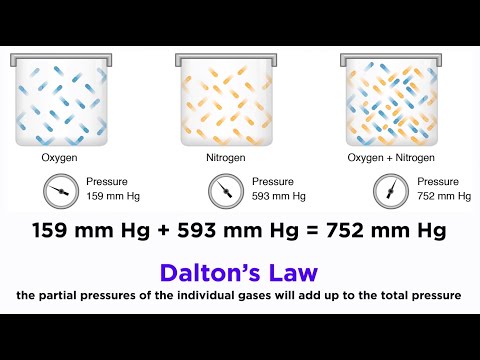
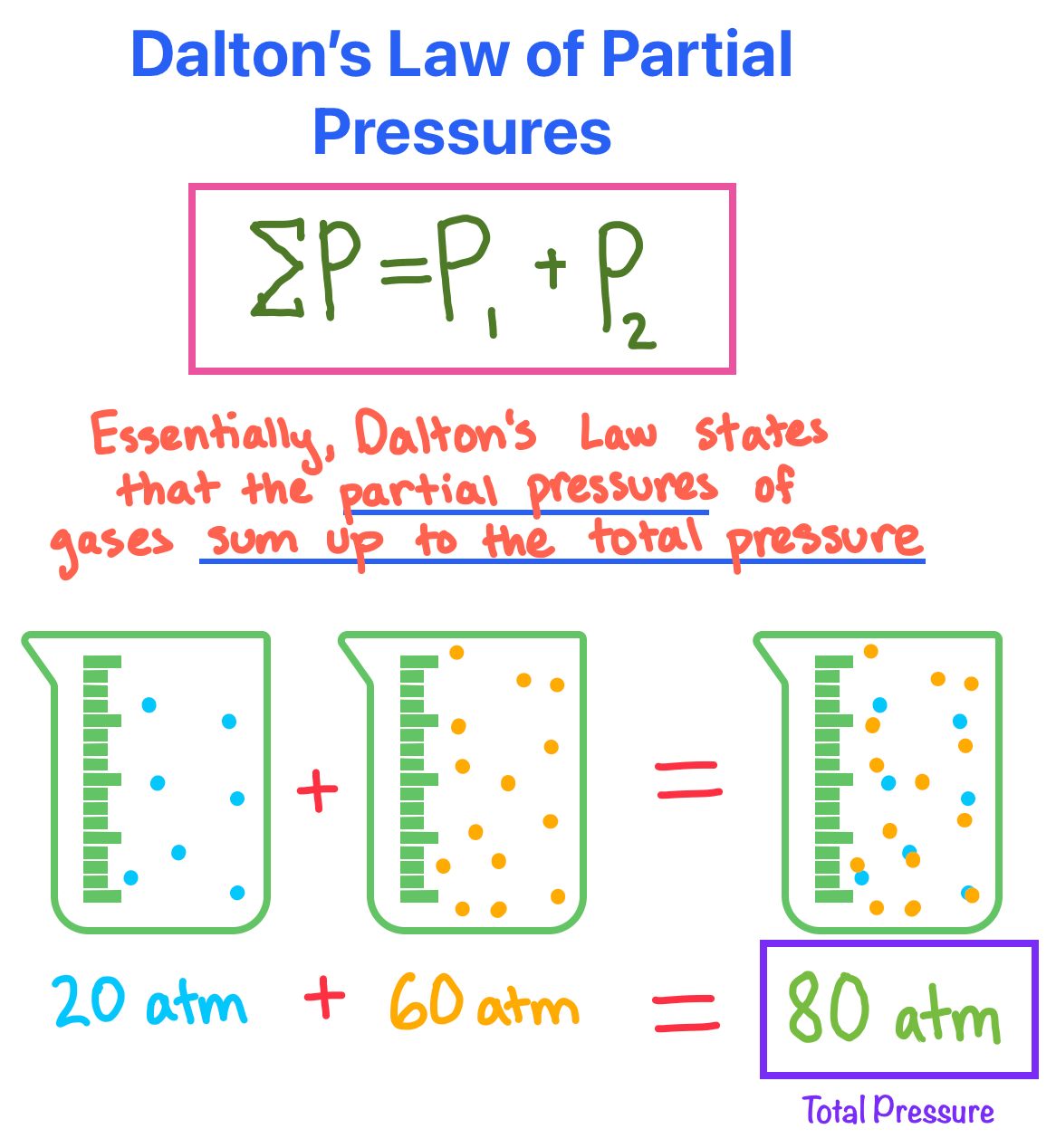
We've spent a lot of time studying the gas laws. We investigated Boyles' Law, Charles' Law, Gay-Lussac's Law, Avagadro's Law, the combined gas law, and the ideal gas law. We know how pressure, temperature, volume, and moles all relate. But, the entire time, we've been looking at one gas in a container. How often do we have only one gas? Not often. So, we also need to look at canisters containing many gases.
Mixtures of Gases
Gas mixtures are unique. Kinetic molecular theory taught us that gases are in random motion. They diffuse throughout their container. The gases in mixtures also diffuse. Each gas spreads out completely and fills its container. So, gas mixtures are homogeneous. But, we must have inert gases. They do not react. If they collide, they bounce off each other. Each gas maintains its identity. Since each gas keeps its identity, our system is the sum of its components. We have two ways to study each part.
First, we can examine the partial pressures. A gas's partial pressure is the gas pressure exerted if that gas were alone. From the ideal gas law, we know that pressure depends on volume, temperature, and moles. Remember, gas pressure is a physical property. So, two gases at the same temperature, volume, and moles will have equal pressures. For ideal gases, it does not depend on their chemical properties!
The second way is the mole fraction (X). The mole fraction is the ratio of an individual gas to the total. It has the formula X=ntotalngas. We can see that it's unitless. As an example, let's say a gas has a mole fraction of 0.40. Forty percent of the particles in the container are that gas. It also contributes forty percent of the total pressure.
To help us understand, let's study the mathematical formulas.
Daltons Law of Partial Pressures
John Dalton is most famous for creating his atomic theory. He revolutionized the way we thought about atoms, elements, compounds, and chemical reactions. But he also worked on gas laws! Dalton's interests led him to study mixtures of gases. In 1805, he published a paper explaining "Dalton's law of Partial Pressures."
There are two forms of Dalton's law.
(1) Ptotal=ΣP1+P2+P3+...
The first shows us that the total pressure is the sum of the partial pressures. Have you seen the sigma notation before? If not, it means to add up all the terms. For Dalton's law, each gas contributes a pressure. That's the gas's partial pressure. To find the total, we add each of the partial pressures together. So, we can treat each gas individually. If we find the pressure exerted by each gas, then we can solve for the total.
Let's look at a basic example. Let's say we have a canister with three gases. They contribute 120.0 torr, 400.0 torr, and 1000.0 torr of pressure. What is the total pressure in atmospheres?
Ptotal=ΣP1+P2+P3+...→Ptotal=120.0torr+400.0torr+1000.0torr=1520.0torr
The question asks us for the pressure in atmospheres. So, we need to use dimensional analysis to convert the units.
1520.0torr×760torr1atm=2.0atm.
The three gases produce a pressure that's double the atmospheric pressure.
(2) Ptotal=ΣX1Ptotal+X2Ptotal+X3Ptotal+...
The second form of Dalton's law uses the mole fraction. Each gas's contribution to the total pressure relates to how much of the mixture it composes. Let's look at the ideal gas law. For ease, let's say we have three gases.
PtotalV=ntotalRT - start with the ideal gas law.
Ptotal=VRT×(n1+n2+n3) -seperate out the moles into their components.
ntotalPtotal=VRT×(X1+X2+X3)- divide both sides by ntotal to get the mole fractions.
Ptotal=VRTntotal×(X1+X2+X3)- Multiply both sides by ntotal to isolate Ptotal.
Ptotal=Ptotal×(X1+X2+X3)- VntotalRT is Ptotal. So, we've derived the second from of Dalton's law.
Finally, we can relate the two forms of Dalton's law. Why? Both forms equal Ptotal.
ΣX1Ptotal+X2Ptotal+X3Ptotal+...=ΣP1+P2+P3+...
So, each term must be equal. For example, X1Ptotal=P1 → X1=PtotalP1. So, we can also write the mole fraction as a pressure ratio.
Roadmap for Solving Dalton's Law Problems
Always start by listing the variables you know!
-
If you have partial pressures, add them to find the total.
-
If you have grams convert to moles.
-
If you have moles and total pressure, first calculate the mole fraction.
Next, multiply the mole fractions and total pressure to find the partial pressures.
-
If you have moles, temperature, and volume, use the ideal gas law to find total pressure. Then, use the mole fractions to calculate the partial pressures. Or you can use the ideal gas law to find the partial pressures. Next, add the partial pressures to find the total pressure.
Example Problems
- Let's say we have a canister with a mixture of noble gases. The canister holds 1.0 mole of helium, 2.0 moles of neon, and 2 moles of Argon. The canister is 95.0 L at a temperature of 25oC. Find the partial pressure of each gas.
List what you know.
nHe=1.0
nNe=2.0
nAr=2.0
ntotal=nHe+nNe+nAr=5.0mols
T=25oC→298.15K
V=95.0L
We have moles, volume, and temperature. So we use the ideal gas law to find total pressure.
PtotalV=ntotalRT→Ptotal=95L5mols×0.0802mols×KL×atm×298.15K=1.26atm
Next, we calculate the mole fraction of each gas.
XHe=ntotalnHe=51=0.20
XNe=ntotalnNe=52=0.40
XAr=ntotalnAt=52=0.40
Finally, we calculate the partial pressure by using the total pressure and mole fraction.
PHe=XHe×Ptotal=0.20×1.25atm=0.25atm
PNe=XNe×Ptotal=0.40×1.25atm=0.50atm
PAr=XAr×Ptotal=0.40×1.25atm=0.50atm
- Let's say we have a 2.0 L canister. It contains 50.0 grams of nitrogen (a diatomic element) and 25.0 g of helium. The canister is at 200.0 K. How would we calculate the partial pressures and the total pressure?
Start by listing your variables.
mN2=50.0g
mHe=25.0g
ntotal=?,nN2=?,nHe=?
V= 2.0 L
T= 200.0 K
PTotal=?
PN2=XN2×PTotal=?
PNe=XHe×PTotal=?
Next, convert mass to moles.
nN2=28.0molg50.0g=1.79mols. Remember, that since nitrogen is diatomic its molar mass is double its atomic mass.
nHe=4.0molg25.0g=6.25mols
ntotal=1.79mols+6.25mols=8.04mols
Now we have total moles, volume, and temperature. So, we use the ideal gas law to calculate the total pressure.
PtotalV=ntotalRT→Ptotal=2L8.04mols×0.0802mols×KL×atm×200.0K=64.5atm
Calculate the mole fractions.
XN2=ntotalnN2=8.04mols1.79mols=0.22
XHe=ntotalnHe=8.046.25=0.78
Calculate the partial pressures.
PN2=XN2×PTotal=0.22×64.5atm=14.2atm
PNe=XHe×PTotal=0.78×64.5atm=50.3atm