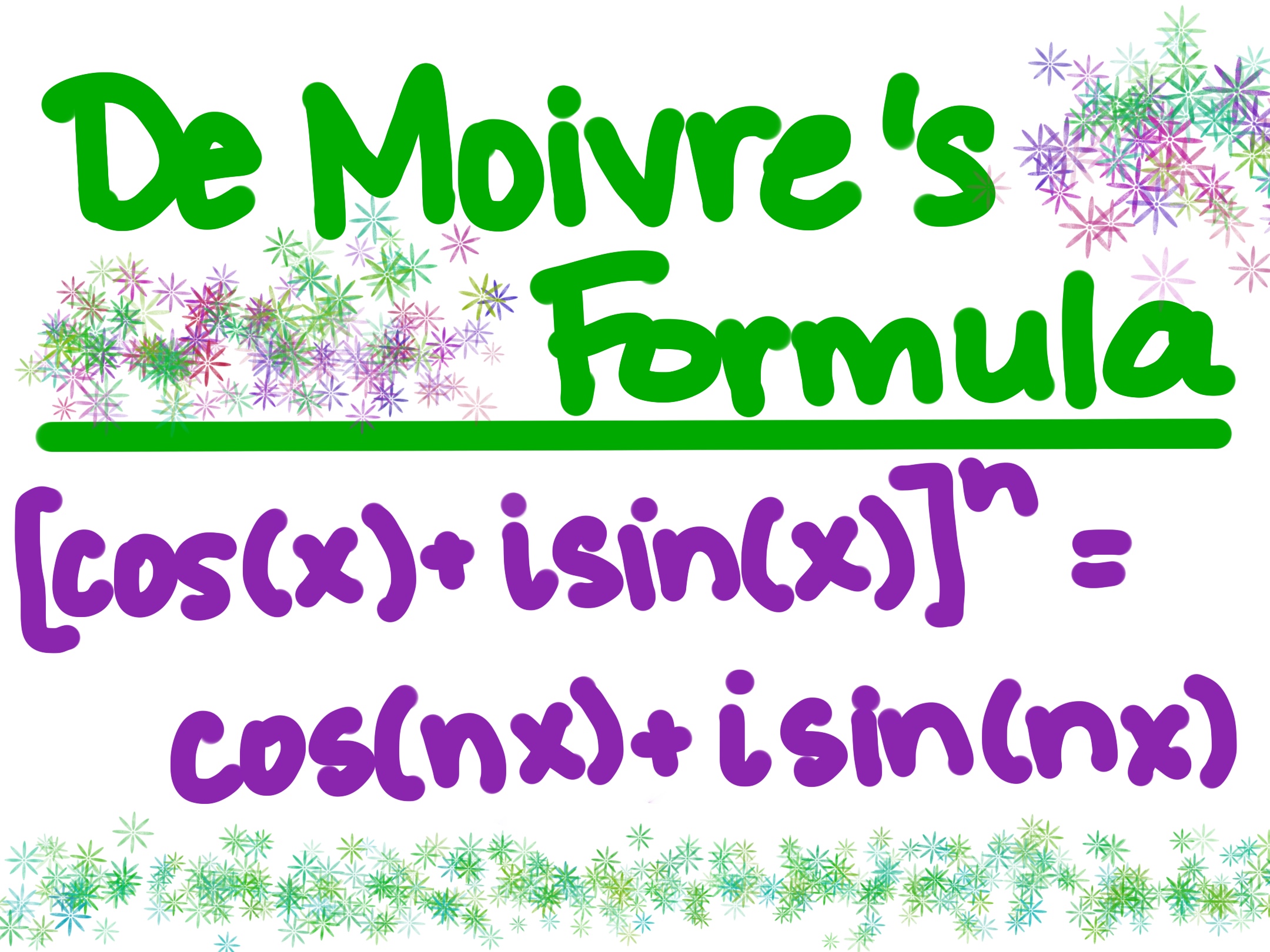
A common situation in algebra is when we have to find the expansion of a complex number, i.e. (rcisθ)n (where cisθ=cosθ+isinθ). An interesting result known as de Moivre's Formula actually says that (rcisθ)n=rncisnθ.
We'll proceed by proving a more generalized statement of the multiplication of two complex numbers, and then we'll extend that to get de Moivre's Formula.
Let z1=r1cisθ1 and z2=r2cisθ2. Multiplying the two complex numbers gives:
r1r2(cosθ1+isinθ1)(cosθ2+isinθ2) =r1r2((cosθ1cosθ2−sinθ1sinθ2)+i(sinθ1cosθ2+cosθ1sinθ2)) =r1r2(cos(θ1+θ2)+isin(θ1+θ2))
=r1r2cis(θ1+θ2)
So, we have just found that multiplying two complex numbers in polar form multiplies their magnitudes, and more interestingly, adds their arguments.
This makes de Moivre's Formula almost obvious. If we let z1=z2=z, then we get z1z2=z2=r2cis(θ+θ)=r2cis2θ. Similarly, z3=z2z=r2rcis(2θ+θ)=r3cis3θ
We can continue in this process to find that zn=(rcisθ)n=rncisnθ. A formal proof would be by induction, but this should give you a general idea of how it works.
Ultimately, we have proved two very strong statements:
(r1cisθ1)(r2cisθ2)=r1r2cis(θ1+θ2) (rcisθ)n=rncisnθ
The former is very useful in say, coordinate geometry, because it means that multiplying by cisθ rotates a point counterclockwise by an angle of θ. The latter is strongly relevant in the next section, when we are faced with the challenge of finding roots to the equation zn−1=0.
De Moivre’s Theorem is commonly used when finding roots of unity.