We've been studying radioactivity! Do you remember nuclear stability? We learned that some elements have unstable nuclei. Larger atomic nuclei have more prominent electrostatic repulsion. Eventually, the electrostatic repulsion overcomes the strong nuclear force. Do you remember the stability cut-off? It's the metal, lead. So, anything with an atomic number above 82 decays. For a long time, nuclear chemists thought the cut-off was Bismuth. But, it turns out that Bismuth-209 is radioactive. It just has a gigantic half-life of 2.01×10¹⁹ years!
What happens to unstable nuclei? They decay! Remember, there are four types of decay. Alpha decay is the ejection of a helium nucleus. The benefit is that it reduces the mass. Beta decay converts a neutron to a proton and discharges an electron. But remember, there are two types of beta decay. There is also beta-plus decay. It converts a proton to a neutron via the release of a positron. We also have the possibility of electron capture. The atom absorbs an electron to convert a proton to a neutron. Where does it get the electron? From one of its inner atomic orbitals! Remember, beta decay and electron capture attempt to balance the electrostatic repulsions and the strong force. Finally, there is gamma decay. It's analogous to excited electrons that release a photon. But, nuclei have a ton of energy. So, to relax, they always release a photon whose wavelength is in the gamma region. That's the highest energy on the electromagnetic spectrum!
Decay Series
So, we know the different types of decay. And we know radioactive elements are aiming to become lead. But what happens if they can't reach it via alpha decay? For example, consider the actinide, Thorium. Thorium has an atomic mass of 232 and the atomic number of 90. Alpha decay reduces its atomic number to 88. Remember, alpha decay is the quickest way to reduce the mass. That's radium. But, radium is still above lead. So, it's also radioactive! So, we expect radium to undergo decay, also. When an element experiences multiple decays, we call it a decay series or decay chain.
There are a couple of terms we need to know for decay series. The original element is called the parent. The one created by the decay is called the daughter. Any subsequent radioactive decays generate granddaughter elements.
There are four decay series that occur in nature. Two are generated by uranium isotopes and one each by Thorium and Neptunium. How were these elements created? In stars! Billions of years ago, various stars collapsed or collided. The energy of a collapsing star is enormous. So, it generates massive elements. Many of these elements have substantial half-lives. So, we still find them on earth billions of years later! What about the heavier elements on the periodic table. They are either created experimentally or unbelievably rare. Let's look at each of the natural decay series.
Uranium-238 Decay
Uranium-238 is the most common isotope, with a natural abundance of 99%. It also has unbelievable stability! Its half-life is 4.5 billion years. That's as old as the earth!
The decay process begins via alpha decay. The product is Thorium-234. The thorium isotope then undergoes two beta-minus decays to produce Uranium-234. Next, there are four successive alpha decays to reach Polonium-218. At this point, it can experience either alpha or beta decay. Via a series of alpha and beta decays, we hit lead-206.
Uranium-235 Decay
Uranium-235 is famous because it was used in the atomic bomb. It readily undergoes nuclear fission. The nuclear reaction creates a chain reaction that releases a lot of energy. It's also exceptionally rare, with a natural abundance of 0.7%. So, if we want to use it, we need to enrich it. In nuclear reactors, we enrich U-235 to about 20%.
The decay series for U-235 begins with alpha decay to Th-231. The Thorium then undergoes beta decay to Protactinium-231. Pa-231 alpha decays to Actinium-227. At this point, there are two possible paths. The first is four successive alpha-decays to Bismuth-215. This is followed by beta decay to Polonium-215. The other path is an initial beta decay to Thorium-227. It's followed by three alpha decays to Polonium-215. Here, we've reached another branching point. It can either alpha or beta decay. Each path concludes at Pb-207.
Thorium Decay
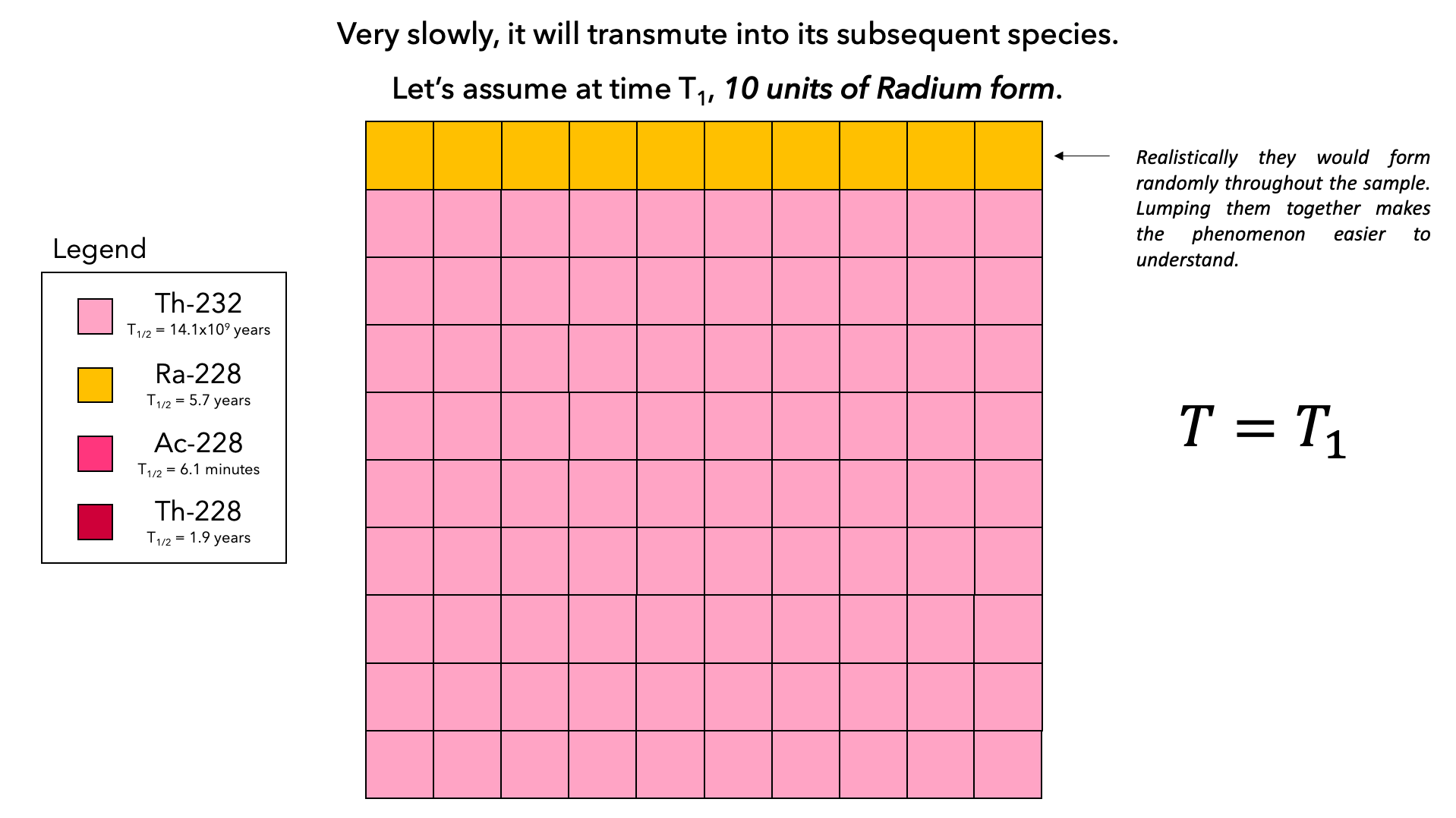
The most common isotope of Thorium is 232. It has a natural abundance of 99.98% and a half-life of 14 billion years! Its decay series begins with alpha decay to the alkaline-earth metal Radium-228. The radium then undergoes two successive beta decays to Thorium-228. Next, Thorium-228 experiences three alpha decays to reach Polonium-216. Polonium-216 is a branch point. The final result of both paths is lead-208.
Neptunium Decay
The Neptunium-237 decay series is the most unique. Unlike the others, it ends at Thallium-205 instead of lead. The decay series is no longer found in nature because Neptunium-237 has a half-life of 2.3 million years. It begins with alpha decay to Protactinium-233. Next, we see beta decay to Uranium-233. Uranium-233 will experience two alpha decays. The result is Radium-225 which beta decays to Actinium-225. Actinium-225 undergoes three alpha-decays to Bismuth-213, which is the branching point. Eventually, we hit lead-209. But it's an unstable isotope of lead! So, it beta decays to Bismuth-209. Finally, Bismuth-209 alpha decays to Thallium-205.