
Illustrated · 3 min
There are many different types of thermodynamic processes -- a passage from an initital state of the sytem to its final state. The prefix iso- means "equal" in Ancient Greek so the processes we're focusing on in this article are ones where one condition is held constant.
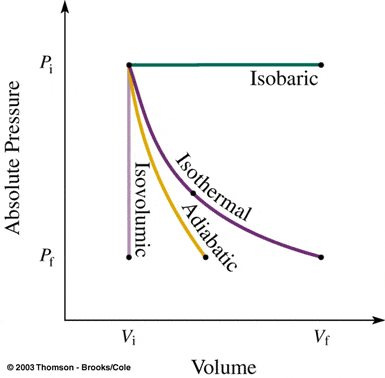
PV diagrams of types of processes
An isothermal process is one in which the temperatue of the system does not change. This is illustrated by the dark purple line in the diagram above. The ideal gas law gives us the equation where P is pressure of the gas, V is the volume, n is the number of moles of gas, R is the gas constant (8.31 Joules per mole Kelvin) and T is the temperature. Since the number of moles of gas in a closed system and the gas constant stay the same, we are able to solve for the temperature of the gas during an isothermal process if we know its pressure and volume. This also explains why the line on the diagram seems to show that the gas's pressure and volume are inversely proportional.
The first law of thermodynamics is commonly known as where U is the internal energy of the system, Q is the heat added to the system and W is the work done by the system. Since the internal energy of the system does not change during an isothermal process, we have which is useful for knowing whether heat was added to or removed from the system. Both the work and heat can be calculated by
The word isobaric comes from the Greek word báros, meaning "weight" so an isobaric thermodynamic process is one in which the pressure of the system remains constant. Thus an isobaric process would be expressed as a straight horizontal line in a PV diagram. The work of a system is the area under the PV curve so it is calculated by
for a system at constant pressure. The negative sign can get confusing. It's there because remember in the first law, W is work down by the system. Thus negative work is when a gas expands, when the system is doing work and positive work is when the gas contracts or when work is being done on the system.
Next, the Greek root choro means space, which is appropriate because an isochoric process is one in which the volume of the system stays constant. Just imagine the system being held in a rigid box that cannot change its volume or shape. This process is shown on the PV diagram in light purple as a straight vertical line with the label "isovolumic", another way to say "isochoric". In an isochoric process, no work is being down by or on the system since its volume stays constant. Thus we know and the internal energy of a system at constant volume can be calculated by
Finally we have adiabatic processes, indicated by the yellow in the PV diagram above, where the no heat is added or removed to the system or in other words which means By using the equation for work: we are able to calculate the internal energy of the system.
In summary, there are many different types of thermodynamic processes. Because of the first law, we are able to calculate the work down by the system or the internal energy of the system or the heat added to the system if we know some elements are held constant such as temperature and volume. The equations in the article help use calculate the exact numbers.