Video · + 1 min read
What happens when a raw egg hits a hot pan?

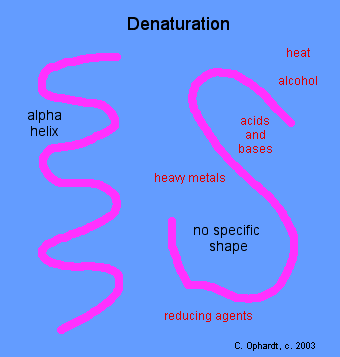
The clear, gooey egg whites turn opaque and solid. Heat causes proteins in the egg to undergo denaturation: the proteins unfold and lose their three-dimensional structure.
Think of a protein like a sticky string. A folded protein has all the sticky bits stuck to one another, keeping the string coiled up in a specific shape. Heat makes molecules move and jiggle - the more heat, the faster molecules move. At high enough temperatures, the jiggling uncoils the protein, turning it into a loose, floppy string. The exposed sticky bits can now get attached to other protein molecules. This is why the egg white turns solid: the denatured proteins stick to one another, forming a solid aggregate.
Besides heat, other factors can cause protein denaturation by interfering with the amino acid interactions that stabilize the folded structure (in other words, changing the "stickiness" of different parts of the protein string). Changes in pH can disrupt hydrogen bonding. Salt ions can prevent salt bridges from forming between amino acid side chains. Reducing agents can break disulfide bonds.