Alternate proof: Proof by implicit differentiation
dxd(sin−1x): We let y=sin−1x, so then x=siny. Thus dxdx=dxdsin(y)→1=cosydxdy→dxdy=cosy1=1−sin2y1=1−x21.
For cos−1x, we use the fact that cos−1x+sin−1x=2π, which is a constant. Thus dxdcos−1x+dxdsin−1x=0, so dxdcos−1x=−1−x21.
For tan−1x, we let x=tany so 1=sec2ydxdy, so dxdy=sec2y1=1+tan2y1=1+x21.
The derivative of cot−1x is −1+x21 because of the inverse cofunction identities.
With sec−1x, we again let x=secy. Now we have 1=secytanydxdy→dxdy=secytany1=±secysec2y−11=±xx2−11. Now we notice that the sign is positive if x≥1 and negative if x≤−1, so we simply have that dxdy=∣x∣x2−11. The derivative for csc−1x is again the negative of that.
For lnx: x=ey→dxdy⋅ey=1→dxdy=ey1=x1.
I might as well note that since logax=lnalnx, its derivative is simply xlna1.
Here's a video by patrickJMT showing you how to take the derivative of inverse trigonometric functions.
Inverse trig derivatives aren't any harder than other derivatives but they can be a pain to memorize and remember. I for one did not remember any of these rules after all these years since I took Calc 1.
Also remember that inverse trig operations can be expressed in multiple ways.
sin−1=asin=arcsin
Here's the list of the derivatives.
dxdsin−1xdxdcos−1xdxdtan−1xdxdcsc−1xdxdsec−1xdxdcot−1x=1−x21=−1−x21=1+x21=−xx2−11=xx2−11=−1+x21
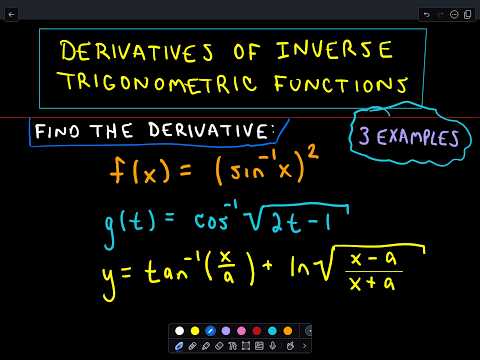
The first example he solves is:
f(x)f′(x)=(sin−1x)2=2(sin−1x)⋅[sin−1x]′=2(sin−1x)1−x21=1−x22(sin−1x)
The next example is:
g(t)g′(t)=cos−12t−1=−1−(2t−1)21⋅[2t−1]′=−1−(2t−1)21⋅21(2t−1)−21⋅[2t−1]′=−1−(2t−1)21⋅21(2t−1)−21⋅2=−1−(2t−1)21⋅2t−11=−1−(2t−1)1⋅2t−11=−2−2t1⋅2t−11
The final example he solves is:
y=tan−1(ax)+lnx+ax−a
In this problem the letter a is just some arbitrary constant. Just treat it as you would any other number. Also note that we can simplify this problem by using some logarithm properties.
yy′=tan−1(ax)+21lnx+ax−a=tan−1(ax)+21ln(x−a)−21ln(x+a)=1+(ax)21⋅[ax]′+21x−a1−21x+a1=1+(ax)21⋅a1+2(x−a)(x+a)x+a−2(x−a)(x+a)x−a=1+(ax)21⋅a1+2(x−a)(x+a)(x+a)−(x−a)=1+(ax)21⋅a1+2(x2−a2)2a=1+(ax)21⋅a1+x2−a2a=a[1+(ax)2]1+x2−a2a=a+a2ax21+x2−a2a=a+ax21+x2−a2a=aa2+ax21+x2−a2a=aa2+x21+x2−a2a=x2+a2a+x2−a2a=(x2+a2)(x2−a2)a(x2−a2)+(x2+a2)(x2−a2)a(x2+a2)=(x2+a2)(x2−a2)a(x2−a2)+a(x2+a2)=x4−a4a(2x2)=x4−a42ax2
Here's another video where he goes over another example of inverse trig derivatives. The problem he looks at is:
yy′=xcos−1(x)=[x]′cos−1(x)+x[cos−1(x)]′=cos−1(x)+x⋅−1−(x)21⋅[x]′=cos−1(x)−x⋅1−x1⋅2x1=cos−1(x)−21−xx
In this next video he looks at a slightly harder example. The problem is:
y=sec−11+x2
As always, it's good practice to rewrite the problem without the radical symbol.
yy′=sec−1(1+x2)21=(1+x2)21[(1+x2)21]2−11⋅[(1+x2)21]′=(1+x2)211+x2−11⋅21(1+x2)−21⋅[1+x2]′=(1+x2)211+x2−11⋅2(1+x2)211⋅2x=(1+x2)211+x2−11⋅(1+x2)211⋅x=(1+x2)21(1+x2)211+x2−1x=(1+x2)x2x=(1+x2)∣x∣x
In this final video he goes over one more harder example:
y=sin−1(1+sinxcosx)
This isn't going to be much fun.
y′=1−(1+sinxcosx)21⋅[1+sinxcosx]′=1−(1+sinxcosx)21⋅[1+sinx]2[cosx]′(1+sinx)−cosx[1+sinx]′=1−(1+sinxcosx)21⋅(1+sinx)2−sinx(1+sinx)−cosxcosx=1−(1+sinxcosx)21⋅(1+sinx)2−sinx−sin2x−cos2x=1−(1+sinxcosx)21⋅(1+sinx)2−sinx−1=(1+sinx)2(1+sinx)2−(1+sinx)2cos2x1⋅(1+sinx)2−sinx−1=(1+sinx)2(1+sinx)2−(1+sinx)2cos2x1⋅(1+sinx)2−sinx−1=(1+sinx)21+2sinx+sin2x−cos2x1⋅(1+sinx)2−sinx−1=1+sinx1+2sinx+sin2x−cos2x1⋅(1+sinx)2−sinx−1=1+2sinx+sin2x−cos2x1+sinx⋅(1+sinx)2−sinx−1=1+2sinx+sin2x−cos2x1⋅1+sinx−sinx−1=1+2sinx+sin2x−cos2x(1+sinx)−1(sinx+1)=1+2sinx+sin2x−cos2x−1
Recall that cos2+sin2=1 so if we rearrange that we get cos2=1−sin2.
y′=1+2sinx+sin2x−(1−sin2x)−1=2sinx+2sin2x−1
(Video) Deriving the Derivative of Inverse Tangent
by PatrickJMT
Here's a good video by patrickJMT showing you how to derive the derivative of inverse tangent. This is helpful because it can be hard to remember all the derivative formulas for inverse trig functions. Furthermore, this is a good procedure to remember because you can use a similar method to derive many derivative formulas, like logarithms.
So the function we have is
y=tan−1x
and we want to know what y′ or, in other words, dxdy. We could just differentiate both sides but this doesn't help since we don't know the derivative for tan−1x. So let's rearrange our function by taking the tangent of both sides.
tany=tan(tan−1x)
Since a function and its inverse cancel, this now becomes:
tany=x
Now we can use implicit differentiation and take the derivative of both sides.
dxd(tany)sec2y⋅[y]′sec2ydxdydxdy=dxd(x)=1=1=sec2y1
So we want our derivative to be in terms of x but we have a y in there. We do have the expression: tany=x. So if we can transform sec2y somehow into something with tany. Luckily, we have a nice trig identity to help us out.
cos2y+sin2ycos2ycos2y+cos2ysin2y1+tan2y=1=cos2y1=sec2y
So we can substitute this into our derivative above.
dxdy=sec2y1=1+tan2y1
And since we have our expression tany=x, we can now express our derivative in terms of x.
dxdy=1+x21