Trigonometric Identities, or Trig Identities for short, are equalities that relate the six trigonometric functions (sine, cosine, tangent, cosecant, secant, and cotangent).
Let's start with the simplest: Reciprocal Identities.
sin(θ)=csc(θ)1
cos(θ)=sec(θ)1
tan(θ)=cot(θ)1
csc(θ)=sin(θ)1
sec(θ)=cos(θ)1
cot(θ)=tan(θ)1
As you can see, these six identities really just tell you what the reciprocal of each function is.
Try a quick problem.
Using the Reciprocal Identities, define cosecant in terms of sine.
You should have gotten csc(θ)=sin(θ)1.
Now let's move on to slightly more exciting identities! The Quotient Identities are pretty straightforward.
tan(θ)=cos(θ)sin(θ)
cot(θ)=sin(θ)cos(θ)
Next, we'll learn about the Pythagorean Identities.
sin2(θ)+cos2(θ)=1
1+tan2(θ)=sec2(θ)
1+cot2(θ)=csc2(θ)
These identities derive from the Pythagorean Theorem, which you can look up over here.
Now, let's talk about the Even-Odd Identities.
sin(−θ)=−sin(θ)
cos(−θ)=cos(θ)
tan(−θ)=−tan(θ)
csc(−θ)=−csc(θ)
sec(−θ)=sec(θ)
cot(−θ)=−cot(θ)
Using all the information we've gathered so far, try to solve the following problem.
Which of the following are equivalent to sin(θ)?
Ok, you've got the first four trig identities. Now, here's the Co-Function Identities.
sin(2π−θ)=cos(θ)
cos(2π−θ)=sin(θ)
tan(2π−θ)=cot(θ)
csc(2π−θ)=sec(θ)
sec(2π−θ)=csc(θ)
cot(2π−θ)=tan(θ)
Here's one last one. The Double-Angle Identities can be used when you are trying to find the trig function of (2θ).
sin(2θ)=2cos(θ)sin(θ)
cos(2θ)=cos2(θ)−sin2(θ)
*Note that cos(2θ) also equals 2cos2(θ)−1, which also equals 1−2sin2(θ).
tan(2θ)=1−tan2(θ)2tan(θ)
All of these identities are very useful in solving complicated trigonometric equations or functions.
For example,
Simplify csc2(θ)tan2(θ)−1 to a single trigonometric function.
The correct answer for that problem is tan2(θ).
Here's how it's done:
We have csc2(θ)tan2(θ)−1. We can change csc2(θ) to sin2(θ)1 by using the Reciprocal Identities.
Now, we have sin2(θ)1tan2(θ)−1. We can replace tan2(θ) with (cos(θ)sin(θ))2 with the Quotient Identities.
So far, we've simplified our original expression to sin2(θ)1(cos(θ)sin(θ))2−1. Now, we want to cancel out the sin2(θ) from the numerator and denominator.
This results in two terms: cos2(θ)1−1. We want to try and combine these two terms by multiplying the 1 by cos2(θ)cos2(θ).
Almost done! By combining the two fractions we now get cos2(θ)1−cos2(θ)
We can use our Pythagorean Identities for the next step to replace 1−cos2(θ) with sin2(θ).
This leaves us with cos2(θ)sin2(θ) which can be simplified using the Quotient Identities to give us tan2(θ).
Nice job! You're ready to use these Trigonometric Identities to solve other complex problems! :)
Worth the struggle
Twenty minutes on one hard problem can teach more than ten easy exercises. These problems are worth staying with. These are real problems from the AMC 12 and AIME, the national math competitions for middle and high school students, each with a worked solution on LIVE by Po-Shen Loh.
There are many trigonometric identities in the world, and I'm not going to list them all here. However, I'll continue with some of the most common and important trig identites that you must know.
tan(x)=cos(x)sin(x)
This is an IMPORTANT fact. Sometimes, you might want to deal with sin and cos because most of the below identities are in sin and cos.
sin2(x)+cos2(x)
What is the value of sin2(x)+cos2(x), where x∈R. Let's test with some simple values.
What is the value of sin2(30)+cos2(30)? (Treat everything in degrees from now on, unless I say it is in radians)
Correct.
What is the value of sin2(45)+cos2(45)?
Do you see what's going on here?
In fact, sin2(x)+cos2(x)=1 for all real x! This is quite a useful fact and often known as the Pythagorean identity. It gives us a way to express sin terms in terms of cos and vice versa.
sin(x)=sin(180−x), sin(x)=−sin(−x) and cos(x)=cos(−x).
I'll not go into further detail on this. They're not really hard to prove.
sin(x)=cos(90−x),cos(x)=sin(90−x) and tan(90−x).
These three identities are again useful. If you list the values of sin(30),sin(45),sin(60), you'll notice that they're equal to cos(60),cos(45),cos(30) respectively.
And indeed, sin(x)=cos(90−x) and cos(x)=sin(90−x) for all real x.
Now, what about tan(90−x)? What is it equal to?
Ineed, tan(90−x)=tan(x)1. Again, the proof is not really hard. We can in fact rewrite it as tan(90−x)=cot(x). (Recall that cot(x)=tan(x)1.)
Addition Formulas and Subtraction Formulas
This is the most important trig identity in this article.
Complex Numbers in Proving Trig IdentitiesBasic Facts
We define the complex numbers C as C={a+bi∣(a,b)∈R2},i2=−1. Here in a complex number z=a+bi, a is called the real part, written ℜ(z)=a and b is called the imaginary part, written ℑ(z)=b. One good thing about dealing with complex numbers in equations is that one can equate the real and imaginary parts. For some real parameters A,B,C,D we have A+Bi=C+Di⟺A=C,B=D. Another helpful thing is the distributivity or linearity of the ℜ or ℑ functions. We have ℜ∑=∑ℜ,ℑ∑=∑ℑ.
Euler’s Formula
The following formula was given by Leonhard Euler and is a very useful one relating complex numbers and trigonometry. For any complex x we have eix=cosx+isinx. There are many ways to prove this. One outline is included here: first, rewrite the equation as eixcosx+isinx=1, consider the function y=e−ix(cosx+isinx), differentiate it. The works are not shown here, but the derivative turns out to be 0 so the function must be constant. Plug in x=0 to get y=1, hence y=1 for all x. Notice that setting x=π we get a beautiful identity eiπ+1=0.
Note: If you are familiar with calculus, there is also another proof involving a manipulation of the Taylor Series of sine and cosine.
De Moivre’s Formula
De Moivre's Formula helps ease out computations a lot. It states that for any complex x and integer n(cosx+isinx)n=cosnx+isinnx. The proof is one liner if we apply Euler's formula twice as below (cosx+isinx)n=(eix)n=ei(nx)=cosnx+isinnx. Notice that in the complex number z=eix=cosx+isinx, we have ℜ(z)=cosx and ℑ(z)=sinx.
Complex Approaches to Trig Problems!
1. Derive the addition formulas of sine and cosine.
Solution. Just notice that by applications of Euler's formula
Now equating real and imaginary part of both sides, we have cos(x+y)=cosxcosy−sinxsinysin(x+y)=sinxcosy+cosxsiny deriving the formulas. □2. Prove that k=0∑n−1cosn2kπ=0∀n∈N−{1}.
Solution. Let z=e2πi/n=cos(2π/n)+isin(2π/n). Then we have zn=e2πi=1⟹zn−1=0. Since z=1zn−1=(z−1)(1+z+z2+⋅⋅⋅+zn−1)=0∴k=0∑n−1zk=0⟹ℜk=0∑n−1zk=0. Now notice that by application of De Moivre's formula
zk=(cosn2π+isinn2π)k=cosn2kπ+isinn2kπ∴ℜ(zk)=cosn2kπ. Therefore by the linearity of ℜ function we finally have 0=ℜk=0∑n−1zk=k=0∑n−1ℜ(zk)=k=0∑n−1cosn2kπ.□
3. Prove the Pythagorean identity, cos2x+sin2x=1.
Solution. We can cleverly factor cos2x+sin2x as a difference of squares: (cosx+isinx)(cosx−isinx). From here, we use Euler's identity, so we have cos2x+sin2x=(cosx+isinx)(cosx−isinx)=(eix)(e−ix)=1.□
Two Problems To Try
1. (IMO 1963/5) Prove that cos7π−cos72π+cos73π=21.
2. (Proofathon) Show that for all odd k≥3coskπ+cosk3π+⋯+cosk(k−2)π=21. (1 is a special case of 2!)
Sometimes, where working with a trigonometric expression, it is useful to replace all the sinθ and cosθ with a rational expression in terms of a single variable. As it turn out, tan2θ is a convenient choice.
Recall from the Double Angle Identity section that:
cosθ=2cos22θ−1
Since cos22θ+sin22θ=1, this can also be written as:
cosθ=cos22θ+sin22θ2cos22θ−1=1+tan22θ2−1=1+tan22θ1−tan22θ
Now sinθ can be dealt with in a similar fashion. Try to derive an expression for sinθ in terms of tan2θ
We start in the same way. Recall that:
sinθ=2sin2θcos2θ
This can be rewritten using sin2θ=tan2θcos2θ:
sinθ=2tan2θcos22θ
Now we finish exactly as before:
sinθ=(2tan2θ)cos22θ+sin22θcos22θ=1+tan22θ2tan2θ
Using these two expressions, we can derive similar expressions for cscθ,secθ,tanθ,cotθ. The result is the following. If tan2θ=t, then:
sinθ=1+t22tcosθ=1+t21−t2tanθ=1−t22tcotθ=2t1−t2secθ=1−t21+t2cscθ=2t1+t2
Using these identities, any trigonometric identity with a single argument can be reduced to a polynomial verification in one variable. Additionally, this characterization can be used to prove trigonometric inequalities.
We will now work a brief example illustrating the former use.
Let θ∈(0,2π) be an angle. Simplify the following: (sinθ+cosθ+1cscθ−sinθ)(sinθ+cosθ−1secθ−cosθ)
We let t=tan2θ. Then we can simply plug in the above identities into the expression:
(1+t22t+1+t21−t2+12t1+t2−1+t22t)(1+t22t+1+t21−t2−11−t21+t2−1+t21−t2)
Simplifying a little, this becomes:
(2t(2t+2)(1+t2)2−(2t)2)((1−t2)(2t−2t2)(1+t2)2−(1−t2)2)
Using the fact that (1−t2)2+(2t)2=(1+t2)2, this can be further simplified:
(2(2t)(t+1)(1−t2)(2t)(1−t)(2t)2(1−t2)2)=(8t2(1+t)2(1−t)24t2(1+t)2(1−t)2)=21
And so the expression is simply 21.
Some of us have seen the formula eiθ=cosθ+isinθ before (if you haven't, check it out here!). However, this doesn't really help us find the value of cosθ or sinθ individually.
The best we can do is ℜ[eiθ]=cosθ and ℑ[eiθ]=isinθ. (For a complex number z=a+bi, we denote ℜ(z)=a, the real part, and ℑ(z)=b, the imaginary part.)
If we plugged another value of θ into the equation, maybe we could get a system and solve for cosθ,sinθ.
What value should we plug in for θ?
If we plug in −θ, we get the equation e−iθ=cos(−θ)+isin(−θ).
Now notice that cos(−θ)+isin(−θ)=cosθ−isinθ! If we put together our two equations
eiθ=cosθ+isinθ and
e−iθ=cosθ−isinθ, we get a system that allows us to solve for cosθ and sinθ!
By adding the two equations, we find cosθ=2eiθ+e−iθ.
Let's subtract the equations. What do we get for sinθ?
These are two very useful formulas for cos,sin. Let's just do a sanity check and make sure that cos2θ+sin2θ=1:
(2eiθ+e−iθ)2+(2ieiθ−e−iθ)2 equals
41(e2iθ+e−2iθ+2e0−e2iθ−e−2iθ+2e0)=1, as expected!
There's still a bit more we can do though: If eiθ=z, then e−iθ=z1. Thus we may simplify the formulas to
In this explanation we're going to prove the identity
tan(2x)=2cos(x)−sec(x)2sin(x).
In doing so we're going to highlight some of the techniques you can use to prove other identities. Every time we prove an identity, we can use it to derive other ones.
A good first attempt is to work from left-to-right, trying to turn the simpler-looking side of the identity into the more complicated-looking side. In this case the left-hand side is less intimating so we start there.
We know more about sines and cosines than tangents, and they are easier to manipulate, so we write
tan(2x)=cos(2x)sin(2x).
The reason this is helpful is we know double-angle identities for sine and cosine:
sin(2x)cos(2x)=2sin(x)cos(x)=2cos2(x)−1
We substitute these into our previous equation:
tan(2x)=2cos2(x)−12sin(x)cos(x)
This fraction is starting to resemble the right-hand side of the identity we wanted to prove. The numerator we have now and the numerator we want differ by a factor of cos(x), so divide the numerator and denominator by cos(x):
This is the same as the right-hand side of the identity we wanted to prove, so we're all done! We've successfully proven a trig identity!
One of the great things about trig identities is that there are multiple ways to prove most, if not all of them. Perhaps you can look around the other explanations and get more ideas for how to prove this identity.
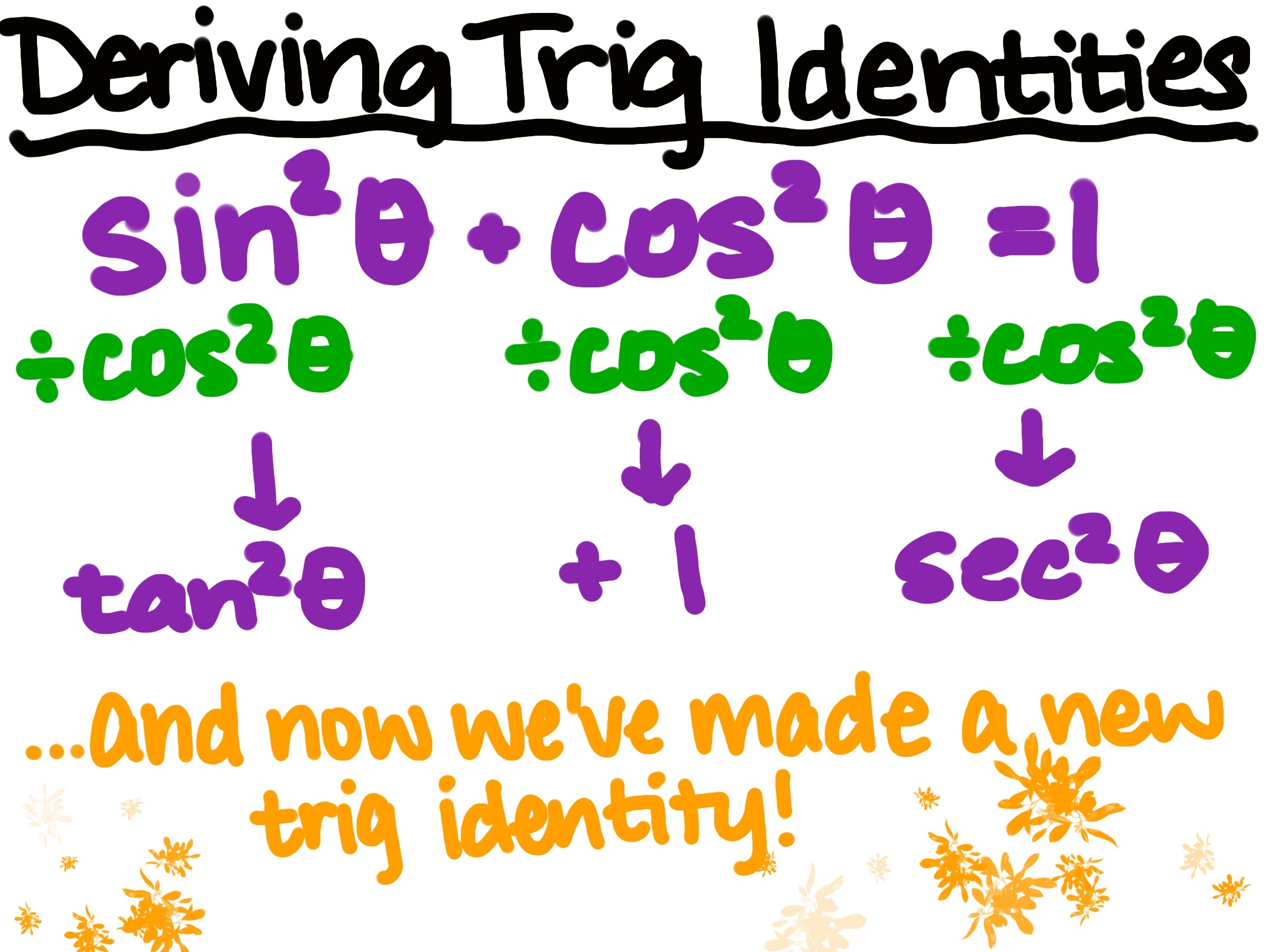
Trig identities are math rules that are always true for certain angle functions like sine, cosine, and tangent. We've already learned some of the basic ones, like:
sin2(θ)+cos2(θ)=1
You can use the identities you already know to create new ones!
Image source: by Anusha Rahman
As we can see in the above example, we can divide both sides by cos2(θ). So, we can simplify to:
tan2(θ)+1=sec2(θ)
...and now you've just made a new identity! We used what we already knew and turned it into something new. You can also apply this new identity in real problems, like proving that two sides of an equation are equal.
You can use it to simplify an expression like sec2(θ)+tan2(θ), which we now know equals 1.
You can use it to work backward: if you see tan2(θ), you can replace it with sec2(θ)−1 to make solving easier.
It's like having a toolbox - the more complex the tools, the more ways you can solve things.