Read · 1 min
+2 contributors


In our study of how to find the roots of polynomials, we have discovered multiple methods such as the rational roots test, conjugate root theorem, and the intermediate value theorem. This next lesson will add one more tool to our tool box!
##Introduction
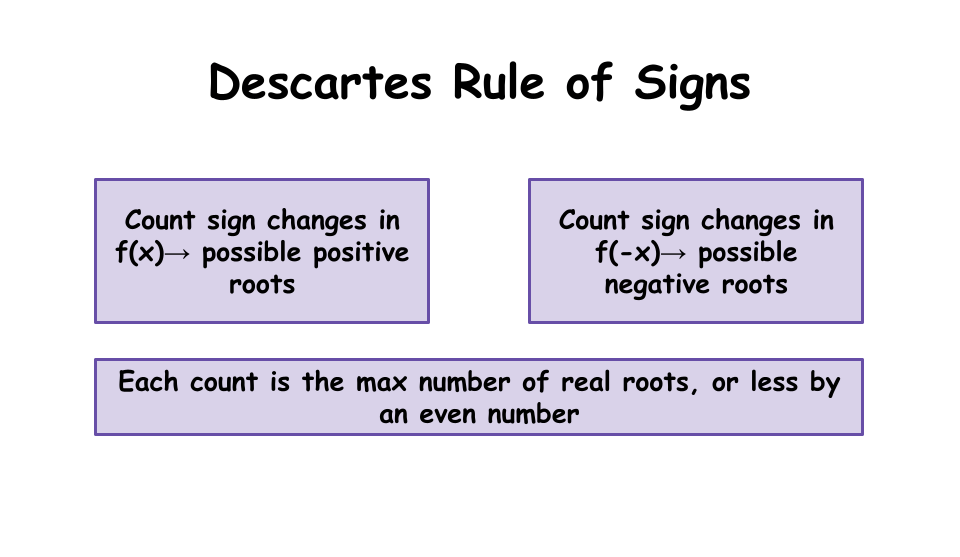
The Descartes' Rule of Signs can help us determine the number of positive and negative roots a polynomial has. While it can only tell us the number of roots, not the actual roots themselves, the rule is still very helpful if we cannot graph or factor the polynomial easily.
The Descartes' Rule of Signs states that the number of sign changes of is equal to the maximum number of positive roots. Similarly, the number of sign changes of is equal to the maximum number of negative roots.
There may be some complex roots, as visible with the quadratic formula, so there can be multiple possibilities for the number of roots. To find those possibilities, subtract a factor of from the maximum number of both positive and negative roots until you hit or a negative number.
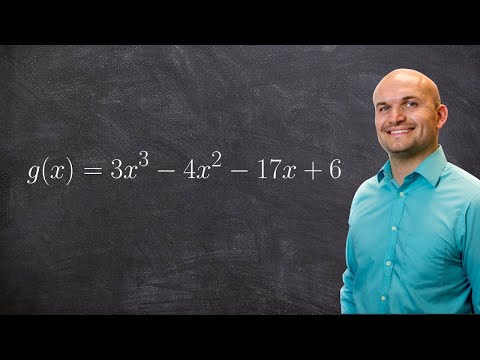
Let's look at an example polynomial:
The first step to using this rule is to rewrite the polynomial in order of increasing to decreasing degree.
Now, let's count the number of sign changes.
There is a sign change from to and to . As there are sign changes, we know that there are or positive roots.
To find the number of negative roots, we have to find the number of sign changes for .
Let's first write .
There is one sign change from to , so there is one negative root.
Therefore, in total there are or positive roots and negative root.