Differentiating an Integral Function (Half of FTC)

Before this, knowIntro to the Fundamental Theorems of Calculus (FTC)What Is an Integral Function?

Video · + 2 min read

(Video) Fundamental Theorem of Calculus - Part 1

by PatrickJMT
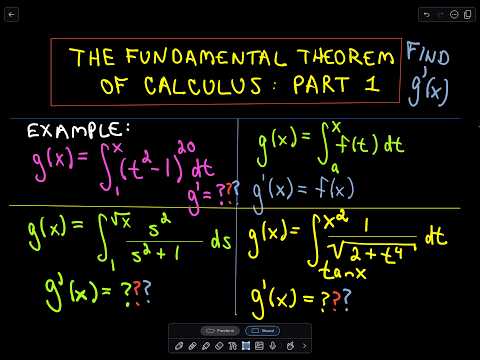
Here's a video by patrickJMT where he explains the Fundamental Theorem of Calculus Part 1 and how you can solve problems with it.

The Fundamental Theorem of Calculus Part 1

If ff is continuous on [a,b][a,b], then g(x)=∫axf(t)dta≤x≤bg(x)=\int_a^xf(t)dt\quad a\le x\le b is continuous on [a,b][a,b], differentiable on (a,b)(a,b), and g′(x)=f(x)g'(x)=f(x)

Essentially, we're just taking the derivative of an integral. In other words, the derivative of an integral of a function is just the function. Basically, the two cancel each other out like addition and subtraction. Furthermore, we're just taking the variable in the top limit of the integral, xx, and substituting it into the function being integrated, f(t)f(t).

Problem 1 - Standard

Find the derivative of g(x)=∫1x(t2−1)20dtg(x)=\int_1^x(t^2-1)^{20}dt

All we need to do in this problem is replace the variable with xx. g′(x)=(x2−1)20g'(x)=(\color{red}{x}^2-1)^{20}

Problem 2 - Variable in Lower Limit

Find the derivative of h(x)=∫x2[cos⁡(t2)+t]dth(x)=\int_x^2[\cos(t^2)+t]dt

In this problem the variable is in the lower limit. To apply the Fundamental Theorem of Calculus, the variable needs to be in the upper limit. Luckily, we can flip the limits of integration as long as we put a negative sign out front. ∫x2[cos⁡(t2)+t]dt=−∫2x[cos⁡(t2)+t]dt\int_x^2[\cos(t^2)+t]dt=-\int_2^x[\cos(t^2)+t]dt

Now that the variable is in the upper limit we can find the derivative. h′(x)=−[cos⁡(x2)+x]h'(x)=-[\cos(\color{red}{x}^2)+\color{red}{x}]

Problem 3 - Expression in Upper Limit

Find the derivative of g(x)=∫1xs2s2+1dsg(x)=\int_1^{\sqrt x}\frac{s^2}{s^2+1}ds

In this problem, we have our variable in the top limit but it's an expression. To solve these problems we need to apply the chain rule. You can substitute in the expression but then you also need to multiply it by the derivative of the expression. g′(x)=(x)2(x)2+1⋅[x]′g′(x)=xx+1⋅12xg′(x)=x2(x+1)\begin{align} g'(x)&=\frac{(\color{red}{\sqrt x})^2}{(\color{red}{\sqrt x})^2+1}\cdot\color{red}{[\sqrt x]'}\\ g'(x)&=\frac{x}{x+1}\cdot\frac{1}{2\sqrt x}\\ g'(x)&=\frac{\sqrt x}{2(x+1)} \end{align}

Problem 4 - Expressions in Both Limits

Find the derivative of g(x)=∫tan⁡xx212+t4dtg(x)=\int_{\tan x}^{x^2}\frac{1}{\sqrt{2+t^4}}dt

In this problem we have a variable in both the upper and lower limit. What we can do is split the integral into two integrals at some point between the limits. ∫abf(x)dx=∫acf(x)dx+∫cbf(x)dx\int_a^bf(x)dx=\int_a^cf(x)dx+\int_c^bf(x)dx

Since, it doesn't matter where we break it up at, let's just choose zero. =∫tan⁡x012+t4dt+∫0x212+t4dt=\int_{\tan x}^0\frac{1}{\sqrt{2+t^4}}dt+\int_0^{x^2}\frac{1}{\sqrt{2+t^4}}dt

We need to flip the first integral because the variable is on the bottom. =−∫0tan⁡x12+t4dt+∫0x212+t4dt=-\int_{0}^{\tan x}\frac{1}{\sqrt{2+t^4}}dt+\int_0^{x^2}\frac{1}{\sqrt{2+t^4}}dt

Now we substitute the upper limit in and make sure to multiply by the derivative. g′(x)=−[12+tan⁡4x]⋅[tan⁡x]′+[12+(x2)4]⋅[x2]′g′(x)=−12+tan⁡4x⋅sec⁡2x+12+x8⋅2xg′(x)=2x2+x8−sec⁡2x2+tan⁡4x\begin{align} g'(x)&=-\bigg[\frac{1}{\sqrt{2+\color{red}{\tan}^4\color{red}{x}}}\bigg]\cdot\color{red}{[\tan x]'}+\bigg[\frac{1}{\sqrt{2+\color{red}{(x^2)}^4}}\bigg]\cdot\color{red}{[x^2]'}\\ g'(x)&=-\frac{1}{\sqrt{2+\tan^4x}}\cdot\sec^2x+\frac{1}{\sqrt{2+x^8}}\cdot2x\\ g'(x)&=\frac{2x}{\sqrt{2+x^8}}-\frac{\sec^2x}{\sqrt{2+\tan^4x}} \end{align}

Interactive · 1 question

As mentioned previously, the first Fundamental Theorem of Calculus relates the derivative of a function to its antiderivative. Let's begin with an example:

Calculate the derivative of the integral ∫0x4t3 dt.\int_0^x 4t^3\, dt.

Choose one answer

Illustrated · 1 min

Consider an arbitrary function, and denote aa and bb as two different values such that the function, ff, is continuous on [a,b][a,b]. Finally, suppose that tt is some value in the interval [a,b][a,b].

Let us define F(x)=∫atf(x) dxF(x) = \displaystyle\int_{a}^{t}{f(x)} \ dx. Basically, this will return the area under the curve f(x)f(x).

Now, what the Fundamental Theorem of Calculus says is: F′(x)=f(x)F'(x) = f(x) Translating this into English, we get that the rate of the area between aa and tt is essentially ff evaluated at tt.

Intuitively, this makes sense; if the rate of the area change is decreasing, the function values will get smaller and smaller. However, this is not a formal proof. If you would like to know the formal proof, see the next section.

This gives us many insights into what we will study soon, and the idea that the Fundamental Theorem of Calculus gives is fantastic!

Read · 1 min

Happy Thanksgiving, reader! How about try out these problems? Lol, have fun!

Type a concept, like “slope” or “photosynthesis”.

↑ ↓ to choose · Enter to openSearch explanations and problems

