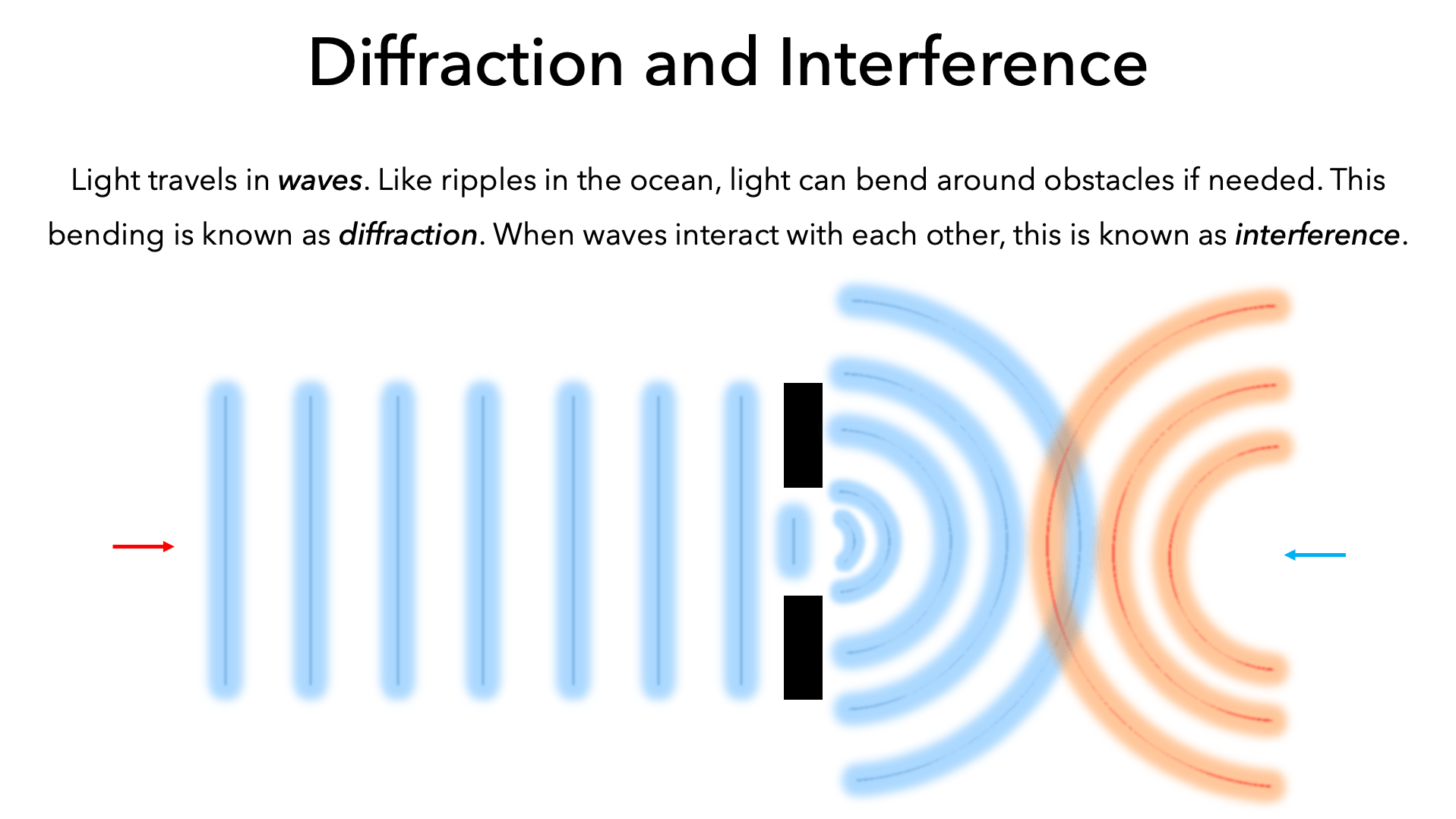
In the 1800s Thomas Young performed a paramount experiment. At the time, there was debate over the properties of light. Some chemists thought that light consists of particles. Others considered light to be a wave. Young set out to settle the debate.
Light Passing through a Slit
Let's imagine we had a light source that produced a single wavelength of visible light. We'll shine the light on a screen. But let's put a barricade between the light source and the screen. Let's say the barrier has a single rectangular slit in the center. What shape will appear on the screen? If light is a particle, we would expect a rectangular illumination. It would look exactly like the slit. But that's not what happens! In reality, the light gets spread out. You'll see multiple bands. Why? Light is a wave. So, it experiences diffraction. What's that? Diffraction occurs when waves bend around the edge of an object. The wave continues to propagate as it passes the slit. So, it fills the space behind the barrier. So far, it seems that light is a wave.
Young's Double Slit Experiment
So, we know what happens if we use one slit. But Thomas Young was a much more creative scientist. He wondered what would happen if his barricade had two slits. What would we expect to see if light is a particle? The screen should have two rectangular illuminations. What did Young observe? He saw bands of light. Between the bands were dark regions. What's happening? The light from the two slits was interfering. Interference occurs when waves combine. There are two kinds of interference: constructive and destructive. They differ by whether the waves are in-phase or out-of-phase. What does that mean? In-phase waves have peaks and troughs that align. So, their amplitudes are additive or constructive. Out-of-phase waves occur when peaks and troughs overlap. They cancel each other. So, we call it destructive interference. It caused the dark regions between the illuminated bands. Young thought he had settled the matter. Light was a wave!
Quantum Mechanics
Unfortunately for Thomas Young, Albert Einstein would upend his definitive conclusions. Einstein was attempting to explain the photoelectric effect. When specific wavelengths of light are shined on a metal, it produces a current. Electrons got ejected from the metal's surface. If light only behaved as a wave, the wavelength wouldn't matter. Instead, current would be proportional to intensity. Einstein proposed that light behaved as a particle. He applied Planck's quantum theory to the photons and electrons. The photon's energy was quantized and depended on its wavelength. Only particles with specific energies could remove an electron. Today, we would call it ionization energy. The electron in the outermost orbital absorbs enough energy to overcome its electrostatic attraction to the nucleus.
Einstein's solution prepared the way for the wave-particle duality. Light had both particle and wave properties.
Electrons, Protons, Nuclei, and Molecules
Einstein solved the photoelectric effect in 1905. Almost twenty years later, Louis de Broglie would change quantum mechanics. He combined Einstein's relativity equation with Planck's quantum theory. What was the result? All matter had a wavelength. The wave-particle duality is applicable to any object. We call it the de Broglie wavelength.
So, what happens if we do the double-slit experiment with electrons, protons, and neutrons? They all behave like the light. They experience constructive and destructive interference! You can even do it with atoms and molecules! In 2001, chemists achieve an interference pattern using the carbon allotrope buckminsterfullerene (C60). In 2019, a team of physicists did a double-slit experiment using a 2000-atom molecule. The molecule had a molecular mass of over 25,000 amu! It still created the interference pattern.