
Illustrated · 1 min
By Sylvia Freeman

+2 contributors
Contributors



Image source: By Sylvia Freeman
Illustrated · 1 min
Image source: By Sylvia Freeman
Interactive · 1 question
Diffusion is the random motion of particles from areas of high concentration to low concentration, or "down the concentration gradient". When the concentration is equal everywhere, it is said to be in equilibrium. Cell membranes help to control diffusion.
You've seen the process of diffusion if you've ever poured milk into tea, like in the picture below.

Image source: By iirliinnaa CC0, via pixabay.com
Diffusion is a type of passive transport, which means that no energy input is needed for it to happen. It just does it all by itself over time. It even occurs when there is a semipermeable membrane separating two solutions—one with a high concentration of solute and one with a low concentration. Passive transport requires no energy or effort from the cell.

Image source: By Karol Langner [Public domain], via Wikimedia Commons
Diffusion .
Select all correct options
Let's illustrate this with an example about Times Square in New York City on New Years. Let's start by assuming that all of the people are within 500 feet of the ball and are surrounded by a barrier. They decide it's too crowded because they are at a very high concentration (there are a lot of people packed in a small space). They begin to spread out and cross the barrier, and a few people end up 1,000 feet away from the ball. These people are in an area of low concentration.
The people still in the crowd are like, "Hey, look at those people with all that room. That's a great idea." They begin to cross the barrier, too. All of the people spread out until the number of people inside the barrier is the same as the number of people outside the barrier. In other words, they are in equilibrium.
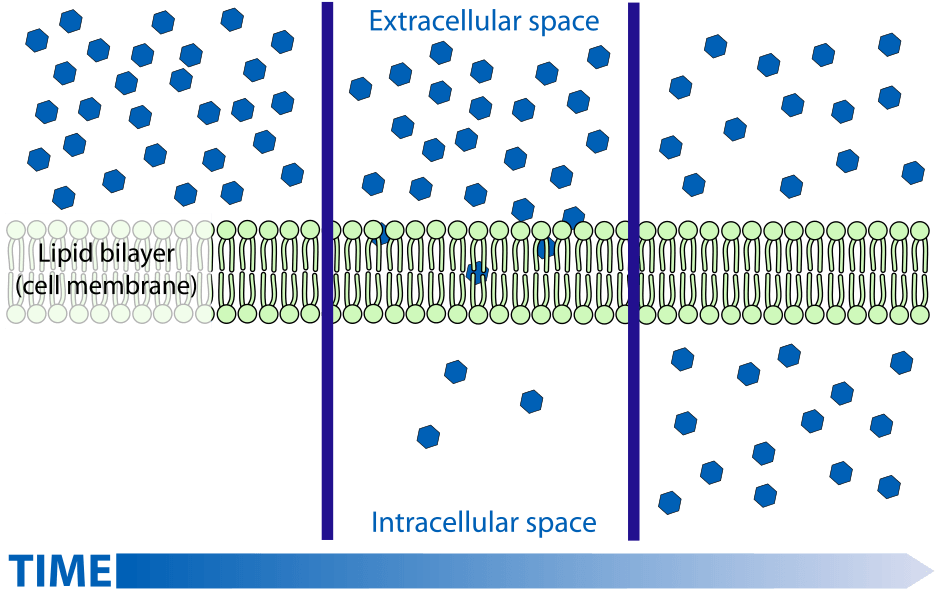
Image source: By LadyofHats [Public domain], via Wikimedia Commons
You're probably thinking "Well, that's great. What does that have to do with cells though?" This example explains how solutes diffuse into the cell, like in the picture above. This process is how oxygen and carbon dioxide enter and leave cells.
: A semi-permeable phospholipid bilayer
: The movement of particles from areas of high concentration to areas of low concentration
: The movement of water molecules from areas of high water concentration to areas of low water concentration
: The movement of particles from areas of high concentration to areas of low concentration with the help of an enzyme
: The movement of particles across the membrane with no help from the cell
Illustrated · 3 min
Diffusion is a form of passive transport. This means that it requires no energy to occur. It just happens on its own.
Although there are a few types of diffusion, here's the main thing you need to know about the base idea:

Image source: By Hannah Bonville
I like to think of concentration as how crowded a given area is with a particular thing.

Image source: By JrPol (modified by expii) CC BY 3.0, via Wikimedia Commons
Think of a big party. There's usually one really crowded room (a high concentration of people). Often, there's an area next to this room (like a hallway) that is much less crowded. This would be an area of low concentration of people.
Many of us at that party would have the urge to move from the crowded room to the less crowded hallway. In more scientific terms, we'd want to move from a region of higher concentration to an area of lower concentration.
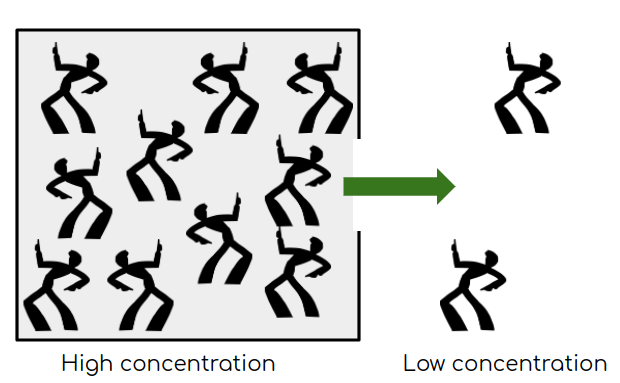
Image source: By Clker-Free-Vector-Images CC0, via pixabay.com
It doesn't take much effort to do this. You don't have to force your way into the hallway—there's already tons of room.
This is pretty much how it works in biology too. Diffusion is the movement of molecules from areas of high concentration to areas of low concentration. This movement does not require energy, so it is passive.

Image source: By BruceBlaus CC BY 3.0, via Wikimedia Commons
The picture above is another good example of diffusion. The food coloring (the solute) is initially concentrated in one area. The clear water around it (the solvent) has a low concentration of food coloring.
Over time, the food coloring spreads from the region of high concentration into the region of low concentration, turning the whole cup of water purple.
Another good example is how cream diffuses through a cup of coffee. It starts in an area of high concentration and then gradually moves into areas of low concentration.

Image source: By iirliinnaa CC0, via pixabay.com
Notice how the result in all three examples of diffusion is an even concentration throughout the whole space.
As a result of diffusion, there are no longer distinct areas of high concentration and low concentration. Everything is spread out evenly.
This is called dynamic equilibrium.

Image source: By Gabi Slizewska
It's important to note that once equilibrium is reached, the movement of substances does not stop. This is where the "dynamic" part of dynamic equilibrium comes from.
Substances will continue to move around passively, but there will be no net change in concentration.
Let's look quickly at an example of diffusion across a biological membrane.

Image source: By LadyofHats [Public domain], via Wikimedia Commons
All the concepts we talked about before (high and low concentration, passive movement, dynamic equilibrium) hold true for diffusion across semipermeable membranes as well.
At first, there is a high concentration of some solute outside the cell. Over time, the solute begins to move inside the cell (the area with a lower concentration). This continues until there is an equal concentration both inside and outside the cell.
The substance that moves across the membrane can be anything from carbon dioxide to ions, and even water. When water diffuses across a membrane, it is called osmosis.
: A semi-permeable phospholipid bilayer
: The movement of particles from areas of high concentration to areas of low concentration
: The movement of water molecules from areas of high water concentration to areas of low water concentration
: The movement of particles from areas of high concentration to areas of low concentration with the help of an enzyme
: The movement of particles across the membrane with no help from the cell
Video
by Teacher's Pet

This video by Teacher's Pet explains how materials can move across a cell membrane without using energy by following the concentration gradient. Remember, things move randomly from areas of high concentration to areas of low concentration.



