Solutions are mixtures that are the same throughout (homogenous). They consist of a solute (dissolved substance) and solvent (dissolving substance). Typically the solvent is water or an organic solvent. The solute can be a solid, liquid, or a gas. The amount of solvent per volume of solvent is used to describe the concentration of the solution. In chemistry, molarity (M=moles/liter) is a commonly used measurement of concentration.
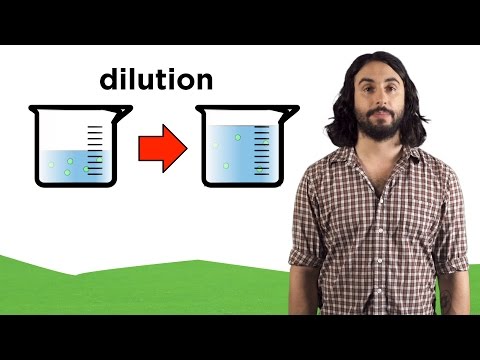
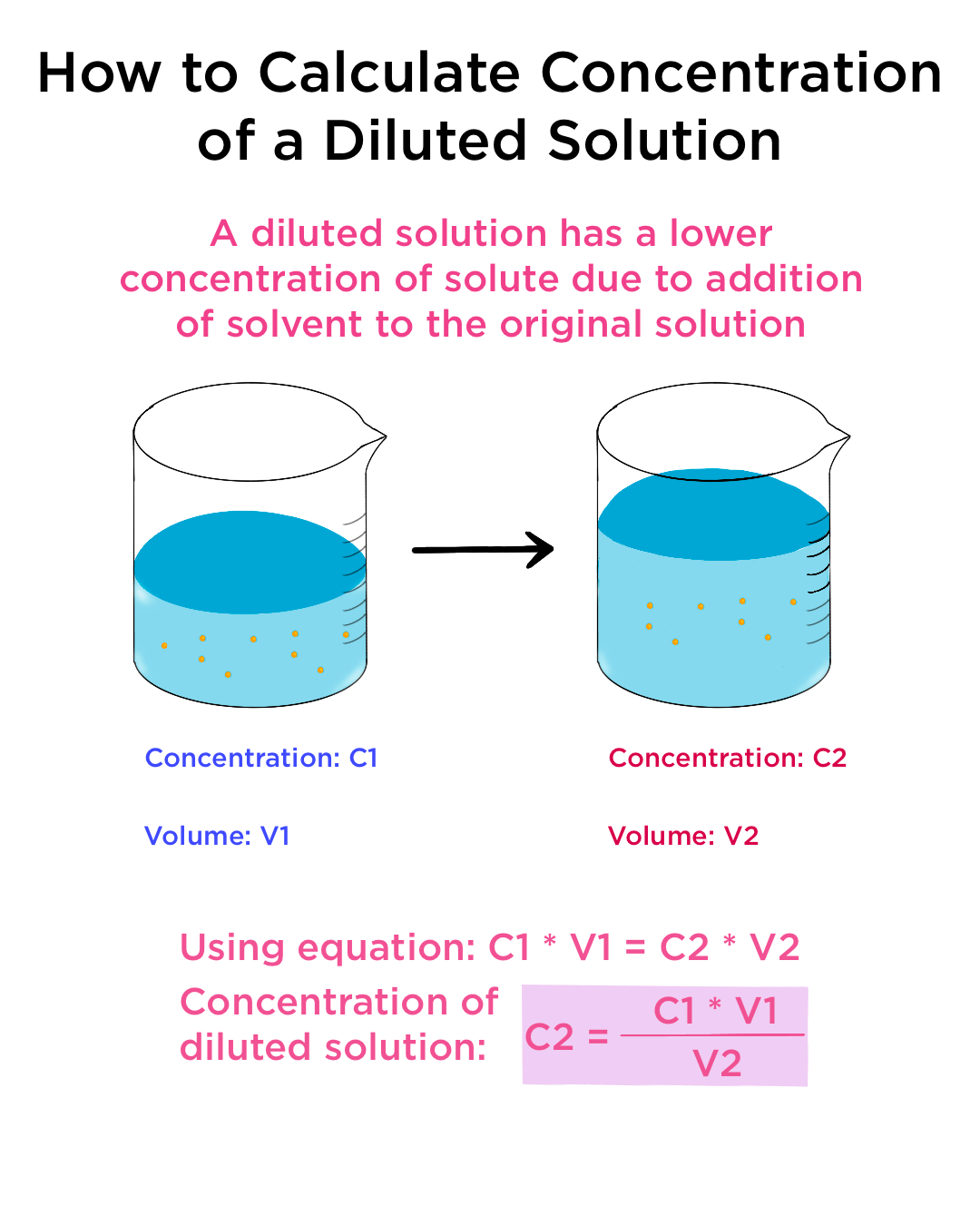
Diluting a solvent means to lower the concentration by adding more of the solvent to the solution. This can be done by adding solvent to the main bulk of the solution or taking some volume of the solution and adding solvent to it.
Quantitative solution dilutions can be easily calculated using an equation:
C1V1 = C2V2
C1 stands for the initial concentration, C2 for the final concentration, V1 for the initial volume, and V2 for the final volume. The initial concentration can be found by taking the amount of solute divided by the volume of solvent. The initial volume is the amount of the initial solution being diluted. No matter what volume of the initial solution is removed, before dilution, the concentration remains the same. The final volume is the volume of the initial solution plus the amount of solvent added to dilute.
Examples of Dilution Calculations
Example 1: 10.0 mL of a 2.0 M NaOH aqueous solution is diluted with 4.8 mL of water. What is the concentration of the solution after dilution?
C1= 2.0MV1= 10.0mLV2= 14.8mLC2= solve(2.0M)(10.0mL) = (C2)(14.8mL)C2= 1.4M
Example 2: How would you make 50.50 mL of 1.25 M HCL solution from a 6.58 M HCl solution?
(6.58M)(V1) = (1.25M)(50.50mL)V1= 9.59mL
I would take 9.59mL of 6.58 M HCl solution and add 40.91 mL of water to dilute the solution. The final solution would have a volume of 50.50 mL and have the concentration of 1.25 M HCL.