
Illustrated · 1 min
Eukaryotic cells can be divided into three kinds based on the number of sets of chromosomes they have: haploids, diploids, and polyploids. Different organisms have different numbers of chromosomes, and different cells have different numbers of sets of chromosomes. If that sounds a bit confusing, keep reading :)
Recall that there are 23 chromosomes in a normal human karyotype (see picture below). That is, 23 chromosomes cells make one full "set" of human chromosomes. The number of chromosomes in an organism is typically referred to by the letter n. So for humans, n = 23. (As we will see in a bit, not all organisms have 23 chromosomes!)
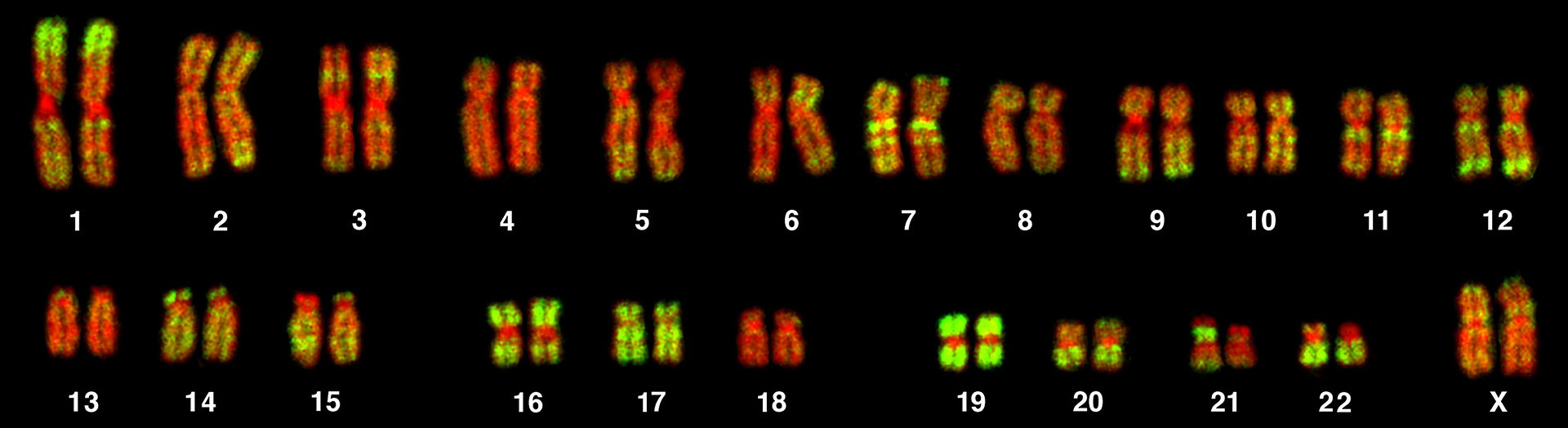
A human karyotype, showing 23 pairs of chromosomes... 23x2 = 46 total! (attribution: Public Library of Science)
diploid: 2 sets of chromosomes = 2n
Most of the cells in the human body ("in the body" = somatic) are diploid (di- means "two of"), which means they have 2 full sets of chromosomes, or 2n. Why two? One set from the mother and one from the father. Since humans have 23 chromosomes, this means that diploid cells have 23x2 = 46 chromosomes inside them.
haploid: 1 set of chromosomes = n
The other cells in the human body are haploid cells, containing one full set of chromosomes. Why do these cells only have one set? Because these cells are gametes: sperm cells or egg cells which may ultimately fuse together to form a new organism during sexual reproduction. Since humans have 23 chromosomes, haploid cells have 23x1 = 23 chromosomes inside them.
polyploid: more than 2 sets of chromosomes
Some organisms have cells which are neither haploid or diploid. Watermelon, for example, is a triploid — it contains three full sets of chromosomes per cell, and strawberries have TEN sets per cell! Organsims which have more than two sets of chromosomes per cell (so definitely not humans) are known as polyploids.