We've been studying Van der Waal's forces. They're an umbrella term for different intermolecular interactions. That's the electrostatic interactions that occur between molecules. They're responsible for a substance's physical properties.
The first type we investigated was dispersion forces. What causes dispersion forces? The random movement of electrons. When we studied quantum mechanics, we learned that electrons obey the laws of probability. It's unlikely to find electrons evenly distributed throughout an orbital. Instead, they become unevenly spaced. The variable distribution creates temporary dipoles. So, there is a quick moment of attraction between molecules. All molecules have electrons. So, all molecules experience dispersion forces.
Today, we'll study a permanent intermolecular interaction: dipole-dipole interactions.
What are Dipole-Dipole Interactions?
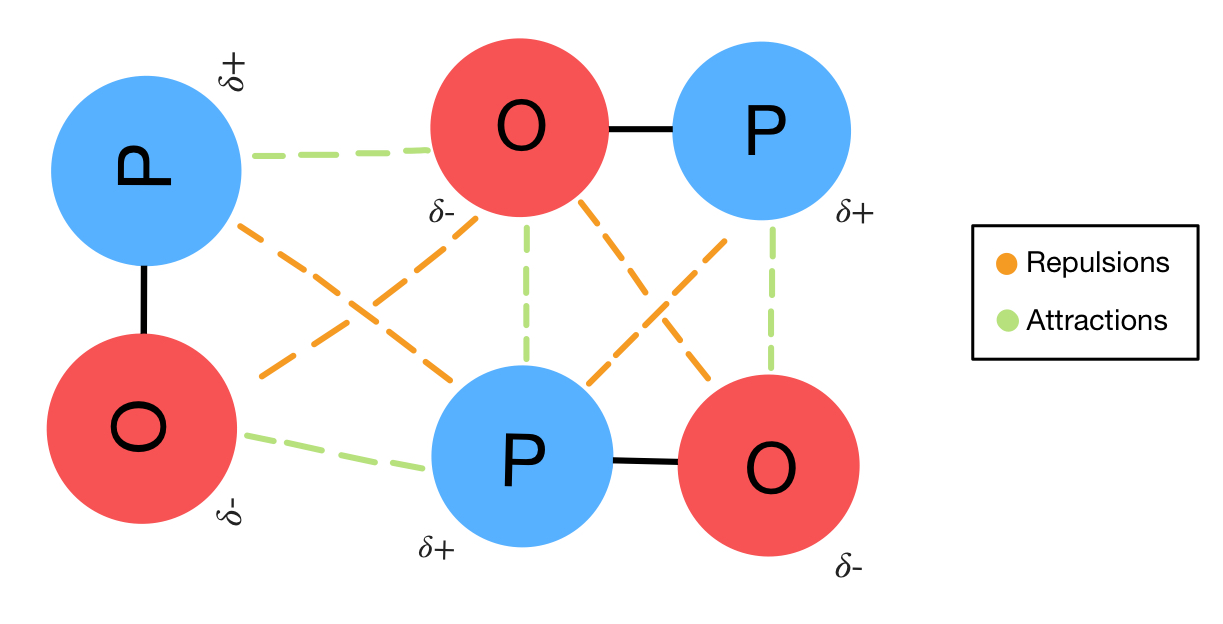
Dipole-dipole interactions occur between two polar molecules. Two factors create a polar molecule. First, we need a polar bond. The two atoms need a significant electronegativity difference. What's the result? The electrons get shared unevenly. The more electronegative atom hogs the electrons. So, it builds up a partial negative charge. The less electronegative atom gets left with too little electron density. It will be partially positive. But, we also need the correct molecular geometry. Why? If the molecule is symmetrical, the dipoles will cancel. That's why linear molecules, like carbon dioxide, are nonpolar. They have polar bonds. But, the geometry is symmetrical. A molecule with a polar bond and the correct geometry will have a permanent dipole!
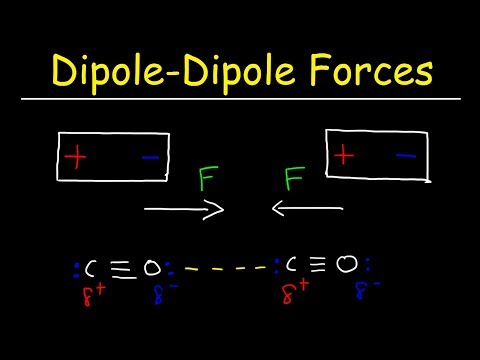
Now let's look at dipole-dipole interactions. The most apparent type of interaction occurs between two permanent dipoles. One molecule's positive side attracts the negative side of another molecule. The molecules can be the same or two different polar molecules.
We can also have a polar-nonpolar interaction. Imagine a polar molecule's positive side approaching a nonpolar molecule. The nonpolar molecule's electrons are attracted to the positive charge. We've induced a dipole on the nonpolar molecule. Induced dipoles are weak and temporary. But, they do create an attractive force.
Dipole-Dipole Interactions and States of Matter
Dipole-dipole interactions are the backdrop for the phases of matter. Many polar molecules are liquids or solids at STP. Why? A molecule needs enough energy to escape the intermolecular attractions. That's why phase changes require energy! But, dipole-dipole interactions are relatively strong interactions. So, overcoming those forces requires more energy. In contrast, most gases only experience dispersion forces. They are the weakest intermolecular attraction. So, it's easy to overcome them.
Remember, the temperature is the average kinetic energy of the molecules. Let's say we're at room temperature. The molecules don't have enough energy to become gases. So, polar molecules are often liquids and solids. The intermolecular forces also explain the arrangement of the particles. In liquids, the molecules have sufficient energy to slide past each other. In solids, the dipole-dipole force is more significant than the kinetic energy. The molecules become locked into a lattice structure.