Discriminant of a Quadratic Equation - Definition & Examples

Before this, knowThe Quadratic Formula - Defintion & Examples

Read · 1 min

The Discriminant

When does ax2+bx+c=0ax^2+bx+c=0 have a real solution? Well, we know how to find the solutions using the quadratic formula:

x=−b±b2−4ac2a.x = \frac{-b \pm \sqrt{b^2-4ac}}{2a}.

That makes it look like we can always find solutions. However, we can't always take a square root! Sometimes you'll get a negative number under the radical. A negative under the radical means there are no real number solutions to the radical. We can use the formula under the radical, b2−4acb^2-4ac, called the discriminant, to determine the number of roots of solutions in a quadratic equation. There are three cases:

  • b2−4ac<0b^2-4ac < 0: The equation has 00 real solutions. The graph does not cross the xx-axis.
  • b2−4ac=0b^2-4ac = 0: The equation has 11 real solution. The graph touches the xx-axis at one point.
  • b2−4ac>0b^2-4ac > 0: The equation has 22 real solutions. The graph crosses through the xx-axis at two points.

To learn more about how to determine solutions using the x-intercepts, check out this lesson. Using the discriminant will be really helpful when you're trying to quickly solve quadratic equation word problems later on!

Stretch your creativity

Contest problems rarely look like the examples you studied. Solving one means finding your own way in. These are real problems from the AMC 8, AMC 12 and AIME, the national math competitions for middle and high school students, each with a worked solution on LIVE by Po-Shen Loh.

Illustrated · 1 min

Discriminant

Let's do a little review before we investigate the discriminant. Given a quadratic equation in standard form, ax2+bx+c=0,ax^2+bx+c=0, where a,b,a, b, and cc are constants and a≠0,a\neq 0, we can use the quadratic formula, x=−b±b2−4ac2a,x=\frac{-b\pm \sqrt{b^2-4ac}}{2a}, to find the solutions of the equation.

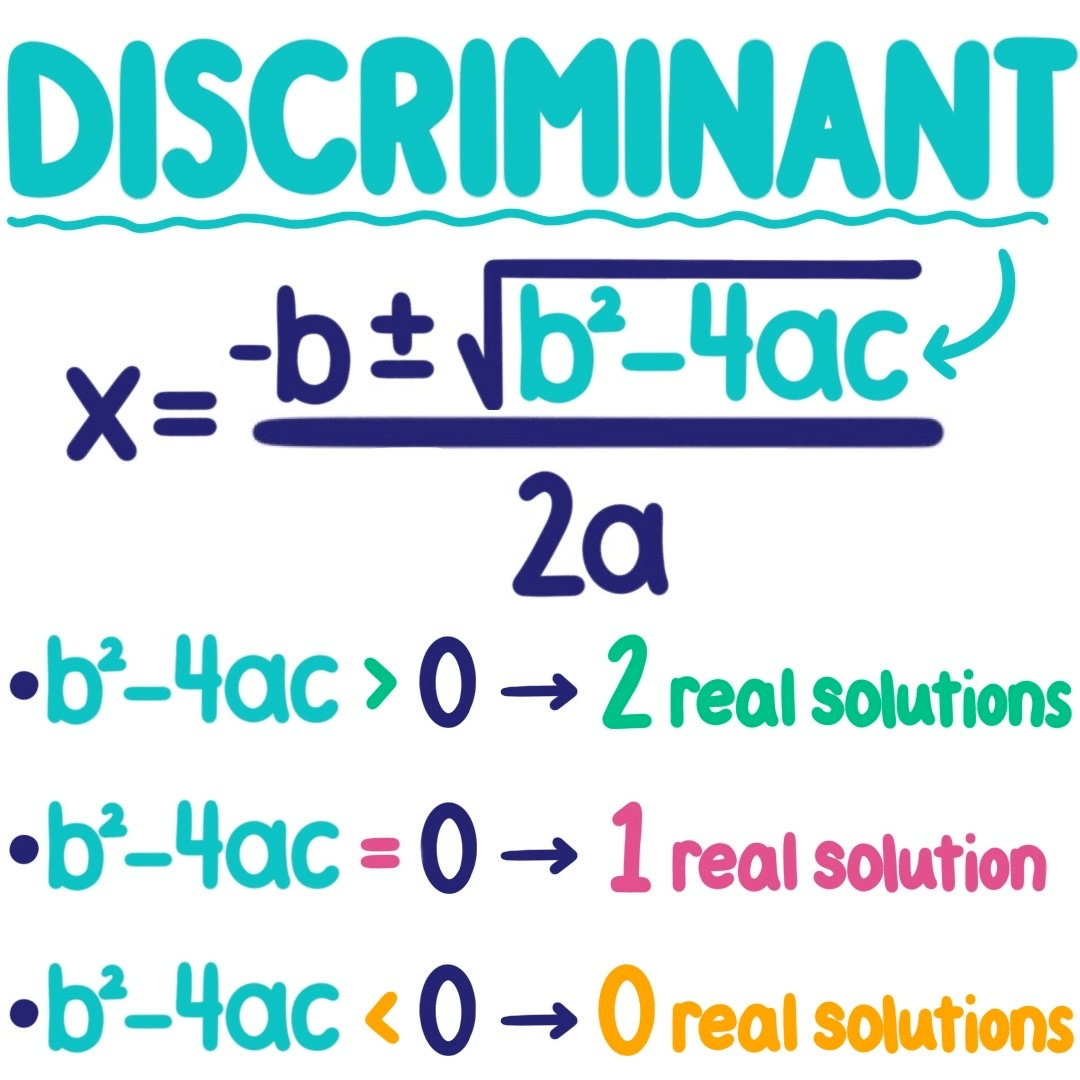
The discriminant of a quadratic equation is b2−4ac,b^2-4ac, the quantity under the square root sign in the quadratic formula. x=−b±b2−4ac2ax=\frac{-b\pm \sqrt{\boxed{b^2-4ac}}}{2a} Discriminant=b2−4ac\text{Discriminant}=\boxed{b^2-4ac}

If the discriminant is greater than 0,0, the quadratic equation has 22 real solutions.

If the discriminant is equal to 0,0, the quadratic equation has 11 real solution.

If the discriminant is less than 0,0, the quadratic equation has 00 real solutions. (Instead of real solutions, the quadratic equation has 22 imaginary solutions.)

Discriminant: The b^2-4ac in the quadratic formula x=(-b±sqrt{b^2-4ac})/2a. 
b^2-4ac > 0 --> 2 real solutions.
b^2-4ac = 0 --> 1 real solution.
b^2-4ac < 0 --> 0 real solutions.

Image source: By Expii

When the discriminant is negative, the quadratic formula produces complex roots. If this happens, you can also try factoring with complex numbers. We'll dive into these concepts later!

Video

(Video) The Discriminant

by Eddie Woo

This video by Eddie Woo explains the discriminant.

Summary\large{\text{Summary}}

The discriminant is the part of the quadratic formula under the radical. It is used to tell you how many roots you will have. x=−b±b2−4ac2aDiscriminant: b2−4acx=\frac{-b\pm\sqrt{\color{#8925AE}{b^2-4ac}}}{2a}\\ \text{Discriminant: }b^2-4ac

In general, there are three possible outcomes for the discriminant:

  1. b2−4ac<0→b^2-4ac<0\rightarrow No real roots. Roots will have imaginary numbers. This means the quadratic is either always above the axis, or always below.
  2. b2−4ac=0→b^2-4ac=0\rightarrow One real root. The graph touches the xx-axis in one place.
  3. b2−4ac>0→b^2-4ac>0\rightarrow Two real roots. The graph crosses the xx-axis twice.

Type a concept, like “slope” or “photosynthesis”.

↑ ↓ to choose · Enter to openSearch explanations and problems

