Read · 1 min
+7 contributors




The Discriminant
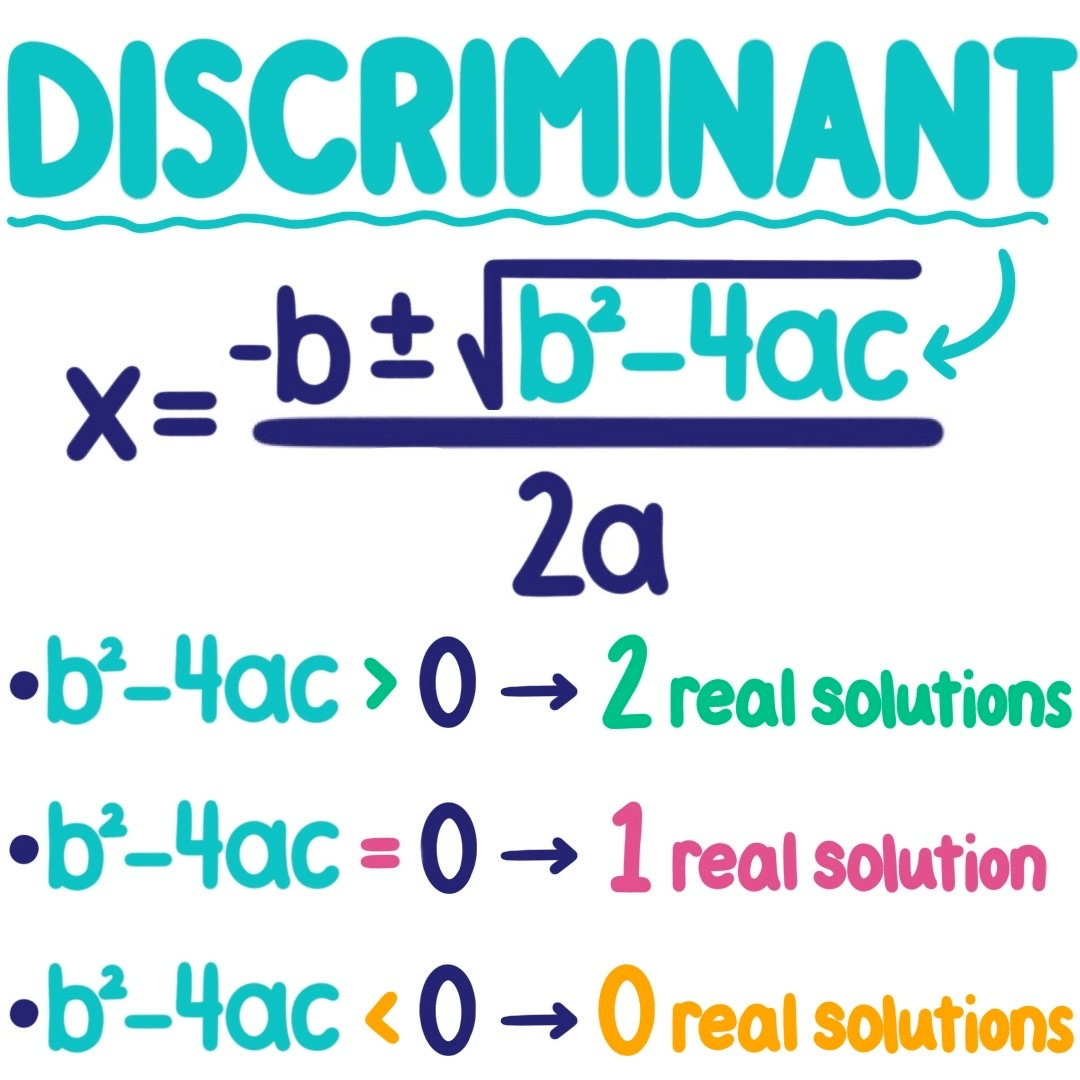
When does have a real solution? Well, we know how to find the solutions using the quadratic formula:
That makes it look like we can always find solutions. However, we can't always take a square root! Sometimes you'll get a negative number under the radical. A negative under the radical means there are no real number solutions to the radical. We can use the formula under the radical, , called the discriminant, to determine the number of roots of solutions in a quadratic equation. There are three cases:
- : The equation has real solutions. The graph does not cross the -axis.
- : The equation has real solution. The graph touches the -axis at one point.
- : The equation has real solutions. The graph crosses through the -axis at two points.
To learn more about how to determine solutions using the x-intercepts, check out this lesson. Using the discriminant will be really helpful when you're trying to quickly solve quadratic equation word problems later on!