Illustrated · 1 min

Distillation is a method to separate solvents, and to purify liquids. In distillation a mixture is boiled, and the resulting vapor is collected and condensed into a new container. A simple distillation setup is diagrammed below.
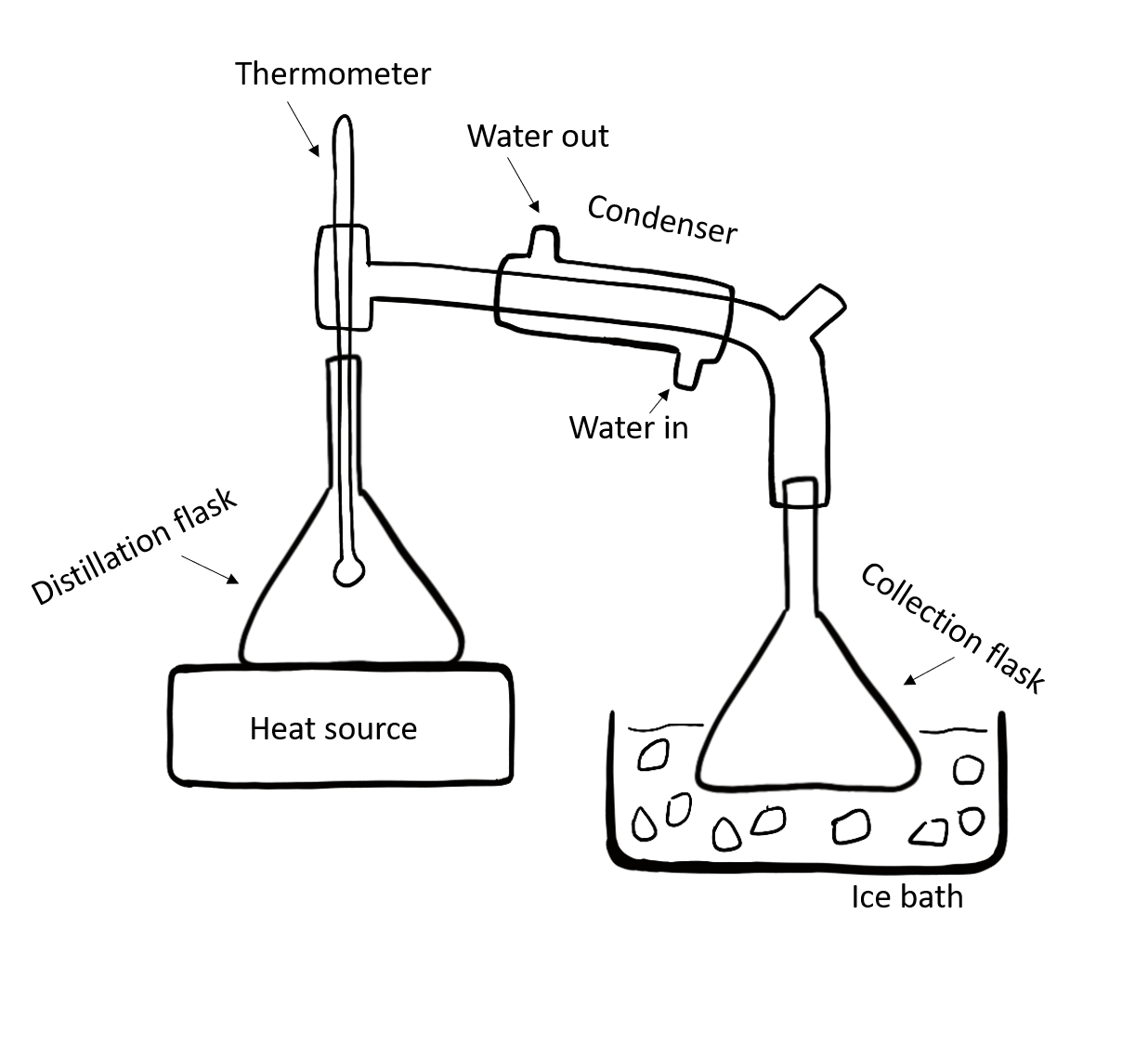
Image by Sylvia Freeman
Separation
Distillation is commonly used to separate liquids from one another. In order for this to be successful the liquids must have different boiling points. If the boiling points are too similar then both of the liquids will boil off. For example, ethanol has a boiling point of about , DMSO has a boiling point of about , and 2-propanol has a boiling point of about . DMSO is easily separated from ethanol and 2-propanol by distillation since the boiling points are so different, but ethanol and 2-propanol would be difficult to separate since the boiling points are so similar. When performing separation, we are often concerned with what remains in the distillation flask.
Purification
Distillation can also be used to purify liquids. Two common examples are ethanol and water. Ethanol can be distilled to produce strong liquors such as brandy and gin (please do not try this at home, it is illegal). Salt water can be distilled in order to give freshwater. Much like separation, purification is based on boiling away a substance. The difference between them is in purification we are often concerned with what ends up in the collection flask.