Dividing Fractions — Process & Examples

Before this, knowMultiplying Fractions — Process & Examples

Interactive · 1 question

Dividing Fractions

You can divide a fraction by another fraction in just three steps!

  1. Switch the numerator and denominator of the fraction you are dividing by.
  2. Multiply the two fractions together.
  3. Simplify your answer if needed.
Example for Dividing Fractions: 1/2 ÷ 3/4. Step One: switch the numerator and denominator of 3/4 so that it becomes 4/3. Step Two: Multiply 1/2 x 4/3 to get 4/6. Step Three: Simplify to get 2/3.

Image by Caroline Kulczycky

You can also check your work with a fraction calculator. However, nothing beats understanding how to do the process yourself.

Let's do another example!

What is 67÷314?\frac{6}{7} \div \frac{3}{14}?

Choose one answer

Interactive · 6 questions

Dividing fractions

Something to be pleased about before we start: dividing fractions is easier than adding or subtracting them!

This is because the denominators of the fractions being divided do NOT need to be the same. In fact, that doesn't make the problem any easier or harder.

There are 44 steps to follow to divide fractions:

Step One: Simplify all fractions involved (this is called reducing the fraction)

Step Two: Flip the second fraction upside down (in other words, find its reciprocal)

Step Three: Multiply the numerators

Step Four: Multiply the denominators

The last two steps are a problem in multiplying fractions together. But really, this is just multiplying two pairs of numbers.

Let's work through the problem below. The idea is that it is easier to divide fractions that are simplified. When we do this, we aren't changing the value of anything. That's because simplifying a fraction gives an equivalent fraction.

Consider the expression: 23÷67\frac{2}{3} \div \frac{6}{7} Which statement below is true?

Choose one answer

Video

(Video) Dividing Fractions

by Math Antics

Here's another mathantics video that teaches you how to divide fractions.

Summary\large{\text{Summary}}

Fractions, just like any rational numbers, can be divided by each other. To divide fractions, we need to turn them into multiplication problems. You can magically do that using the reciprocal.

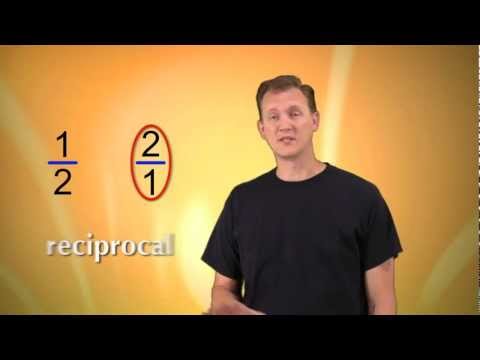
A reciprocal of a number is just the the number with its numerator and denominator flipped. If you have the number 35\frac35, its reciprocal will be 53\frac53. Integers, like 55, can be thought of as 51\frac51. Thus, their reciprocal will be 15\frac15.

So how can we turn division into multiplication? All we have to do is take the reciprocal of the second fraction. For example, suppose we have, 12÷32\frac12\div\frac32 We can turn this into a multiplication problem by replacing 32\frac32 with its reciprocal, 23\frac23. 12÷32→12×23\frac12\div\frac32\quad\rightarrow\quad\frac12\times\frac23 All you need to do now is multiply the numerators together and the denominators together. 12×23=1×22×3=26=13\frac{1}{2}\times\frac23=\frac{1\times2}{2\times3}=\frac26=\frac13 So, 12÷32=13\frac12\div\frac32=\frac13

Test Yourself: 39÷58\frac39\div\frac58

Choose one answer

Type a concept, like “slope” or “photosynthesis”.

↑ ↓ to choose · Enter to openSearch explanations and problems