Illustrated · 1 min

+2 contributors


Two or More
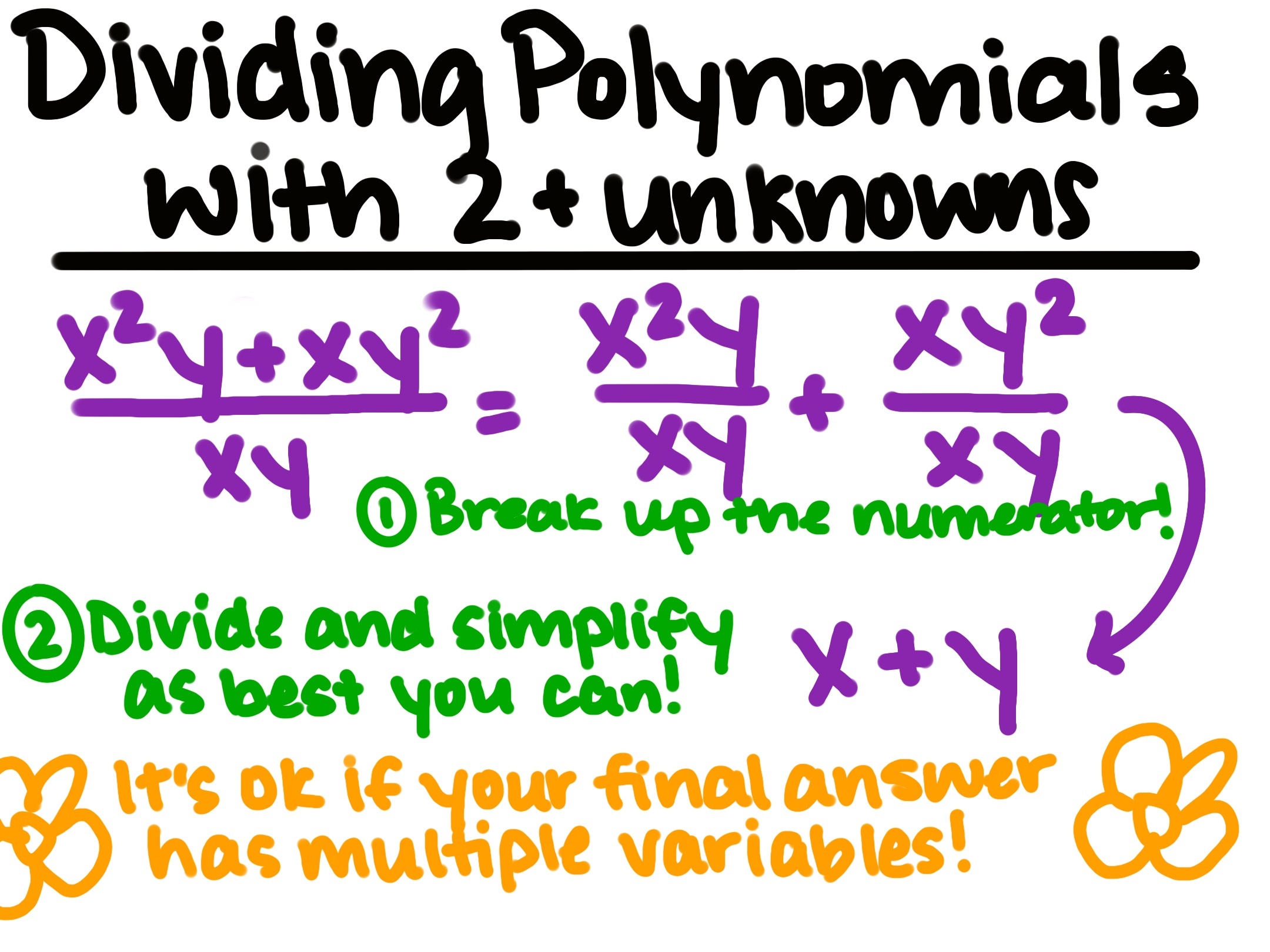
So we've learned how to use long division to divide polynomials but those were only with one variable. Now it's time for multiple variables.

Fortunately, it's not much different. But there is one thing we have to do.
Think about when we had to fill in zero coefficients for missing terms. Well, with multiple variables, we have to do the same thing but with combinations of the variables. Unfortunately, we won't really know what combinations are needed until we start the problem. So for now, just leave a blank space.
With the blank space in, our long division problem becomes: We go about solving this the same way as when there's only one variable. Starting with we ask what we need to multiply it by to get the first term in the dividend, . The answer is , since .
Then, we multiply this quotient, , with our divisor, . This gives us: .
When we come across a variable combination we don't have, we can add a zero coefficient in the dividend to make it more clear what to do. As you can see, we have an . Therefore, we can put a in our dividend to help us with the subtraction easier.