DNA Replication — Steps & Diagram

Before this, knowDNA Structure — Overview & Diagrams

Illustrated · 3 min

DNA Replication in Eukaryotes and Prokaryotes

DNA replication

Image source: By Gabi Slizewska

DNA can replicate itself because its two strands are complementary. This means that one strand can be used as a template to make the other strand. It happens right before cell division via mitosis or meiosis so that each new daughter cell can have a complete genome.

Before replication can start, the double strands of DNA need to separate from each other. An enzyme called DNA helicase breaks the hydrogen bonds that connect the two strands, allowing them to come apart.

The point where this unzipping starts is called an origin point. Eukaryotic DNA can have more than one origin point, but prokaryotes can only have one.

The points where DNA is currently unwinding are called replication forks.

A comparison of eukaryotic and prokaryotic DNA replication

Image source: By Gabi Slizewska

Directionality of DNA

To understand how the actual replication happens, let's review the structure of DNA. The two strands of DNA are antiparallel, meaning they run in opposite directions. One strand runs from 5' to 3' (read "five prime to three prime") and the other from 3' to 5'. Each strand is made up of nucleotides, and the strands are complementary to one another.

So what is this 5' and 3' nonsense?

It all has to do with the nucleotide bases that make up each DNA strand. As you hopefully remember, each nucleotide is made up of a 5-carbon sugar, a phosphate group, and a nitrogenous base. On the sugar molecule, carbon 3 is connected to a hydroxyl (−OH-OH) group, and carbon 5 is connected to the phosphate group. When nucleotides come together to form a strand, the phosphate group of one nucleotide has to connect to carbon 3 on the sugar of another nucleotide. So, the nucleotides have to be connected in a specific way, thereby giving DNA directionality as shown below.

A diagram of the nucleotides and how they make up DNA

Image source: By Gabi Slizewska

Role of DNA Polymerase

Now how does this come into play during replication?

The main enzyme involved in DNA synthesis is DNA polymerase III. An enzyme called RNA primase lays down a primer on each template strand so the polymerase knows where to begin. Then, DNA polymerase III moves down each strand and connects the complementary nucleotides, following the DNA sequences, to create the second complementary strand.

But there is one issue with DNA polymerase—it can only move along the DNA strand in one direction, from the 3' end to the 5' end.

So, when the DNA polymerase runs down a single strand of DNA, it moves from the 3' end to the 5' end, and it creates the second strand in the 5' to 3' direction. This is pretty confusing, so make sure to study some diagrams.

Leading Vs. Lagging Strands

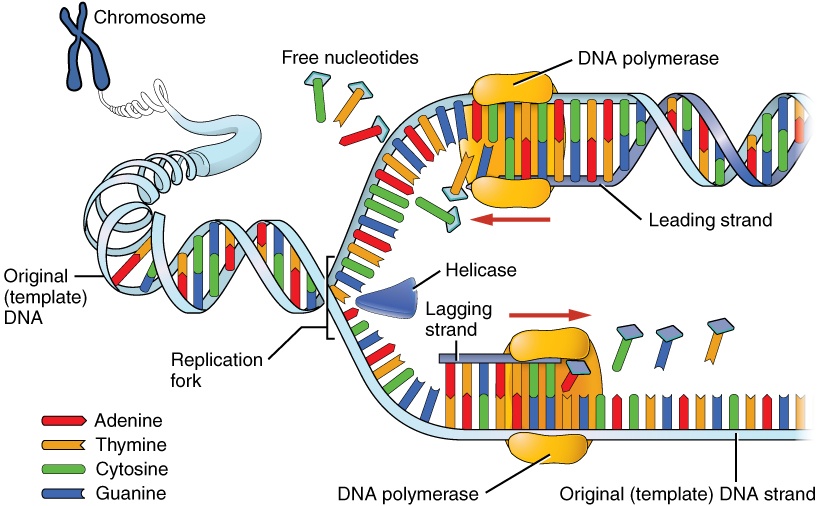
The issue with this directionality thing is that DNA polymerases on each of the DNA strands will move in opposite directions. When it moves towards the replication fork, the strand it's on is called the leading strand. When it moves away from the replication fork (towards the origin), it's on the lagging strand.

A diagram of DNA replication showing the leading strand and the lagging strand.

Image source: By Gabi Slizewska

Replication along the leading strand is continuous, but on the lagging strand, DNA polymerase has to make the new strand in segments called Okazaki fragments. Then, DNA polymerase I replaces the RNA primers with DNA nucleotides, and an enzyme called DNA ligase has to connect all the fragments to create a continuous strand.

At the ends of a eukaryotic DNA molecule are segments called telomeres. These segments don't code for genes because parts of them are removed at the end of replication. They are there to protect the genes from being removed. An enzyme then checks the new strands for errors. In the end, we should have two complete DNA molecules which are identical to each other and the original DNA molecule.


Illustrated · 2 min

How Is DNA Replicated?

DNA replication is exactly what it sounds like—it's how organisms replicate their DNA. This process occurs during interphase of the cell cycle and ensures that each of the daughter cells has the same set of DNA (one of the nucleic acids critical for life). This prepares the cells for division by mitosis or meiosis.

For replication to begin, the double-stranded DNA must be pulled apart, or "unzipped". Once they are separated, two new strands are formed by matching the base pairs.

Remember how DNA has four bases that like to pair together? Well, if the separated strand of DNA has an available adenine, thymine is added to it. If a cytosine is free, then guanine is added. By matching these pairs up for the entire strand, a new double helix of DNA will form.

This process is known as semi-conservative replication, where half of the double helix is from the original DNA and the other strand is newly made.

DNA replication is a semi-conservative process. It can be thought of as unzipping a zipper: you have one thing that is divided into two.

Image source: By OpenStax CC BY 4.0, via Wikimedia Commons

Role of DNA Polymerase

Replication of DNA is made possible by a nifty little enzyme called DNA polymerase. This enzyme joins the nucleotides mentioned above together to create the new DNA, and then "proofreads" the newly-made strand to check for any errors. Basically, this enzyme is responsible for making the replicated DNA exactly the same as the original.

DNA Replication in Prokaryotes

The process of replication in prokaryotes is pretty different from replication in eukaryotes. In prokaryotic cells, the DNA is in a large, circular ring. The process of replication starts at one point and works its way around the DNA in both directions until there are two copies.

Prokaryotes have circular DNA instead of the double helix shape of eukaryotes. DNA replication in prokaryotes is easier than that of eukaryotes for this reason.

Image source: By David Tribe, Rehua CC BY-SA 3.0, via Wikimedia Commons

DNA Replication in Eukaryotes

In eukaryotes, the process of replication is quite a bit more sophisticated. The DNA in these cells are not in nice little rings; rather, they are jumbled up, long strands. Because of this, replication can begin at basically any part of the strand and can proceed in both directions.

Vocabulary Review:\color{#8925AE}{\text{Vocabulary Review:}}

DNA\color{#8925AE}{\text{DNA}} : The macromolecule that stores all of an organism's genetic information

Semiconservative Replication\color{#8925AE}{\text{Semiconservative Replication}} : During DNA replication, one strand is newly made and the other strand is from the original molecule

Transmission\color{#8925AE}{\text{Transmission}} : How genetic information is passed down through generations

Illustrated · 2 min

Steps of Replication

When a cell divides during mitosis, the first thing it has to do is ensure that the new cells will have identical DNA to itself. The replication of DNA occurs during the S phase of interphase.

Simply put, DNA replication is the process by which an organism's DNA makes a copy of itself. This process of replication was confirmed to be a "semi-conservative" process by scientists Matthew Meselson and Franklin Stahl, meaning that the strands of the parent molecule are separated and each strand is used as a template for a newly synthesized complementary strand of DNA. The process by which replication occurs can seem fairly complicated, but thinking about it as three separate steps can help.

DNA replication is a semi-conservative process.

Image source: By Adenosine at English Wikipedia CC BY-SA 2.5, via Wikimedia Commons

Initiation:

DNA replication begins at a site on the chromosome called the origin of replication. This site is recognized by an enzyme that opens up the two strands and allows helicase to further unwind the double helix, a process that is necessary for replication to continue.

As the helicase enzyme continues to open up the helix, it separates DNA into two strands. The place where the two strands begin unwinding is called the replication fork. These strands can be used to make new complementary strands called the leading strand and lagging strand. The leading strand is synthesized moving towards the fork whereas the lagging strand is synthesized moving away from the fork.

Before DNA polymerase III can lay down complementary DNA bases, an enzyme called RNA primase comes and lays down short RNA primers. Since DNA polymerase III synthesizes both new strands at the same time and moves in the 5' to 3' direction, a lot more primers are required when synthesizing the lagging strand. This results in short fragments of complementary DNA following the primers. These segments are called Okazaki fragments.

DNA replication is a semi-conservative process. It can be thought of as unzipping a zipper: you have one thing that is divided into two.

Image source: By LadyofHats [Public domain], via Wikimedia Commons

Diagram showing DNA unzipping in two places

Image source: By Boumphreyfr CC BY-SA 3.0, via Wikimedia Commons

Elongation:

The next step in replication is the elongation phase. In this phase of replication, a new type of DNA polymerase is involved called DNA polymerase I. DNA polymerase works to remove the previously mentioned RNA primers and replace them with complementary DNA nucleotides. This step works to fix the previous issues mentioned with the lagging strand and create a continuous strand of newly synthesized DNA.

Once DNA polymerase has added the DNA segments, DNA ligase joins the two Okazaki fragments, resulting in a continuous strand of DNA.

Termination:

Once all of the DNA has been replicated through the previously mentioned processes, the replication enzymes will leave the DNA and a new copy of the DNA remains.

Video

(Video) DNA Replication: The Cell's Extreme Team Sport

by Amoeba Sisters

When a cell divides during meiosis or mitosis the first thing it has to do is ensure that the new cell will have identical DNA to itself. During interphase, a cell replicates its DNA (makes a new copy of it). In this video, the Amoeba Sisters explain how this process works.

Type a concept, like “slope” or “photosynthesis”.

↑ ↓ to choose · Enter to openSearch explanations and problems